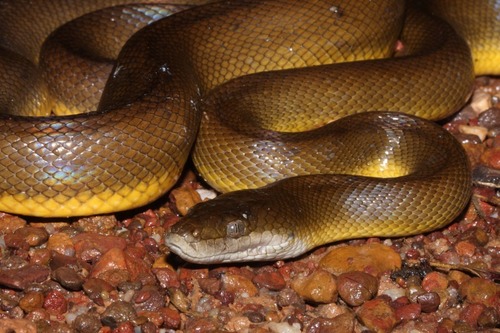
Arafura File Snake

Arafura File Snake

Acrochordus arafurae

Silhouette: Christina Zdenek · PhyloPic

LCLeast ConcernNTVUENCR
Daily sighting probability ~10% · With luck
at Kakadu National Park

In 3 days ~30% in a week ~60%

6 Verified sightings at Kakadu National Park From 2019 to 2026
6 In 1 park
October Best month
☀️🌙 Day & Night When it's spotted

About the Arafura File Snake

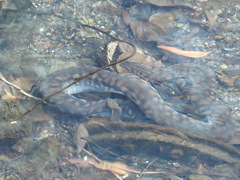
Acrochordus arafurae, known by the common names Arafura file snake, elephant trunk snake, and wrinkle file snake, is an aquatic snake species found in northern Australia and New Guinea. No subspecies are currently recognized.

This snake was first described by Samuel Booker McDowell in 1979 Adults grow to 8.25 ft (2.5 m) in length. They have very loose skin and are known to prey on large fish, such as eel-tailed catfish. Females are usually larger than males and they have been known to give birth to up to 17 young. The skin is used to make drums in New Guinea.

Arafura file snakes are often hunted by indigenous peoples of Northern Australia. In the Kunwinjku language of West Arnhem Land, the snakes are known as kedjebe (or bekka in Eastern dialects), while in the Yolŋu language of East Arnhem Land they are called djaykuŋ, among other names.

Acrochordus.com Species Acrochordus arafurae at The Reptile Database. Accessed 16 August 2007. Arafura Filesnakes at Life is Short but Snakes are Long Wikipedia →

Global Distribution

Parks Where Found

# Park Country Daily sighting probability
1 Kakadu National Park 🇦🇺 Australia
~10%

More parks will be added in future updates.

Zoos & Centres Where Found

# Zoo / Centre Country
1 Territory Wildlife Park 🇦🇺 Australia In captivity
2 Melbourne Zoo 🇦🇺 Australia In captivity
3 Sea Life Sydney Aquarium 🇦🇺 Australia In captivity
4 Wild Life Sydney 🇦🇺 Australia In captivity

Closest Relatives at Kakadu National Park

No species of the same family or order lives in Kakadu National Park, so these are its closest relatives here: other reptiles.

Before you go

What are the chances of seeing an Arafura File Snake in Kakadu National Park?

With luck

About 10% of wildlife watchers report an Arafura File Snake sighting in Kakadu National Park on a given day, based on 6 verified sightings from GBIF citizen-science data from 2019 to 2026. It is the 43rd most-seen of the 54 reptiles we can rate there. Over three days the chance rises to about 30%, and over a week to about 60%, if each day is a fresh chance.

When is the best time to see an Arafura File Snake in Kakadu National Park?

June–July and October

In those months about 20% of wildlife watchers report an Arafura File Snake in Kakadu National Park on a given day, against under 5% in September and November–May, the lowest months. Those are among Kakadu National Park's driest months, with about 10 mm of rain a month against 350 mm in January.

What time of day is best to see an Arafura File Snake?

Between 8 and 11 pm

Across all the parks we cover, that three-hour window holds the most Arafura File Snake sightings with a recorded time, and about 6 in 10 of them come between 6 pm and 6 am: it is seen both by day and at night.

Where else can you see an Arafura File Snake?

Only Kakadu National Park, in our data

Kakadu National Park is the only park on Wallace's Line with enough records to rate Arafura File Snake sightings: about 10% of wildlife watchers there report one on a given day.

Where does the Arafura File Snake sighting chance come from?

GBIF citizen-science records

It is estimated from how often the Arafura File Snake is recorded against all the reptiles logged in Kakadu National Park (6 verified sightings from 2019 to 2026), calibrated against known sighting rates. Figures are rounded to the nearest 10% because citizen-science data supports honest approximations, not decimals, and months with records from fewer than five people show "—". How it works.

← Back to Kakadu National Park