
Olive Python

Olive Python

Liasis olivaceus

Silhouette: SeismicShrimp · PhyloPic

LCLeast ConcernNTVUENCR Endemic
Daily sighting probability ~30% · Possible
at Kakadu National Park

In 3 days ~60% in a week ~90%

22 Verified sightings at Kakadu National Park From 2019 to 2026
41 In all 2 parks
March Best month
🌙 Nocturnal When it's spotted

About the Olive Python

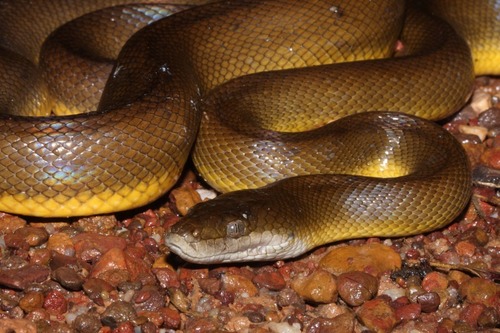
The olive python (Liasis olivaceus) is a species of snake in the family Pythonidae. The species is endemic to Australia. Two subspecies are recognized, including the nominate subspecies described here. With adults reaching over 4 m (13 ft) in total length (including the tail), L. olivaceus is Australia's third-largest snake species (surpassed only by the amethystine python and Oenpelli python). Its high number of dorsal scale rows (61–72 at midbody), makes the skin look smoother than that of other pythons. The number of ventral scales is 355–377. The colour pattern is a uniform chocolate brown to olive green, while the belly is usually cream-coloured. The adult weight is typically 10–20 kilograms (22–44 lb), and a large female can exceed 20 kilograms (44 lb) in captivity.

Unfortunately, this species is occasionally confused with the venomous king brown snake, Pseudechis australis, and may be mistakenly killed based on the misidentification. L. olivaceus is found in Western Australia, the Northern Territory, and Queensland. The type locality given is "North Australia; Port Essington" (Northern Territory, Australia). The olive python... Wikipedia →

Global Distribution

Parks Where Found

# Park Country Daily sighting probability
1 Litchfield National Park 🇦🇺 Australia
~40%
2 Kakadu National Park 🇦🇺 Australia
~30%

Zoos & Centres Where Found

# Zoo / Centre Country
1 Living Desert Zoo and Gardens 🇺🇸 United States In captivity
2 Berlin Zoological Garden 🇩🇪 Germany In captivity
3 Parc de l'Auxois 🇫🇷 France In captivity
4 Taronga Zoo 🇦🇺 Australia In captivity
5 Lone Pine Koala Sanctuary 🇦🇺 Australia In captivity
6 Perth Zoo 🇦🇺 Australia In captivity
7 Espace zoologique de Saint-Martin-la-Plaine 🇫🇷 France In captivity
8 Tbilisi Zoo 🇬🇪 Georgia In captivity
9 Adelaide Zoo 🇦🇺 Australia In captivity
10 Rainforestation Nature Park 🇦🇺 Australia In captivity
11 Featherdale Sydney Wildlife Park 🇦🇺 Australia In captivity
12 Rockhampton Zoo 🇦🇺 Australia In captivity
13 Wagga Zoo 🇦🇺 Australia In captivity
14 Siam Serpentarium 🇹🇭 Thailand In captivity
15 Aquarium Berlin 🇩🇪 Germany In captivity
16 National Aquarium 🇺🇸 United States In captivity
17 Port Moresby Nature Park 🇵🇬 Papua New Guinea In captivity
18 Wildlife HQ Zoo 🇦🇺 Australia In captivity

Before you go

What are the chances of seeing an Olive Python in Kakadu National Park?

Possible

About 30% of wildlife watchers report an Olive Python sighting in Kakadu National Park on a given day, based on 22 verified sightings from GBIF citizen-science data from 2019 to 2026. It is the 13th most-seen of the 54 reptiles we can rate there. Over three days the chance rises to about 60%, and over a week to about 90%, if each day is a fresh chance.

When is the best time to see an Olive Python in Kakadu National Park?

March

In that month about 50% of wildlife watchers report an Olive Python in Kakadu National Park on a given day, against under 5% in November and December, the lowest months. That is one of Kakadu National Park's wettest months, with about 170 mm of rain against almost none in August.

What time of day is best to see an Olive Python?

Between 8 and 11 pm

Across all the parks we cover, that three-hour window holds the most Olive Python sightings with a recorded time, and about 7 in 10 of them come between 6 pm and 6 am: it is mostly seen at night.

Is Kakadu National Park the best place to see an Olive Python?

2nd of 2

Of the 2 parks where we can rate Olive Python sightings, Kakadu National Park ranks 2nd at about 30%. The best odds are in Litchfield National Park (Australia, about 40%).

Where does the Olive Python sighting chance come from?

GBIF citizen-science records

It is estimated from how often the Olive Python is recorded against all the reptiles logged in Kakadu National Park (22 verified sightings from 2019 to 2026), calibrated against known sighting rates. Figures are rounded to the nearest 10% because citizen-science data supports honest approximations, not decimals, and months with records from fewer than five people show "—". How it works.

← Back to Kakadu National Park