Brown-cheeked Fulvetta

Brown-cheeked Fulvetta

Alcippe poioicephala

Silhouette: Sheatherius · PhyloPic

LCLeast ConcernNTVUENCR
Daily sighting probability ~40% · Likely
at Kanha National Park

In 3 days ~80% in a week >90%

6,338 Verified sightings at Kanha National Park From 2019 to 2026
9,447 In all 11 parks
February Best month
🌅 Crepuscular When it's spotted

About the Brown-cheeked Fulvetta

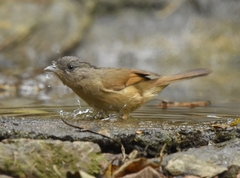
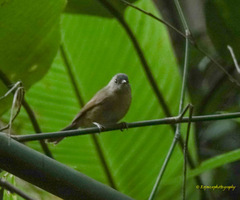
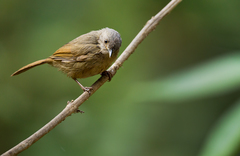
The brown-cheeked fulvetta (Alcippe poioicephala) is a babbler-like bird belonging to the family Leiothrichidae found in the forests of South and Southeast Asia. It was formerly called the quaker babbler in India and common nun babbler in Malaya. They forage on trees for insects, sometimes hanging from the branches in a tit-like manner, and visiting flowers for nectar. They are often hard to see in vegetation but they have loud multi-note whistling calls in the morning and afternoon.

The brown-cheeked fulvetta is a small dull coloured bird measuring 15 cm from beak to tail tip. The grey bill is short and weak and the upper mandible is curved. The genus Alcippe has the bill widest at the nostrils which are long and has a membrane overhanging it. The tail feathers are all nearly of the same length. The wings are brownish, the underside is buff and the crown is grey. The crown is not demarcated from the rest of the head in the nominate subspecies but in some, there is a dark stripe that begins behind the eyes and meets at the nape. The sexes are indistinguishable and several birds may forage in a loose flock, sometimes joining mixed-species foraging flocks. While foraging... Wikipedia →

Sounds

Song0:33

Thailand · 2024

© Peter Ericsson · XC948601 · CC BY-NC-SA 4.0

Call0:37

Laos · 2022

© Bram Piot · XC747112 · CC BY-NC-SA 4.0

Song0:27

Thailand · 2023

© FREDERIC Lionel · XC938734 · CC BY-NC-SA 4.0

Global Distribution

Parks Where Found

# Park Country Daily sighting probability
1 Kanha National Park 🇮🇳 India
~40%
2 Kaeng Krachan National Park 🇹🇭 Thailand
~30%
3 Periyar National Park 🇮🇳 India
~20%
4 Doi Inthanon National Park 🇹🇭 Thailand
~10%
5 Mudumalai National Park 🇮🇳 India
~10%
6 Bandhavgarh National Park 🇮🇳 India
~10%
7 Satpura National Park 🇮🇳 India
~10%
8 Khao Sok National Park 🇹🇭 Thailand
<5%
9 Nagarhole National Park 🇮🇳 India
<5%
10 Eravikulam National Park 🇮🇳 India
<5%
11 Bandipur National Park 🇮🇳 India
<5%

Cities Where Found

# City Country Daily sighting probability
1 Mumbai 🇮🇳 India
<5%

Before you go

What are the chances of seeing a Brown-cheeked Fulvetta in Kanha National Park?

Likely

About 40% of wildlife watchers report a Brown-cheeked Fulvetta sighting in Kanha National Park on a given day, based on 6,338 verified sightings from GBIF citizen-science data from 2019 to 2026. It is the 33rd most-seen of the 286 birds we can rate there. Over three days the chance rises to about 80%, and over a week to over 90%, if each day is a fresh chance.

When is the best time to see a Brown-cheeked Fulvetta in Kanha National Park?

January to April

In those months about 50% of wildlife watchers report a Brown-cheeked Fulvetta in Kanha National Park on a given day, against about 10% in July and September, the lowest months. Those are among Kanha National Park's driest months, with about 20 mm of rain a month against 430 mm in July.

What time of day is best to see a Brown-cheeked Fulvetta?

Between 9 am and noon

Across all the parks we cover, that three-hour window holds the most Brown-cheeked Fulvetta sightings with a recorded time, and about 7 in 10 of them come between 6 am and 6 pm: it is most active around dawn and dusk.

Is Kanha National Park the best place to see a Brown-cheeked Fulvetta?

Yes

Of the 11 parks where we can rate Brown-cheeked Fulvetta sightings, Kanha National Park has the highest daily chance: about 40%. Next come Kaeng Krachan National Park (Thailand, about 30%) and Periyar National Park (India, about 20%).

Where does the Brown-cheeked Fulvetta sighting chance come from?

GBIF citizen-science records

It is estimated from how often the Brown-cheeked Fulvetta is recorded against all the birds logged in Kanha National Park (6,338 verified sightings from 2019 to 2026), calibrated against known sighting rates. Figures are rounded to the nearest 10% because citizen-science data supports honest approximations, not decimals, and months with records from fewer than five people show "—". How it works.

← Back to Kanha National Park