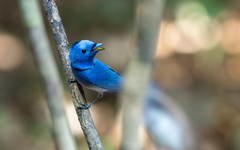
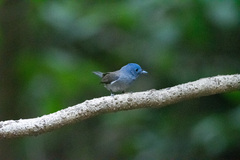
Black-naped Monarch

Black-naped Monarch

Hypothymis azurea

Silhouette: Sheatherius · PhyloPic

LCLeast ConcernNTVUENCR
Daily sighting probability ~40% · Likely
at Kanha National Park

In 3 days ~80% in a week >90%

6,314 Verified sightings at Kanha National Park From 2019 to 2026
17,268 In all 41 parks
April Best month
🌅 Crepuscular When it's spotted

About the Black-naped Monarch

The black-naped monarch (Hypothymis azurea) is a passerine bird belonging to the family of monarch flycatchers found in southern and south-eastern Asia. They are sexually dimorphic, with the male having a distinctive black patch on the back of the head and a narrow black half collar ("necklace"), while the female is duller with olive brown wings and lacking the black markings on the head. They have a call that is similar to that of the Asian paradise flycatcher, and in tropical forest habitats, pairs may join mixed-species foraging flocks. Populations differ slightly in plumage colour and sizes.

The black-naped monarch was described by the French polymath Georges-Louis Leclerc, Comte de Buffon in 1779 in his Histoire Naturelle des Oiseaux. The bird was also illustrated in a hand-coloured plate engraved by François-Nicolas Martinet in the Planches Enluminées D'Histoire Naturelle which was produced under the supervision of Edme-Louis Daubenton to accompany Buffon's text. Neither the plate caption nor Buffon's description included a scientific name but in 1783 the Dutch naturalist Pieter Boddaert coined the binomial name Muscicapa azurea in his catalogue of the Planches... Wikipedia →

Sounds

Call0:42

Vietnam · 2026

© Ding Li Yong · XC1142762 · CC BY-NC-ND 4.0

Song0:18

Myanmar · 2026

© Thet Zaw Naing · XC1078433 · CC BY-NC-SA 4.0

Call0:40

China · 2023

© JJSUN · XC1070129 · CC BY-NC-SA 4.0

Global Distribution

Parks Where Found

# Park Country Daily sighting probability
1 Kaeng Krachan National Park 🇹🇭 Thailand
~60%
2 Khao Luang National Park 🇹🇭 Thailand
~50%
3 Kanha National Park 🇮🇳 India
~40%
4 Tangkoko Nature Reserve 🇮🇩 Indonesia
~40%
5 Komodo National Park 🇮🇩 Indonesia
~40%
6 Bandhavgarh National Park 🇮🇳 India
~40%
7 Cat Tien National Park 🇻🇳 Vietnam
~40%
8 Way Kambas National Park 🇮🇩 Indonesia
~40%
9 Sinharaja Forest Reserve 🇱🇰 Sri Lanka
~40%
10 Taman Negara National Park 🇲🇾 Malaysia
~30%
11 Wilpattu National Park 🇱🇰 Sri Lanka
~30%
12 Danum Valley Conservation Area 🇲🇾 Malaysia
~30%
13 Khao Sok National Park 🇹🇭 Thailand
~20%
14 Manas National Park 🇮🇳 India
~20%
15 Khao Yai National Park 🇹🇭 Thailand
~20%
16 Satpura National Park 🇮🇳 India
~20%
17 Taroko National Park 🇹🇼 Taiwan
~20%
18 Bali Barat National Park 🇮🇩 Indonesia
~20%
19 Royal Manas National Park 🇧🇹 Bhutan
~20%
20 Tanjung Puting National Park 🇮🇩 Indonesia
~20%
21 Sepilok 🇲🇾 Malaysia
~10%
22 Periyar National Park 🇮🇳 India
~10%
23 Doi Inthanon National Park 🇹🇭 Thailand
~10%
24 Kinabatangan Wildlife Sanctuary 🇲🇾 Malaysia
~10%
25 Cuc Phuong National Park 🇻🇳 Vietnam
~10%
26 Minneriya National Park 🇱🇰 Sri Lanka
~10%
27 Royal Bardia National Park 🇳🇵 Nepal
~10%
28 Mudumalai National Park 🇮🇳 India
~10%
29 Jim Corbett National Park 🇮🇳 India
~10%
30 Nagarhole National Park 🇮🇳 India
~10%
31 Kaziranga National Park 🇮🇳 India
<5%
32 Gir National Park 🇮🇳 India
<5%
33 Chitwan National Park 🇳🇵 Nepal
<5%
34 Kinabalu Park 🇲🇾 Malaysia
<5%
35 Gunung Leuser National Park 🇮🇩 Indonesia
<5%
36 Horton Plains National Park 🇱🇰 Sri Lanka
<5%
37 Sundarbans National Park 🇮🇳 India
<5%
38 Bandipur National Park 🇮🇳 India
<5%
39 Yala National Park 🇱🇰 Sri Lanka
<5%
40 Kerinci Seblat National Park 🇮🇩 Indonesia
<5%
41 Namdapha National Park 🇮🇳 India
<5%

Cities Where Found

# City Country Daily sighting probability
1 Kaohsiung 🇹🇼 Taiwan
~40%
2 Taichung 🇹🇼 Taiwan
~20%
3 Ho Chi Minh City 🇻🇳 Vietnam
~20%
4 Taipei 🇹🇼 Taiwan
~10%
5 Thrissur 🇮🇳 India
~10%
6 Tainan 🇹🇼 Taiwan
~10%
7 Tamluk 🇮🇳 India
~10%
8 Bangkok 🇹🇭 Thailand
~10%
9 Phnom Penh 🇰🇭 Cambodia
~10%
10 Mumbai 🇮🇳 India
~10%

Before you go

What are the chances of seeing a Black-naped Monarch in Kanha National Park?

Likely

About 40% of wildlife watchers report a Black-naped Monarch sighting in Kanha National Park on a given day, based on 6,314 verified sightings from GBIF citizen-science data from 2019 to 2026. It is the 29th most-seen of the 286 birds we can rate there. Over three days the chance rises to about 80%, and over a week to over 90%, if each day is a fresh chance.

When is the best time to see a Black-naped Monarch in Kanha National Park?

February to June

In those months about 50% of wildlife watchers report a Black-naped Monarch in Kanha National Park on a given day, against about 20% in July and September, the lowest months. Those are among Kanha National Park's driest months, with about 60 mm of rain a month against 430 mm in July.

What time of day is best to see a Black-naped Monarch?

Between 4 and 7 am

Across all the parks we cover, that three-hour window holds the most Black-naped Monarch sightings with a recorded time, and about 6 in 10 of them come between 6 am and 6 pm: it is most active around dawn and dusk.

Where does the Black-naped Monarch sighting chance come from?

GBIF citizen-science records

It is estimated from how often the Black-naped Monarch is recorded against all the birds logged in Kanha National Park (6,314 verified sightings from 2019 to 2026), calibrated against known sighting rates. Figures are rounded to the nearest 10% because citizen-science data supports honest approximations, not decimals, and months with records from fewer than five people show "—". How it works.

← Back to Kanha National Park