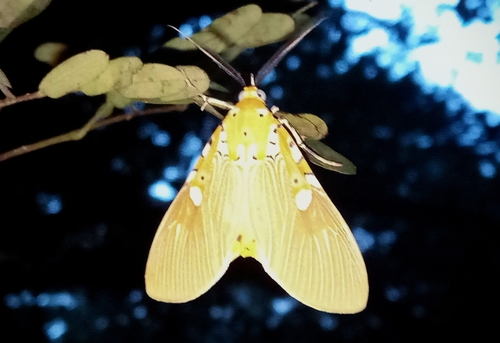
Tasar Silk Moth

Tasar Silk Moth

Antheraea paphia

Daily sighting probability ~10% · With luck
at Kanha National Park

In 3 days ~40% in a week ~70%

6 Verified sightings at Kanha National Park From 2019 to 2026
6 In 1 park
June Best month
☀️🌙 Day & Night When it's spotted

About the Tasar Silk Moth

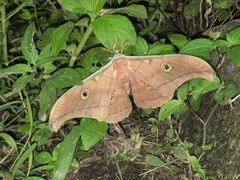
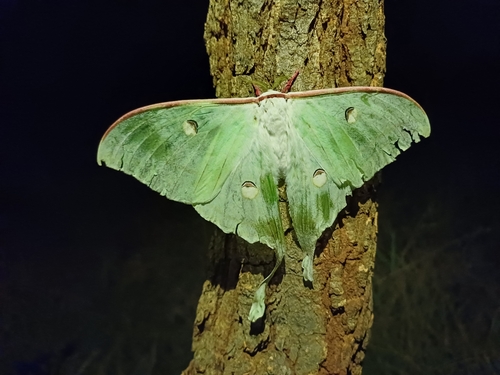
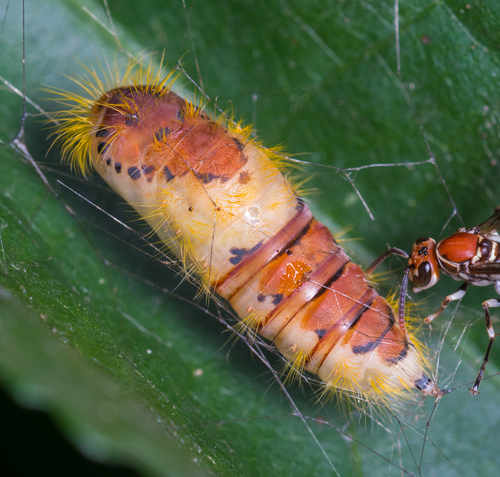
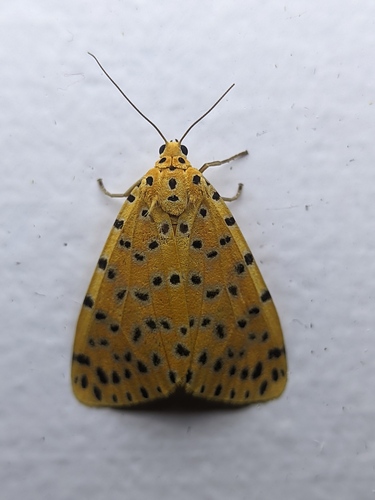
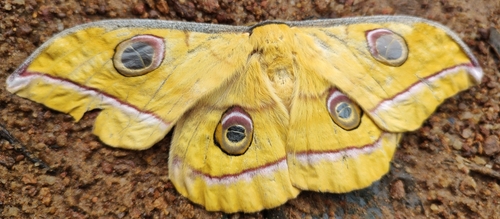
Antheraea paphia, known as the South India small tussore, the tasar silkworm and vanya silkworm is a species of moth of the family Saturniidae found in India and Sri Lanka. There are also populations in Pakistan, Myanmar, Bangladesh, Bhutan and Nepal. The bulk of the literature on this species uses a junior synonym, Antheraea mylitta, rather than the correct name, A. paphia. It is one of a number of tasar silkworms, species that produce Tussar silk, a kind of wild silk that is made from the products of saturniid silkworms instead of the domesticated silkworm (Bombyx mori).

This species is variable, with at least 44 identified ecoraces, populations adapted to varied ecological conditions and food plants. Ten ecoraces are used for silk production and have been studied to obtain data about their life cycles and silk characteristics. Some ecoraces are so well differentiated that they do not interbreed in nature, though they are not genetically distinct and can be bred in captivity.

The male is reddish or yellowish. Costal brown and grey fascia of forewings reaching the apex. Hyaline and ocellated spots (eyespots) are much larger than those of A. roylei. The submarginal... Wikipedia →
Global Distribution

Parks Where Found

# Park Country Daily sighting probability
1 Kanha National Park 🇮🇳 India
~10%

More parks will be added in future updates.

Cities Where Found

# City Country Daily sighting probability
1 Hyderabad 🇮🇳 India
~10%
2 Chennai 🇮🇳 India
~10%
3 Mumbai 🇮🇳 India
~10%
4 Pune 🇮🇳 India
~10%
5 Bengaluru 🇮🇳 India
~10%

Before you go

What are the chances of seeing a Tasar Silk Moth in Kanha National Park?

With luck

About 10% of wildlife watchers report a Tasar Silk Moth sighting in Kanha National Park on a given day, based on 6 verified sightings from GBIF citizen-science data from 2019 to 2026. It is the 81st most-seen of the 106 insects we can rate there. Over three days the chance rises to about 40%, and over a week to about 70%, if each day is a fresh chance.

When is the best time to see a Tasar Silk Moth in Kanha National Park?

June and August–September

In those months about 30% of wildlife watchers report a Tasar Silk Moth in Kanha National Park on a given day, against under 5% in January–May, July and October–November, the lowest months. Those are among Kanha National Park's wettest months, with about 300 mm of rain a month against 10 mm in November.

What time of day is best to see a Tasar Silk Moth?

Between midnight and 3 am

Across all the parks we cover, that three-hour window holds the most Tasar Silk Moth sightings with a recorded time, and about 7 in 10 of them come between 6 pm and 6 am: it is seen both by day and at night.

Where else can you see a Tasar Silk Moth?

Only Kanha National Park, in our data

Kanha National Park is the only park on Wallace's Line with enough records to rate Tasar Silk Moth sightings: about 10% of wildlife watchers there report one on a given day.

Where does the Tasar Silk Moth sighting chance come from?

GBIF citizen-science records

It is estimated from how often the Tasar Silk Moth is recorded against all the insects logged in Kanha National Park (6 verified sightings from 2019 to 2026), calibrated against known sighting rates. Figures are rounded to the nearest 10% because citizen-science data supports honest approximations, not decimals, and months with records from fewer than five people show "—". How it works.

← Back to Kanha National Park