Indian Grassbird

Indian Grassbird

Graminicola bengalensis

Silhouette: Sheatherius · PhyloPic

LCNTNear ThreatenedVUENCR
Daily sighting probability <5% · Rare
at Kaziranga National Park

In 3 days ~10%

30 Verified sightings at Kaziranga National Park From 2019 to 2026
297 In all 3 parks
May Best month
☀️ Diurnal When it's spotted

About the Indian Grassbird

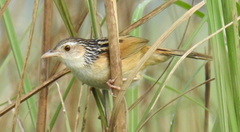
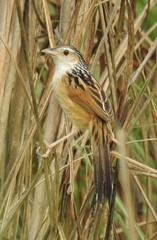
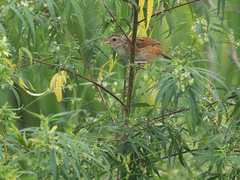
The Indian grassbird (Graminicola bengalensis) is a passerine bird in the family Pellorneidae. It was formerly placed in the Old World warbler family, Sylviidae, and the Old World babbler family, Timaliidae. The species is also known as the rufous-rumped grassbird.

It occurs in tall emergent vegetation in or bordering freshwater swamps or along banks of rivers in the lowlands of Bangladesh, northern India, Bhutan and the Chitwan National Park of Nepal. It is threatened by habitat loss.

The Sukla Phanta Wildlife Reserve in Nepal represents the western limit of its distribution. Collar, N. J., Robson, C. (2007) Family Timaliidae (Babblers) pp. 70 – 291 In: del Hoyo, J., Elliott, A., Christie, D.A. (eds.) Handbook of the Birds of the World, Vol. 12: Picathartes to Tits and Chickadees. Lynx Edicions, Barcelona.

BirdLife International: Rufous-rumped Grassbird Wikipedia →

Sounds

Call0:13

India · 2020

© Dibyendu Ash · XC549723 · CC BY-NC-SA 4.0

Alarm call0:08

India · 2017

© Paul J Willoughby · XC362906 · CC BY-NC-SA 4.0

Call0:27

India · 2018

© Peter Boesman · XC426596 · CC BY-NC-ND 4.0

Global Distribution

Parks Where Found

# Park Country Daily sighting probability
1 Manas National Park 🇮🇳 India
~20%
2 Kaziranga National Park 🇮🇳 India
<5%
3 Chitwan National Park 🇳🇵 Nepal
<5%

Before you go

What are the chances of seeing an Indian Grassbird in Kaziranga National Park?

Rare

Under 5% of wildlife watchers report an Indian Grassbird sighting in Kaziranga National Park on a given day, based on 30 verified sightings from GBIF citizen-science data from 2019 to 2026. It is the 230th most-seen of the 323 birds we can rate there. Over three days the chance rises to about 10%, if each day is a fresh chance.

When is the best time to see an Indian Grassbird in Kaziranga National Park?

May

In that month about 10% of wildlife watchers report an Indian Grassbird in Kaziranga National Park on a given day, against under 5% in August to April, the lowest months. That is one of Kaziranga National Park's wettest months, with about 340 mm of rain against 10 mm in December. June and July have too few records to rate.

What time of day is best to see an Indian Grassbird?

Between 6 and 9 am

Across all the parks we cover, that three-hour window holds the most Indian Grassbird sightings with a recorded time, and about 9 in 10 of them come between 6 am and 6 pm: it is a daytime animal.

Is Kaziranga National Park the best place to see an Indian Grassbird?

2nd of 3

Of the 3 parks where we can rate Indian Grassbird sightings, Kaziranga National Park ranks 2nd at under 5%. The best odds are in Manas National Park (India, about 20%).

Which relatives of the Indian Grassbird live in Kaziranga National Park?

Same family: Pellorneidae

The closest relatives of the Indian Grassbird that you can see in Kaziranga National Park (family Pellorneidae, Ground Babblers and Allies) are Puff-throated Babbler (about 10%) and Abbott's Babbler (about 10%), with each one's daily chance of a sighting.

Where does the Indian Grassbird sighting chance come from?

GBIF citizen-science records

It is estimated from how often the Indian Grassbird is recorded against all the birds logged in Kaziranga National Park (30 verified sightings from 2019 to 2026), calibrated against known sighting rates. Figures are rounded to the nearest 10% because citizen-science data supports honest approximations, not decimals, and months with records from fewer than five people show "—". How it works.

← Back to Kaziranga National Park