Pink-headed Fruit-Dove

Pink-headed Fruit-Dove

Ptilinopus porphyreus

Silhouette: L. Shyamal · PhyloPic

LCLeast ConcernNTVUENCR Endemic
Daily sighting probability <5% · Rare
at Kerinci Seblat National Park

In 3 days ~10% in a week ~20%

20 Verified sightings at Kerinci Seblat National Park From 2019 to 2026
20 In 1 park
December Best month
☀️ Diurnal When it's spotted

About the Pink-headed Fruit-Dove

The pink-headed fruit dove (Ptilinopus porphyreus) also known as pink-necked fruit dove or Temminck's fruit pigeon, is a small colourful dove. The pink-headed fruit dove is a resident breeding endemic bird in Indonesia where it occurs in the mountain forests of Sumatra, Java and Bali at altitudes of 1000–2200 m. It builds a flimsy nest in a tree and lays one or sometimes two white eggs which are incubated for 20 days to hatching, with a further 15–16 days to fledging. It is a shy and inconspicuous species, generally seen singly or in pairs, but flocks of up to 17 birds may form at favoured fruit trees.

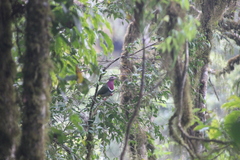
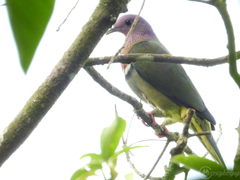
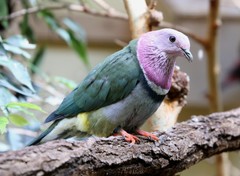
The male has a purple-pink head, neck and throat, bordered below with a white band outlined in greenish black. The upperparts are green and the underparts grey, with yellow undertail coverts. The iris is orange, the bill is greenish, and feet are pink. The female is duller than the male, with a weaker breast band, and the juvenile is an even drabber version of the female. The call is a soft hoo. The male pink-headed fruit doves were observed to be the only ones participating in nest building, the "flimsy" nest mentioned earlier can be described as a "Pigeon-like" nest. Females were observed not participating in the nest building and instead were observed to perch in tall nearby trees.

This dove feeds on figs, small fruit and berries in the upper canopy of the forest, where it is well-camouflaged amongst the green foliage. The pink-headed fruit dove is restricted to less than 12,000 km² of forest in three sites on Sumatra, sixteen on Java and one on Bali, always on forested mountains at least 2000m high. Most sites are smaller than 200 km² and shrinking. However the species is very inconspicuous and it is not yet thought to be threatened.

The pink-headed fruit dove is evaluated as Least Concern on the IUCN Red List of Threatened Species. While in the past the species was rarely found on offer in traditional bird markets in Indonesia, in 2022 it was found that dozens of pink-headed fruit doves were openly offered for sale on Indonesian Facebook pages and other social media platforms Wikipedia →
Sounds

Song0:28

Indonesia · 2014

© Marc Thibault · XC196209 · CC BY-NC-SA 4.0

Call0:14

Indonesia · 2017

© Bruno Durand · XC361044 · CC BY-NC-SA 4.0

Call0:24

Indonesia · 2016

© Gareth K. · XC352873 · CC BY-NC-SA 4.0

Global Distribution

Parks Where Found

# Park Country Daily sighting probability
1 Kerinci Seblat National Park 🇮🇩 Indonesia
<5%

More parks will be added in future updates.

Zoos & Centres Where Found

# Zoo / Centre Country
1 San Diego Zoo 🇺🇸 United States In captivity
2 ZooParc de Beauval 🇫🇷 France In captivity
3 Zoo Pilsen 🇨🇿 Czechia In captivity
4 Walsrode World Bird Park 🇩🇪 Germany In captivity
5 Minnesota Zoo 🇺🇸 United States In captivity
6 Bronx Zoo 🇺🇸 United States In captivity
7 Sedgwick County Zoo 🇺🇸 United States In captivity
8 Chester Zoo 🇬🇧 United Kingdom In captivity
9 Toledo Zoo 🇺🇸 United States In captivity
10 Warsaw Zoo 🇵🇱 Poland In captivity
11 Woodland Park Zoo 🇺🇸 United States In captivity
12 Cameron Park Zoo 🇺🇸 United States In captivity
13 Philadelphia Zoo 🇺🇸 United States In captivity
14 National Aviary 🇺🇸 United States In captivity
15 herpetarium warszawskiego ZOO 🇵🇱 Poland In captivity
16 NaturoSpace 🇫🇷 France In captivity
17 akwarium warszawskiego ZOO 🇵🇱 Poland In captivity

Before you go

What are the chances of seeing a Pink-headed Fruit-Dove in Kerinci Seblat National Park?

Rare

Under 5% of wildlife watchers report a Pink-headed Fruit-Dove sighting in Kerinci Seblat National Park on a given day, based on 20 verified sightings from GBIF citizen-science data from 2019 to 2026. It is the 127th most-seen of the 203 birds we can rate there. Over three days the chance rises to about 10%, and over a week to about 20%, if each day is a fresh chance.

When is the best time to see a Pink-headed Fruit-Dove in Kerinci Seblat National Park?

April–May, July and December

In those months about 10% of wildlife watchers report a Pink-headed Fruit-Dove in Kerinci Seblat National Park on a given day, against under 5% in February–March, June and August–November, the lowest months. January has too few records to rate.

What time of day is best to see a Pink-headed Fruit-Dove?

Between 7 and 10 am

Across all the parks we cover, that three-hour window holds the most Pink-headed Fruit-Dove sightings with a recorded time, and about 8 in 10 of them come between 6 am and 6 pm: it is a daytime animal.

Where else can you see a Pink-headed Fruit-Dove?

Only Kerinci Seblat National Park, in our data

Kerinci Seblat National Park is the only park on Wallace's Line with enough records to rate Pink-headed Fruit-Dove sightings: under 5% of wildlife watchers there report one on a given day.

Which relatives of the Pink-headed Fruit-Dove live in Kerinci Seblat National Park?

Same family: Columbidae

The closest relatives of the Pink-headed Fruit-Dove that you can see in Kerinci Seblat National Park (family Columbidae, Pigeons and Doves) are Little Cuckoo-Dove (about 50%), Pearl-necked Dove (about 30%) and Green-spectacled Green-Pigeon (about 30%), with each one's daily chance of a sighting.

Where does the Pink-headed Fruit-Dove sighting chance come from?

GBIF citizen-science records

It is estimated from how often the Pink-headed Fruit-Dove is recorded against all the birds logged in Kerinci Seblat National Park (20 verified sightings from 2019 to 2026), calibrated against known sighting rates. Figures are rounded to the nearest 10% because citizen-science data supports honest approximations, not decimals, and months with records from fewer than five people show "—". How it works.

← Back to Kerinci Seblat National Park