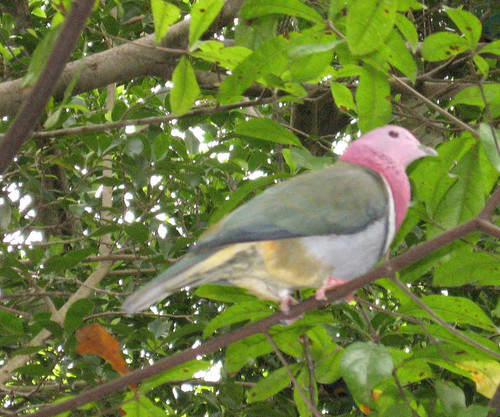
Mountain Imperial-Pigeon

Mountain Imperial-Pigeon

Ducula badia

Silhouette: Sheatherius · PhyloPic

LCLeast ConcernNTVUENCR
Daily sighting probability <5% · Rare
at Kerinci Seblat National Park

In 3 days ~10%

10 Verified sightings at Kerinci Seblat National Park From 2019 to 2026
6,051 In all 14 parks
May Best month
☀️ Diurnal When it's spotted

About the Mountain Imperial-Pigeon

The mountain imperial pigeon (Ducula badia), also known as the maroon-backed imperial pigeon or Hodgson's imperial pigeon, is a species of bird in the pigeon and dove family with a wide range in southeastern Asia. The Malabar imperial pigeon (D. cuprea) of India's Western Ghats was formerly considered conspecific, but was split as a distinct species by the IOC in 2021.

The mountain imperial pigeon is the largest pigeon species in its range at 43–51 cm (17–20 in) long. It has a fairly long tail, broad, rounded wings and slow wing-beats. The head, neck and underparts are vinous-grey with a contrasting white throat and brownish-maroon upperparts and wings, though the upper part of the body can be duller. The underwing is slate-grey and the tail is blackish with a grey horizontal line. The combination the maroon back with the large size give this species a distinctive appearance. Its call consists of a deep, resonant boom that is only detectable at close range.

Though usually solitary, this species has been seen in groups numbering up to 20, especially when going to roost or flying up or down in mountains. They can be difficult to see, since... Wikipedia →

Sounds

Song1:15

Thailand · 2017

© Greg Irving · XC944411 · CC BY-NC-SA 4.0

Duet0:35

Malaysia · 2023

© Lim Ying Hien · XC810383 · CC BY-NC-ND 4.0

Call0:19

Malaysia · 2014

© Mike Nelson · XC191876 · CC BY-NC-SA 4.0

Global Distribution

Parks Where Found

# Park Country Daily sighting probability
1 Khao Yai National Park 🇹🇭 Thailand
~50%
2 Kinabalu Park 🇲🇾 Malaysia
~40%
3 Periyar National Park 🇮🇳 India
~40%
4 Namdapha National Park 🇮🇳 India
~40%
5 Royal Manas National Park 🇧🇹 Bhutan
~20%
6 Kaeng Krachan National Park 🇹🇭 Thailand
~10%
7 Taman Negara National Park 🇲🇾 Malaysia
~10%
8 Manas National Park 🇮🇳 India
~10%
9 Gunung Leuser National Park 🇮🇩 Indonesia
<5%
10 Doi Inthanon National Park 🇹🇭 Thailand
<5%
11 Nagarhole National Park 🇮🇳 India
<5%
12 Kerinci Seblat National Park 🇮🇩 Indonesia
<5%
13 Danum Valley Conservation Area 🇲🇾 Malaysia
<5%
14 Sepilok 🇲🇾 Malaysia
<5%

Before you go

What are the chances of seeing a Mountain Imperial-Pigeon in Kerinci Seblat National Park?

Rare

Under 5% of wildlife watchers report a Mountain Imperial-Pigeon sighting in Kerinci Seblat National Park on a given day, based on 10 verified sightings from GBIF citizen-science data from 2019 to 2026. It is the 154th most-seen of the 203 birds we can rate there. Over three days the chance rises to about 10%, if each day is a fresh chance.

When is the best time to see a Mountain Imperial-Pigeon in Kerinci Seblat National Park?

May

In that month about 10% of wildlife watchers report a Mountain Imperial-Pigeon in Kerinci Seblat National Park on a given day, against under 5% in February–April and June–December, the lowest months. January has too few records to rate.

What time of day is best to see a Mountain Imperial-Pigeon?

Between 7 and 10 am

Across all the parks we cover, that three-hour window holds the most Mountain Imperial-Pigeon sightings with a recorded time, and about 9 in 10 of them come between 6 am and 6 pm: it is a daytime animal.

Is Kerinci Seblat National Park the best place to see a Mountain Imperial-Pigeon?

12th of 14

Of the 14 parks where we can rate Mountain Imperial-Pigeon sightings, Kerinci Seblat National Park ranks 12th at under 5%. The best odds are in Khao Yai National Park (Thailand, about 50%), Kinabalu Park (Malaysia, about 40%) and Periyar National Park (India, about 40%). All parks ranked.

Where does the Mountain Imperial-Pigeon sighting chance come from?

GBIF citizen-science records

It is estimated from how often the Mountain Imperial-Pigeon is recorded against all the birds logged in Kerinci Seblat National Park (10 verified sightings from 2019 to 2026), calibrated against known sighting rates. Figures are rounded to the nearest 10% because citizen-science data supports honest approximations, not decimals, and months with records from fewer than five people show "—". How it works.

← Back to Kerinci Seblat National Park