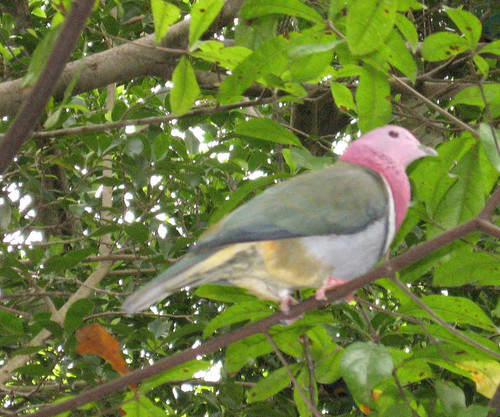
Little Cuckoo-Dove

Little Cuckoo-Dove

Macropygia ruficeps

Silhouette: Sheatherius · PhyloPic

LCLeast ConcernNTVUENCR
Daily sighting probability ~50% · Likely
at Kerinci Seblat National Park

In 3 days ~90% in a week >90%

362 Verified sightings at Kerinci Seblat National Park From 2019 to 2026
2,071 In all 6 parks
July Best month
🌅 Crepuscular When it's spotted

About the Little Cuckoo-Dove

The little cuckoo-dove (Macropygia ruficeps) is a species of bird in the family Columbidae. It is a reddish brown pigeon, and is found in Brunei, China, Indonesia, Laos, Malaysia, Myanmar, Thailand, and Vietnam. It is listed as a species of least concern on the International Union for Conservation of Nature Red List of Endangered Species.

The little cuckoo-dove is a reddish brown pigeon, measuring 27 to 30 cm (11 to 12 in) in length, and weighing 74 to 88 g (2.6 to 3.1 oz). It has cinnamon buff plumage. It has greyish white irides. The beak is brown, and has a black tip. The feet are coral red in colour. The tail is long, and it differentiates the little cuckoo-dove from other sympatric (species existing in the same geographic area and thus frequently encountering one another) pigeons. Little cuckoo-doves travel in loose flocks.

The little cuckoo-dove is found in evergreen hill forests and forest peripheries, in the north of its range. Southwards, it is found in drier forests and in adjacent areas of second-growth forests. It is also found in cultivated areas. It is commonly found in submontane habitats at elevations of 300 to 2,000 m... Wikipedia →

Sounds

Song0:21

Malaysia · 2022

© GABRIEL LEITE · XC731410 · CC BY-NC-SA 4.0

Call0:10

Malaysia · 2012

© Marc Anderson · XC146216 · CC BY-NC-ND 3.0

Song0:12

Indonesia · 2017

© Ross Gallardy · XC410184 · CC BY-NC-SA 4.0

Global Distribution

Parks Where Found

# Park Country Daily sighting probability
1 Kinabalu Park 🇲🇾 Malaysia
~50%
2 Kerinci Seblat National Park 🇮🇩 Indonesia
~50%
3 Gunung Leuser National Park 🇮🇩 Indonesia
~10%
4 Kaeng Krachan National Park 🇹🇭 Thailand
<5%
5 Taman Negara National Park 🇲🇾 Malaysia
<5%
6 Bali Barat National Park 🇮🇩 Indonesia
<5%

Before you go

What are the chances of seeing a Little Cuckoo-Dove in Kerinci Seblat National Park?

Likely

About 50% of wildlife watchers report a Little Cuckoo-Dove sighting in Kerinci Seblat National Park on a given day, based on 362 verified sightings from GBIF citizen-science data from 2019 to 2026. It is the 7th most-seen of the 203 birds we can rate there. Over three days the chance rises to about 90%, and over a week to over 90%, if each day is a fresh chance.

When is the best time to see a Little Cuckoo-Dove in Kerinci Seblat National Park?

May and July

In those months about 60% of wildlife watchers report a Little Cuckoo-Dove in Kerinci Seblat National Park on a given day, against about 30% in November, the lowest month. January has too few records to rate.

What time of day is best to see a Little Cuckoo-Dove?

Between 2 and 5 am

Across all the parks we cover, that three-hour window holds the most Little Cuckoo-Dove sightings with a recorded time, and about 6 in 10 of them come between 6 pm and 6 am: it is most active around dawn and dusk.

Is Kerinci Seblat National Park the best place to see a Little Cuckoo-Dove?

Among the best

Of the 6 parks where we can rate Little Cuckoo-Dove sightings, Kerinci Seblat National Park ranks 2nd at about 50%, level with the leaders once rounded. The best odds are in Kinabalu Park (Malaysia, about 50%).

Where does the Little Cuckoo-Dove sighting chance come from?

GBIF citizen-science records

It is estimated from how often the Little Cuckoo-Dove is recorded against all the birds logged in Kerinci Seblat National Park (362 verified sightings from 2019 to 2026), calibrated against known sighting rates. Figures are rounded to the nearest 10% because citizen-science data supports honest approximations, not decimals, and months with records from fewer than five people show "—". How it works.

← Back to Kerinci Seblat National Park