Bushy-crested Hornbill

Bushy-crested Hornbill

Anorrhinus galeritus

Silhouette: Charles J. Sharp and T. Michael Keesey · PhyloPic

LCNTNear ThreatenedVUENCR
Daily sighting probability ~20% · Possible
at Khao Sok National Park

In 3 days ~50% in a week ~80%

178 Verified sightings at Khao Sok National Park From 2019 to 2026
2,263 In all 9 parks
April Best month
🌅 Crepuscular When it's spotted

About the Bushy-crested Hornbill

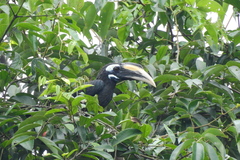
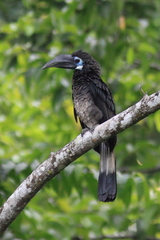
The bushy-crested hornbill (Anorrhinus galeritus) is a bird in the hornbill family. It is found in Brunei, Indonesia, Malaysia, Myanmar, and Thailand. Its natural habitat is subtropical or tropical moist lowland forests.

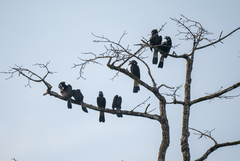
It lives in groups. Females have a unique nesting behavior in which they stay alone in a mud-covered tree hole during incubation and are fed by other hornbills from outside the nest. The bushy-crested hornbill mainly eats fruit: several different species of figs, Indian Mast Tree (Polyalthia lateriflora), Oncosperma horridum, Canarium megalanthum, Canthiumera glabra, Zuccarinia macrophylla, Myristica sp., Horsfieldia sp., champak (Magnolia champaca), Dysoxylum sp., Fibraurea tinctoria, Endocomia macrocoma, and Alseodaphne falcata. Wikipedia →

Sounds

Call0:45

Malaysia · 2026

© Ding Li Yong · XC1145419 · CC BY-NC-ND 4.0

Uncertain0:07

Malaysia · 2025

© Nick Talbot · XC1039247 · CC BY-NC-SA 4.0

Call0:44

Malaysia · 2022

© GABRIEL LEITE · XC730917 · CC BY-NC-SA 4.0

Global Distribution

Parks Where Found

# Park Country Daily sighting probability
1 Kinabatangan Wildlife Sanctuary 🇲🇾 Malaysia
~50%
2 Danum Valley Conservation Area 🇲🇾 Malaysia
~20%
3 Khao Sok National Park 🇹🇭 Thailand
~20%
4 Gunung Leuser National Park 🇮🇩 Indonesia
~10%
5 Way Kambas National Park 🇮🇩 Indonesia
~10%
6 Sepilok 🇲🇾 Malaysia
~10%
7 Taman Negara National Park 🇲🇾 Malaysia
~10%
8 Kerinci Seblat National Park 🇮🇩 Indonesia
~10%
9 Khao Luang National Park 🇹🇭 Thailand
<5%

Zoos & Centres Where Found

# Zoo / Centre Country
1 Sriayuthaya Lion Park 🇹🇭 Thailand In captivity
2 Bangkok Aquarium 🇹🇭 Thailand In captivity

Before you go

What are the chances of seeing a Bushy-crested Hornbill in Khao Sok National Park?

Possible

About 20% of wildlife watchers report a Bushy-crested Hornbill sighting in Khao Sok National Park on a given day, based on 178 verified sightings from GBIF citizen-science data from 2019 to 2026. It is the 42nd most-seen of the 213 birds we can rate there. Over three days the chance rises to about 50%, and over a week to about 80%, if each day is a fresh chance.

When is the best time to see a Bushy-crested Hornbill in Khao Sok National Park?

April

In that month about 40% of wildlife watchers report a Bushy-crested Hornbill in Khao Sok National Park on a given day, against about 10% in July and September, the lowest months.

What time of day is best to see a Bushy-crested Hornbill?

Between 9 am and noon

Across all the parks we cover, that three-hour window holds the most Bushy-crested Hornbill sightings with a recorded time, and about 6 in 10 of them come between 6 am and 6 pm: it is most active around dawn and dusk.

Is Khao Sok National Park the best place to see a Bushy-crested Hornbill?

3rd of 9

Of the 9 parks where we can rate Bushy-crested Hornbill sightings, Khao Sok National Park ranks 3rd at about 20%. The best odds are in Kinabatangan Wildlife Sanctuary (Malaysia, about 50%) and Danum Valley Conservation Area (Malaysia, about 20%).

Which relatives of the Bushy-crested Hornbill live in Khao Sok National Park?

Same family: Bucerotidae

The closest relatives of the Bushy-crested Hornbill that you can see in Khao Sok National Park (family Bucerotidae, Hornbills) are Great Hornbill (about 40%), Oriental Pied Hornbill (about 20%) and Wreathed Hornbill (about 20%), with each one's daily chance of a sighting.

Where does the Bushy-crested Hornbill sighting chance come from?

GBIF citizen-science records

It is estimated from how often the Bushy-crested Hornbill is recorded against all the birds logged in Khao Sok National Park (178 verified sightings from 2019 to 2026), calibrated against known sighting rates. Figures are rounded to the nearest 10% because citizen-science data supports honest approximations, not decimals, and months with records from fewer than five people show "—". How it works.

← Back to Khao Sok National Park