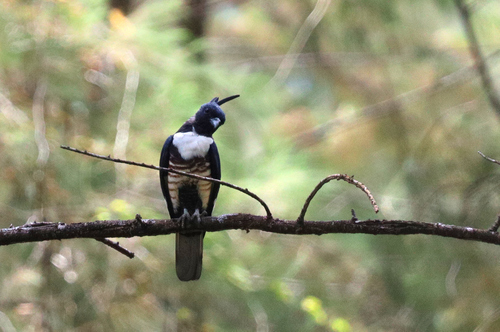
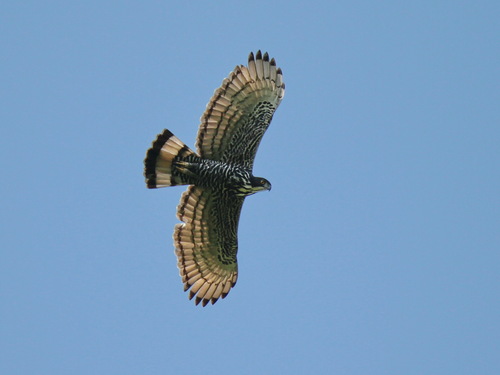
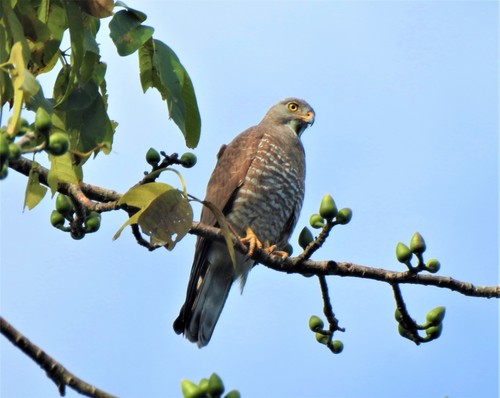
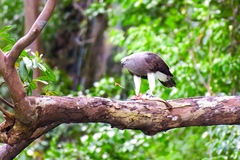
Lesser Fish-Eagle
Daily sighting probability ~30% · Possible
at Khao Sok National Park

In 3 days ~70% in a week ~90%

307 Verified sightings at Khao Sok National Park From 2019 to 2026
1,730 In all 12 parks
October Best month
☀️ Diurnal When it's spotted

About the Lesser Fish-Eagle

The lesser fish eagle (Icthyophaga humilis) is a species of Icthyophaga found in the Indian subcontinent, primarily in the foothills of the Himalayas, and south-east Asia. There are records from Gujarat, Central India and in more recent times from the Kaveri river valley in southern India, although the south Indian records are now thought to come from an isolated population, disjunct from the species' normal range.

Some taxonomic authorities place this species in the genus Icthyophaga. Others place it in the genus Haliaeetus. Lesser fish eagles are fish-eating birds that have feet adapted to aid in gripping slippery fish. They have strongly curved talons, and spicules along the underside of the birds' toes help to grip fish as they pull them from the water.

There are two subspecies: Icthyophaga humilis humilis, which is native to the Malaysian Peninsula, Sumatra, Borneo, and Sulawesi; and Icthyophaga humilis plumbeus, which is native to Kashmir through southeast India, Nepal, and Burma towards Indochina.

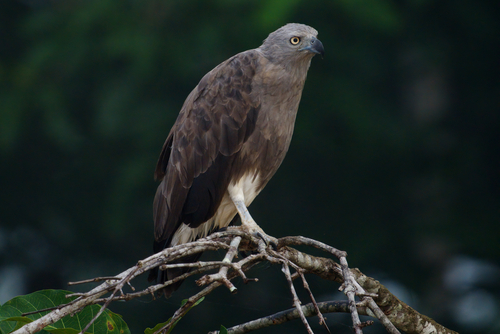
The lesser fish eagle is a medium-sized bird of prey that is primarily gray-brown in colour with broad, blunt wings and coarse featherless legs. They are smaller... Wikipedia →
Global Distribution

Parks Where Found

# Park Country Daily sighting probability
1 Khao Sok National Park 🇹🇭 Thailand
~30%
2 Jim Corbett National Park 🇮🇳 India
~20%
3 Kinabatangan Wildlife Sanctuary 🇲🇾 Malaysia
~20%
4 Danum Valley Conservation Area 🇲🇾 Malaysia
~10%
5 Taman Negara National Park 🇲🇾 Malaysia
~10%
6 Periyar National Park 🇮🇳 India
~10%
7 Royal Bardia National Park 🇳🇵 Nepal
<5%
8 Khao Luang National Park 🇹🇭 Thailand
<5%
9 Chitwan National Park 🇳🇵 Nepal
<5%
10 Bandipur National Park 🇮🇳 India
<5%
11 Namdapha National Park 🇮🇳 India
<5%
12 Sepilok 🇲🇾 Malaysia
<5%

Before you go

What are the chances of seeing a Lesser Fish-Eagle in Khao Sok National Park?

Possible

About 30% of wildlife watchers report a Lesser Fish-Eagle sighting in Khao Sok National Park on a given day, based on 307 verified sightings from GBIF citizen-science data from 2019 to 2026. It is the 23rd most-seen of the 213 birds we can rate there. Over three days the chance rises to about 70%, and over a week to about 90%, if each day is a fresh chance.

When is the best time to see a Lesser Fish-Eagle in Khao Sok National Park?

October

In that month about 60% of wildlife watchers report a Lesser Fish-Eagle in Khao Sok National Park on a given day, against about 10% in May, the lowest month. That is one of Khao Sok National Park's wettest months, with about 280 mm of rain against 35 mm in February.

What time of day is best to see a Lesser Fish-Eagle?

Between 7 and 10 am

Across all the parks we cover, that three-hour window holds the most Lesser Fish-Eagle sightings with a recorded time, and about 8 in 10 of them come between 6 am and 6 pm: it is a daytime animal.

Is Khao Sok National Park the best place to see a Lesser Fish-Eagle?

Yes

Of the 12 parks where we can rate Lesser Fish-Eagle sightings, Khao Sok National Park has the highest daily chance: about 30%. Next come Jim Corbett National Park (India, about 20%) and Kinabatangan Wildlife Sanctuary (Malaysia, about 20%).

Which relatives of the Lesser Fish-Eagle live in Khao Sok National Park?

Same family: Accipitridae

The closest relatives of the Lesser Fish-Eagle that you can see in Khao Sok National Park (family Accipitridae, Hawks, Eagles, and Kites) are Crested Serpent Eagle (about 40%), Oriental Honey-buzzard (about 30%) and Brahminy Kite (about 20%), with each one's daily chance of a sighting.

Where does the Lesser Fish-Eagle sighting chance come from?

GBIF citizen-science records

It is estimated from how often the Lesser Fish-Eagle is recorded against all the birds logged in Khao Sok National Park (307 verified sightings from 2019 to 2026), calibrated against known sighting rates. Figures are rounded to the nearest 10% because citizen-science data supports honest approximations, not decimals, and months with records from fewer than five people show "—". How it works.

← Back to Khao Sok National Park