Dark Blue Tiger

Dark Blue Tiger

Tirumala septentrionis

Daily sighting probability ~30% · Possible
at Khao Yai National Park

In 3 days ~60% in a week ~90%

44 Verified sightings at Khao Yai National Park From 2019 to 2026
246 In all 10 parks
May Best month
☀️ Diurnal When it's spotted

About the Dark Blue Tiger

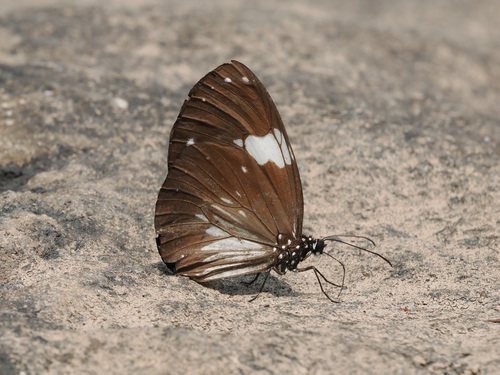
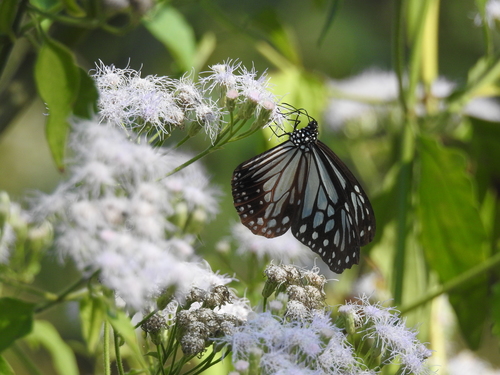
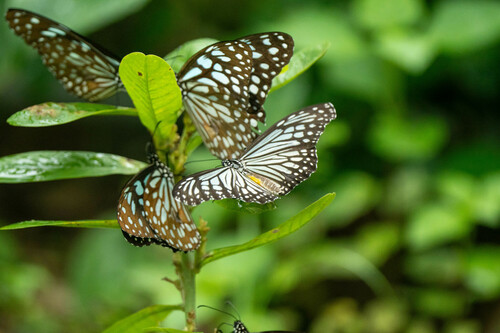
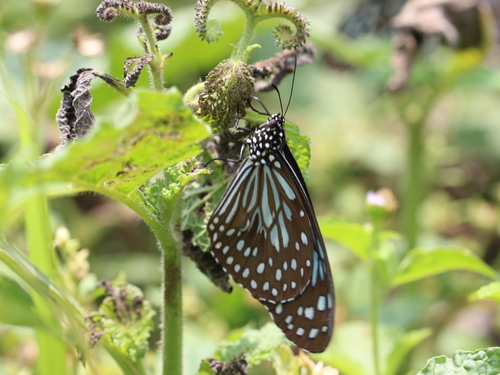
Tirumala septentrionis, the dark blue tiger, is a danaid butterfly found in the Indian subcontinent and Southeast Asia. Tirumala septentrionis has a wingspan from 80–115 mm. The species closely resembles Tirumala limniace, but is sufficiently distinct to be easily recognized, even on the wing. Wings on any butterfly can show strong variations and genetics. For instance, the Dark Blue Tiger butterfly has a large wingspan because of the environment it grew up in, causing it to fly at large distances. Large sized wings were found in a low latitude area as well. Compared to T. limniace, its upperside is darker and the semihyaline markings are narrower, more distinct, and of a bluer tint. In the forewing, in interspace 1 the two streaks are narrower, never coalescent, and the upper streak forms an oval detached spot; the short streaks above vein 5 are outwardly never truncate, always acute. In the hindwing, the two streaks of the discoidal cell united at base are wide apart at their apices, with the lower streak never formed into a hook. On the underside, this species is generally darker, the apex of the forewing and the whole of the ground colour of the hindwing not being... Wikipedia →
Global Distribution

Parks Where Found

# Park Country Daily sighting probability
1 Cuc Phuong National Park 🇻🇳 Vietnam
~40%
2 Namdapha National Park 🇮🇳 India
~40%
3 Kaeng Krachan National Park 🇹🇭 Thailand
~30%
4 Royal Manas National Park 🇧🇹 Bhutan
~30%
5 Yala National Park 🇱🇰 Sri Lanka
~30%
6 Mudumalai National Park 🇮🇳 India
~30%
7 Khao Yai National Park 🇹🇭 Thailand
~30%
8 Periyar National Park 🇮🇳 India
~30%
9 Bandipur National Park 🇮🇳 India
~20%
10 Cat Tien National Park 🇻🇳 Vietnam
~10%

Cities Where Found

# City Country Daily sighting probability
1 Madurai 🇮🇳 India
~30%
2 Thrissur 🇮🇳 India
~20%
3 Bengaluru 🇮🇳 India
~20%
4 Ponnani 🇮🇳 India
~20%
5 Salem 🇮🇳 India
~20%
6 Mysuru 🇮🇳 India
~20%
7 Thiruvananthapuram 🇮🇳 India
~20%
8 Kozhikode 🇮🇳 India
~20%
9 Chennai 🇮🇳 India
~10%
10 Kochi 🇮🇳 India
~10%

Before you go

What are the chances of seeing a Dark Blue Tiger in Khao Yai National Park?

Possible

About 30% of wildlife watchers report a Dark Blue Tiger sighting in Khao Yai National Park on a given day, based on 44 verified sightings from GBIF citizen-science data from 2019 to 2026. It is the 12th most-seen of the 221 insects we can rate there. Over three days the chance rises to about 60%, and over a week to about 90%, if each day is a fresh chance.

When is the best time to see a Dark Blue Tiger in Khao Yai National Park?

May

In that month about 40% of wildlife watchers report a Dark Blue Tiger in Khao Yai National Park on a given day, against about 10% in January and February, the lowest months.

What time of day is best to see a Dark Blue Tiger?

Between 8 and 11 am

Across all the parks we cover, that three-hour window holds the most Dark Blue Tiger sightings with a recorded time, and about 9 in 10 of them come between 6 am and 6 pm: it is a daytime animal.

Which relatives of the Dark Blue Tiger live in Khao Yai National Park?

Same family: Nymphalidae

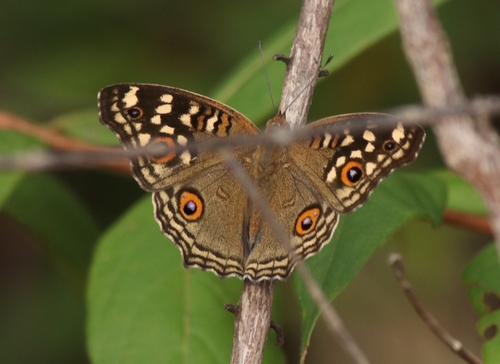
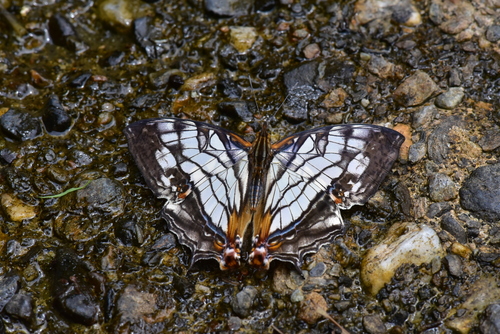
The closest relatives of the Dark Blue Tiger that you can see in Khao Yai National Park (family Nymphalidae, Brush-footed Butterflies) are Magpie Crow Butterfly (about 40%), Commander (about 30%) and Lemon Pansy (about 20%), with each one's daily chance of a sighting.

Where does the Dark Blue Tiger sighting chance come from?

GBIF citizen-science records

It is estimated from how often the Dark Blue Tiger is recorded against all the insects logged in Khao Yai National Park (44 verified sightings from 2019 to 2026), calibrated against known sighting rates. Figures are rounded to the nearest 10% because citizen-science data supports honest approximations, not decimals, and months with records from fewer than five people show "—". How it works.

← Back to Khao Yai National Park