Small-toothed Palm Civet

Small-toothed Palm Civet

Arctogalidia trivirgata

Silhouette: Margot Michaud · PhyloPic

LCLeast ConcernNTVUENCR
Daily sighting probability ~10% · With luck
at Khao Yai National Park

In 3 days ~40% in a week ~70%

11 Verified sightings at Khao Yai National Park From 2019 to 2026
119 In all 6 parks
November Best month
☀️ Diurnal When it's spotted

About the Small-toothed Palm Civet

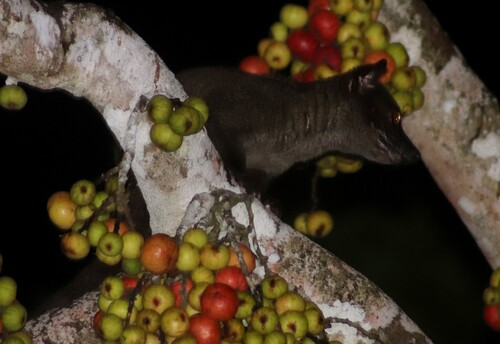
The small-toothed palm civet (Arctogalidia trivirgata), also known as the three-striped palm civet, is a viverrid native to dense forests from Northeast India to mainland Southeast Asia and the islands of Borneo, Sumatra and Java.

A monotypic genus, Arctogalidia means 'bear-weasel' (from ancient Greek arkto- 'bear' + galidia 'little weasel'). The specific epithet trivirgata means 'three-striped' in Latin. The scientific name Paradoxurus trivirgatus was proposed by John Edward Gray in 1832 in his first scientific description of a small-toothed palm civet that was based on a zoological specimen from the Maluku Islands in the collection of the Rijksmuseum van Natuurlijke Historie.

The small-toothed palm civet is a member of the subfamily Paradoxurinae, described by Gray in 1864. There exists a debate among taxonomists as to whether individuals from Borneo and the Peninsular Malaysia are different species. Molecular modelling has suggested that the small-toothed palm civets in Borneo form a different clade belonging to Arctogalidia stigmatica; they may have genetically diverged during the Pliocene when rising sea levels in the South China Sea restricted connections between... Wikipedia →

Sounds

Alarm call0:06

Malaysia · 2023

© Daan Drukker · XC959714 · CC BY-NC-ND 4.0

Global Distribution

Parks Where Found

# Park Country Daily sighting probability
1 Danum Valley Conservation Area 🇲🇾 Malaysia
~40%
2 Kinabatangan Wildlife Sanctuary 🇲🇾 Malaysia
~40%
3 Kerinci Seblat National Park 🇮🇩 Indonesia
~30%
4 Kinabalu Park 🇲🇾 Malaysia
~20%
5 Khao Yai National Park 🇹🇭 Thailand
~10%
6 Kaeng Krachan National Park 🇹🇭 Thailand
~10%

Zoos & Centres Where Found

# Zoo / Centre Country
1 Yaroslavl Zoo 🇷🇺 Russia In captivity
2 Night Safari 🇸🇬 Singapore In captivity
3 Singapore Zoo 🇸🇬 Singapore In captivity
4 River Wonders 🇸🇬 Singapore In captivity

Before you go

What are the chances of seeing a Small-toothed Palm Civet in Khao Yai National Park?

With luck

About 10% of wildlife watchers report a Small-toothed Palm Civet sighting in Khao Yai National Park on a given day, based on 11 verified sightings from GBIF citizen-science data from 2019 to 2026. It is the 20th most-seen of the 24 mammals we can rate there. Over three days the chance rises to about 40%, and over a week to about 70%, if each day is a fresh chance.

When is the best time to see a Small-toothed Palm Civet in Khao Yai National Park?

November and December

In those months about 30% of wildlife watchers report a Small-toothed Palm Civet in Khao Yai National Park on a given day, against under 5% in January, March–June and August–October, the lowest months. Those are among Khao Yai National Park's driest months, with about 35 mm of rain a month against 330 mm in September.

What time of day is best to see a Small-toothed Palm Civet?

Between 2 and 5 pm

Across all the parks we cover, that three-hour window holds the most Small-toothed Palm Civet sightings with a recorded time, and about 9 in 10 of them come between 6 am and 6 pm: it is a daytime animal.

Which relatives of the Small-toothed Palm Civet live in Khao Yai National Park?

Same family: Viverridae

The closest relatives of the Small-toothed Palm Civet that you can see in Khao Yai National Park (family Viverridae, Civets, Genets, and Oyans) are Common Palm Civet (about 30%) and Small Indian Civet (about 20%), with each one's daily chance of a sighting.

Where does the Small-toothed Palm Civet sighting chance come from?

GBIF citizen-science records

It is estimated from how often the Small-toothed Palm Civet is recorded against all the mammals logged in Khao Yai National Park (11 verified sightings from 2019 to 2026), calibrated against known sighting rates. Figures are rounded to the nearest 10% because citizen-science data supports honest approximations, not decimals, and months with records from fewer than five people show "—". How it works.

← Back to Khao Yai National Park