Small Indian Civet

Small Indian Civet

Viverricula indica

Silhouette: Margot Michaud · PhyloPic

LCLeast ConcernNTVUENCR
Daily sighting probability ~20% · Possible
at Khao Yai National Park

In 3 days ~50% in a week ~80%

24 Verified sightings at Khao Yai National Park From 2019 to 2026
50 In all 4 parks
October Best month
☀️🌙 Day & Night When it's spotted

About the Small Indian Civet

The small Indian civet (Viverricula indica) is a civet native to South and Southeast Asia. It is listed as least concern on the IUCN Red List because of its widespread distribution, widespread habitat use and healthy populations living in agricultural and secondary landscapes of many range states.

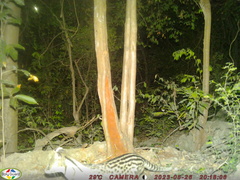
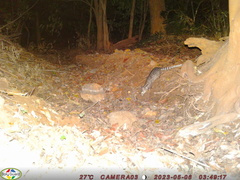
This is the only species in genus Viverricula. The small Indian civet has a rather coarse fur that is brownish grey to pale yellowish brown, with usually several longitudinal black or brown bands on the back and longitudinal rows of spots on the sides. Usually there are five or six distinct bands on the back and four or five rows of spots on each side. Some have indistinct lines and spots, with the dorsal bands wanting. Generally there are two dark stripes from behind the ear to the shoulders, and often a third in front, crossing the throat. Its underfur is brown or grey, often grey on the upper parts of the body and brown on the lower. The grey hairs on the upper parts are often tipped with black. The head is grey or brownish grey, the chin often brown. The ears are short and rounded with a dusky mark behind each ear, and one in front of each eye. The feet are brown... Wikipedia →

Global Distribution

Parks Where Found

# Park Country Daily sighting probability
1 Wilpattu National Park 🇱🇰 Sri Lanka
~30%
2 Khao Yai National Park 🇹🇭 Thailand
~20%
3 Cat Tien National Park 🇻🇳 Vietnam
~20%
4 Minneriya National Park 🇱🇰 Sri Lanka
~10%

Before you go

What are the chances of seeing a Small Indian Civet in Khao Yai National Park?

Possible

About 20% of wildlife watchers report a Small Indian Civet sighting in Khao Yai National Park on a given day, based on 24 verified sightings from GBIF citizen-science data from 2019 to 2026. It is the 16th most-seen of the 24 mammals we can rate there. Over three days the chance rises to about 50%, and over a week to about 80%, if each day is a fresh chance.

When is the best time to see a Small Indian Civet in Khao Yai National Park?

October

In that month about 40% of wildlife watchers report a Small Indian Civet in Khao Yai National Park on a given day, against under 5% in May–July and September, the lowest months.

What time of day is best to see a Small Indian Civet?

Between 8 and 11 pm

Across all the parks we cover, that three-hour window holds the most Small Indian Civet sightings with a recorded time, and about 6 in 10 of them come between 6 pm and 6 am: it is seen both by day and at night.

Is Khao Yai National Park the best place to see a Small Indian Civet?

2nd of 4

Of the 4 parks where we can rate Small Indian Civet sightings, Khao Yai National Park ranks 2nd at about 20%. The best odds are in Wilpattu National Park (Sri Lanka, about 30%).

Which relatives of the Small Indian Civet live in Khao Yai National Park?

Same family: Viverridae

The closest relatives of the Small Indian Civet that you can see in Khao Yai National Park (family Viverridae, Civets, Genets, and Oyans) are Common Palm Civet (about 30%) and Small-toothed Palm Civet (about 10%), with each one's daily chance of a sighting.

Where does the Small Indian Civet sighting chance come from?

GBIF citizen-science records

It is estimated from how often the Small Indian Civet is recorded against all the mammals logged in Khao Yai National Park (24 verified sightings from 2019 to 2026), calibrated against known sighting rates. Figures are rounded to the nearest 10% because citizen-science data supports honest approximations, not decimals, and months with records from fewer than five people show "—". How it works.

← Back to Khao Yai National Park