Black-headed Lapwing

Black-headed Lapwing

Vanellus tectus

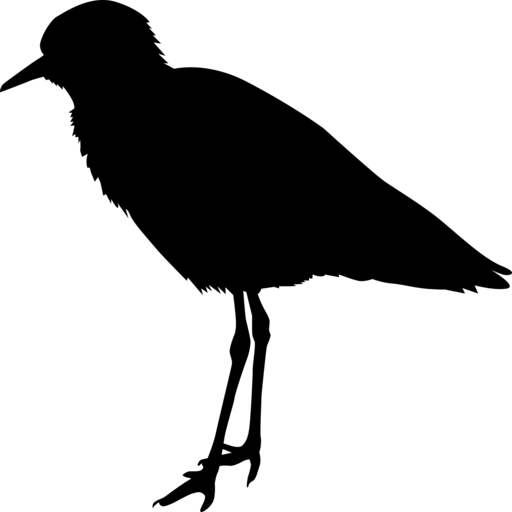
Silhouette: Rebecca Groom · PhyloPic

LCLeast ConcernNTVUENCR
Daily sighting probability ~10% · With luck
at Kidepo Valley National Park

In 3 days ~40% in a week ~60%

47 Verified sightings at Kidepo Valley National Park From 2019 to 2026
818 In all 8 parks
September Best month
☀️ Diurnal When it's spotted

About the Black-headed Lapwing

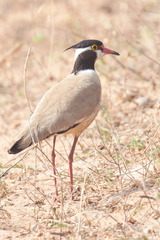
The black-headed lapwing or black-headed plover (Vanellus tectus) is a large lapwing, a group of largish waders in the family Charadriidae. It is a resident breeder across sub-Saharan Africa from Senegal to Ethiopia, although it has seasonal movements. It lays two or three eggs on a ground scrape.

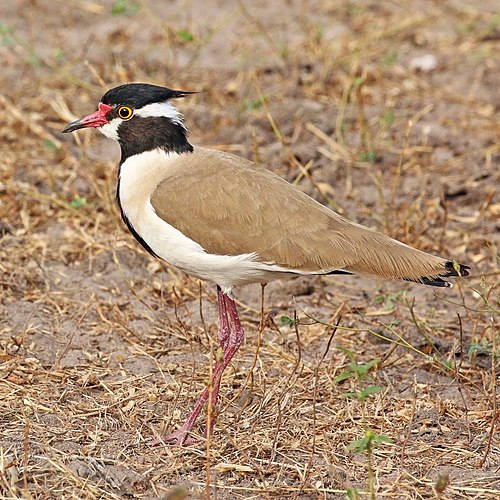
These are conspicuous and unmistakable birds. They are medium-large waders with a black head other than a white forehead, lower face and bands across the rear head and nape. There is a wispy black crest like northern lapwing and the bill and legs are red. The tail is white, tipped black.

In flight, the black-headed lapwing's upperwings have black flight feathers and brown coverts separated by a white bar. The underwings are white with black flight feathers. This species is a common breeder in wet lowland habitats close to water. It often feeds in drier habitats, such as golf courses and grassy scrub, picking insects and other invertebrates from the ground.

The black-headed lapwing has a metallic tink-tink call. The black-headed lapwing was described by the French polymath Georges-Louis Leclerc, Comte de Buffon in 1781 in his Histoire Naturelle des Oiseaux from a specimen collected... Wikipedia →
Sounds

Call0:38

Ethiopia · 2014

© Andrew Spencer · XC267432 · CC BY-NC-SA 4.0

Flight call0:28

Senegal · 2025

© Bram Piot · XC1010778 · CC BY-NC-SA 4.0

Alarm call1:02

Chad · 2024

© Julien Birard · XC960671 · CC BY-NC-SA 4.0

Global Distribution

Parks Where Found

# Park Country Daily sighting probability
1 Tsavo East National Park 🇰🇪 Kenya
~40%
2 Murchison Falls National Park 🇺🇬 Uganda
~20%
3 Meru National Park 🇰🇪 Kenya
~20%
4 Kidepo Valley National Park 🇺🇬 Uganda
~10%
5 Tsavo West National Park 🇰🇪 Kenya
~10%
6 Niokolo-Koba National Park 🇸🇳 Senegal
~10%
7 Awash National Park 🇪🇹 Ethiopia
~10%
8 Amboseli National Park 🇰🇪 Kenya
<5%

Cities Where Found

# City Country Daily sighting probability
1 Maiduguri 🇳🇬 Nigeria
~30%
2 N'Djamena 🇹🇩 Chad
~10%

Zoos & Centres Where Found

# Zoo / Centre Country
1 Zoo Pilsen 🇨🇿 Czechia In captivity
2 Berlin Zoological Garden 🇩🇪 Germany In captivity
3 Aquarium Berlin 🇩🇪 Germany In captivity

Before you go

What are the chances of seeing a Black-headed Lapwing in Kidepo Valley National Park?

With luck

About 10% of wildlife watchers report a Black-headed Lapwing sighting in Kidepo Valley National Park on a given day, based on 47 verified sightings from GBIF citizen-science data from 2019 to 2026. It is the 133rd most-seen of the 332 birds we can rate there. Over three days the chance rises to about 40%, and over a week to about 60%, if each day is a fresh chance.

When is the best time to see a Black-headed Lapwing in Kidepo Valley National Park?

February and September

In those months about 30% of wildlife watchers report a Black-headed Lapwing in Kidepo Valley National Park on a given day, against under 5% in July and August, the lowest months. Those are among Kidepo Valley National Park's driest months, with about 40 mm of rain a month against 130 mm in July. April and May have too few records to rate.

What time of day is best to see a Black-headed Lapwing?

Between 10 am and 1 pm

Across all the parks we cover, that three-hour window holds the most Black-headed Lapwing sightings with a recorded time, and about 8 in 10 of them come between 6 am and 6 pm: it is a daytime animal.

Is Kidepo Valley National Park the best place to see a Black-headed Lapwing?

4th of 8

Of the 8 parks where we can rate Black-headed Lapwing sightings, Kidepo Valley National Park ranks 4th at about 10%. The best odds are in Tsavo East National Park (Kenya, about 40%), Murchison Falls National Park (Uganda, about 20%) and Meru National Park (Kenya, about 20%).

Where does the Black-headed Lapwing sighting chance come from?

GBIF citizen-science records

It is estimated from how often the Black-headed Lapwing is recorded against all the birds logged in Kidepo Valley National Park (47 verified sightings from 2019 to 2026), calibrated against known sighting rates. Figures are rounded to the nearest 10% because citizen-science data supports honest approximations, not decimals, and months with records from fewer than five people show "—". How it works.

← Back to Kidepo Valley National Park