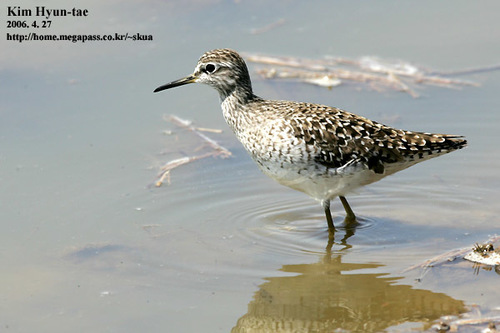
White-winged Tern

White-winged Tern

Chlidonias leucopterus

Silhouette: Andy Wilson · PhyloPic

LCLeast ConcernNTVUENCR
Daily sighting probability <5% · Rare
at Kidepo Valley National Park

In 3 days ~10% in a week ~20%

8 Verified sightings at Kidepo Valley National Park From 2019 to 2026
2,021 In all 38 parks
September Best month
☀️ Diurnal When it's spotted

About the White-winged Tern

The white-winged tern or white-winged black tern (Chlidonias leucopterus) is a species of tern in the family Laridae. It is a small species generally found in or near bodies of fresh water across much of the world, including Europe, Africa, Asia, and Australia. The genus name is from Ancient Greek khelidonios, "swallow-like", from khelidon, "swallow".

The name 'white-winged tern' is the standard in most English-speaking countries; in the United Kingdom, this name is also the one used by the formal ornithological recording authorities, but the older alternative 'white-winged black tern' is still frequent in popular use.

Adult birds in summer have short red legs and a short black bill (small and stubby, measuring 22–25 mm from the feathers, decidedly shorter than the head), a black neck (often with a pale gray back) and belly, very dark grey back, with a white rump and light grey (almost white) tail, which often looks 'square' in juveniles. The face is tinged yellowish. The wings, as the name implies, are mainly white. The inner wing is grayish with brown-tipped coverts. In non-breeding plumage, most of the black is replaced by white or pale grey, though a few blackish... Wikipedia →

Sounds

Call0:56

China · 2026

© Peter Boesman · XC1147405 · CC BY-NC-ND 4.0

Alarm call0:26

Malaysia · 2022

© Lim Ying Hien · XC956647 · CC BY-NC-ND 4.0

Flight call0:11

Mongolia · 2022

© Stanislas Wroza · XC765291 · CC BY-NC-SA 4.0

Global Distribution

Parks Where Found

# Park Country Daily sighting probability
1 Amboseli National Park 🇰🇪 Kenya
~20%
2 Biebrza National Park 🇵🇱 Poland
~20%
3 Hortobágy National Park 🇭🇺 Hungary
~20%
4 Yala National Park 🇱🇰 Sri Lanka
~20%
5 Lake Nakuru National Park 🇰🇪 Kenya
~10%
6 Queen Elizabeth National Park 🇺🇬 Uganda
~10%
7 Ngorongoro Conservation Area 🇹🇿 Tanzania
~10%
8 Chobe National Park 🇧🇼 Botswana
~10%
9 Murchison Falls National Park 🇺🇬 Uganda
~10%
10 Liwonde National Park 🇲🇼 Malawi
~10%
11 Białowieża National Park 🇵🇱 Poland
<5%
12 Hwange National Park 🇿🇼 Zimbabwe
<5%
13 Ningaloo Marine Park 🇦🇺 Australia
<5%
14 Kiskunság National Park 🇭🇺 Hungary
<5%
15 Gobi Gurvansaikhan National Park 🇲🇳 Mongolia
<5%
16 Camargue 🇫🇷 France
<5%
17 Kidepo Valley National Park 🇺🇬 Uganda
<5%
18 Lake Manyara National Park 🇹🇿 Tanzania
<5%
19 Fertő-Hanság National Park 🇭🇺 Hungary
<5%
20 Virunga National Park 🇨🇩 Democratic Republic of the Congo
<5%
21 iSimangaliso Wetland Park 🇿🇦 South Africa
<5%
22 Moremi Game Reserve 🇧🇼 Botswana
<5%
23 Udawalawe National Park 🇱🇰 Sri Lanka
<5%
24 Khao Sok National Park 🇹🇭 Thailand
<5%
25 Wilpattu National Park 🇱🇰 Sri Lanka
<5%
26 Serengeti National Park 🇹🇿 Tanzania
<5%
27 Rottnest Island 🇦🇺 Australia
<5%
28 Tsavo West National Park 🇰🇪 Kenya
<5%
29 uMkhuze Game Reserve 🇿🇦 South Africa
<5%
30 Kafue National Park 🇿🇲 Zambia
<5%
31 Etosha National Park 🇳🇦 Namibia
<5%
32 Kinabatangan Wildlife Sanctuary 🇲🇾 Malaysia
<5%
33 Tarangire National Park 🇹🇿 Tanzania
<5%
34 Tangkoko Nature Reserve 🇮🇩 Indonesia
<5%
35 Kakadu National Park 🇦🇺 Australia
<5%
36 Nairobi National Park 🇰🇪 Kenya
<5%
37 Wadden Sea National Park 🇩🇪 Germany
<5%
38 Kruger National Park 🇿🇦 South Africa
<5%

Cities Where Found

# City Country Daily sighting probability
1 Kuwait City 🇰🇼 Kuwait
~10%
2 Luxor 🇪🇬 Egypt
~10%
3 Padang 🇮🇩 Indonesia
~10%
4 Davao City 🇵🇭 Philippines
<5%
5 Kampala 🇺🇬 Uganda
<5%
6 Denpasar 🇮🇩 Indonesia
<5%
7 San Diego 🇺🇸 United States
<5%
8 Bangkok 🇹🇭 Thailand
<5%
9 Abu Dhabi 🇦🇪 United Arab Emirates
<5%
10 Manila 🇵🇭 Philippines
<5%

Before you go

What are the chances of seeing a White-winged Tern in Kidepo Valley National Park?

Rare

Under 5% of wildlife watchers report a White-winged Tern sighting in Kidepo Valley National Park on a given day, based on 8 verified sightings from GBIF citizen-science data from 2019 to 2026. It is the 283rd most-seen of the 332 birds we can rate there. Over three days the chance rises to about 10%, and over a week to about 20%, if each day is a fresh chance.

When is the best time to see a White-winged Tern in Kidepo Valley National Park?

September and October

In those months about 10% of wildlife watchers report a White-winged Tern in Kidepo Valley National Park on a given day, against under 5% in June–August and November–March, the lowest months. April and May have too few records to rate.

What time of day is best to see a White-winged Tern?

Between 2 and 5 pm

Across all the parks we cover, that three-hour window holds the most White-winged Tern sightings with a recorded time, and about 8 in 10 of them come between 6 am and 6 pm: it is a daytime animal.

Is Kidepo Valley National Park the best place to see a White-winged Tern?

17th of 38

Of the 38 parks where we can rate White-winged Tern sightings, Kidepo Valley National Park ranks 17th at under 5%. The best odds are in Amboseli National Park (Kenya, about 20%), Biebrza National Park (Poland, about 20%) and Hortobágy National Park (Hungary, about 20%).

Which relatives of the White-winged Tern live in Kidepo Valley National Park?

Same order: Charadriiformes

The closest relatives of the White-winged Tern that you can see in Kidepo Valley National Park (order Charadriiformes, Shorebirds and Allies) are African Wattled Lapwing (about 40%), African Jacana (about 20%) and Black-headed Lapwing (about 10%), with each one's daily chance of a sighting.

Where does the White-winged Tern sighting chance come from?

GBIF citizen-science records

It is estimated from how often the White-winged Tern is recorded against all the birds logged in Kidepo Valley National Park (8 verified sightings from 2019 to 2026), calibrated against known sighting rates. Figures are rounded to the nearest 10% because citizen-science data supports honest approximations, not decimals, and months with records from fewer than five people show "—". How it works.

← Back to Kidepo Valley National Park