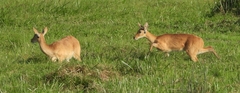
Bohor Reedbuck

Bohor Reedbuck

Redunca redunca

Silhouette: Jan A. Venter, Herbert H. T. Prins, David A. Balfour & Rob Slotow (vectorized by T. Michael Keesey) · PhyloPic

LCLeast ConcernNTVUENCR
Daily sighting probability ~60% · Likely
at Kidepo Valley National Park

In 3 days ~90% in a week >90%

12 Verified sightings at Kidepo Valley National Park From 2019 to 2026
372 In all 10 parks
July Best month
☀️ Diurnal When it's spotted

About the Bohor Reedbuck

The bohor reedbuck (Redunca redunca) is an antelope native to central Africa. The animal is placed under the genus Redunca and in the family Bovidae. It was first described by German zoologist and botanist Peter Simon Pallas in 1767. The bohor reedbuck has five subspecies. The head-and-body length of this medium-sized antelope is typically between 100–135 cm (39–53 in). Males reach approximately 75–89 cm (30–35 in) at the shoulder, while females reach 69–76 cm (27–30 in). Males typically weigh 43–65 kg (95–143 lb) and females 35–45 kg (77–99 lb). This sturdily built antelope has a yellow to grayish brown coat. Only the males possess horns which measure about 25–35 cm (9.8–13.8 in) long.

A herbivore, the bohor reedbuck prefers grasses and tender reed shoots with high protein and low fiber content. This reedbuck is dependent on water, though green pastures can fulfill its water requirement. The social structure of the bohor reedbuck is highly flexible. Large aggregations are observed during the dry season, when hundreds of bohor reedbuck assemble near a river. Males become sexually mature at the age of three to four years, while females can conceive at just one year of age, reproducing every nine to fourteen months. Though there is no fixed breeding season, mating peaks in the rainy season. The gestation period is seven and a half months long, after which a single calf is born. The calves are weaned at eight to nine months of age.

The bohor reedbuck inhabits moist grasslands and swamplands as well as woodlands. The bohor reedbuck is native to Benin, Burkina Faso, Burundi, Cameroon, Central African Republic, Chad, Democratic Republic of the Congo, Ethiopia, the Gambia, Ghana, Guinea, Guinea-Bissau, Kenya, Mali, Mauritania, Niger, Nigeria, Rwanda, Senegal, Sudan, Tanzania, Togo, and Uganda. The animal is possibly extinct in Ivory Coast. Reckless hunting and loss of habitat as a result of human settlement have led to significant decline in the numbers of the bohor reedbuck, although this antelope tends to survive longer in such over-exploited areas as compared to its relatives. The total populations of the bohor reedbuck are estimated to be above 100,000. Larger populations occur in eastern and central Africa than in western Africa. The International Union for Conservation of Nature (IUCN) rates the bohor reedbuck as of least concern. Wikipedia →

Global Distribution

Parks Where Found

# Park Country Daily sighting probability
1 Bale Mountains National Park 🇪🇹 Ethiopia
~70%
2 Kidepo Valley National Park 🇺🇬 Uganda
~60%
3 Amboseli National Park 🇰🇪 Kenya
~50%
4 Tarangire National Park 🇹🇿 Tanzania
~40%
5 Mikumi National Park 🇹🇿 Tanzania
~40%
6 Aberdare National Park 🇰🇪 Kenya
~30%
7 Nairobi National Park 🇰🇪 Kenya
~30%
8 Serengeti National Park 🇹🇿 Tanzania
~30%
9 Masai Mara National Reserve 🇰🇪 Kenya
~20%
10 Murchison Falls National Park 🇺🇬 Uganda
~20%

Cities Where Found

# City Country Daily sighting probability
1 Nairobi 🇰🇪 Kenya
~10%

Before you go

What are the chances of seeing a Bohor Reedbuck in Kidepo Valley National Park?

Likely

About 60% of wildlife watchers report a Bohor Reedbuck sighting in Kidepo Valley National Park on a given day, based on 12 verified sightings from GBIF citizen-science data from 2019 to 2026. It is the 12th most-seen of the 14 mammals we can rate there. Over three days the chance rises to about 90%, and over a week to over 90%, if each day is a fresh chance.

When is the best time to see a Bohor Reedbuck in Kidepo Valley National Park?

July

In that month about 80% of wildlife watchers report a Bohor Reedbuck in Kidepo Valley National Park on a given day, against about 20% in January, April and June, the lowest months. That is one of Kidepo Valley National Park's wettest months, with about 130 mm of rain against 10 mm in February. September and November–December have too few records to rate.

What time of day is best to see a Bohor Reedbuck?

Between 9 am and noon

Across all the parks we cover, that three-hour window holds the most Bohor Reedbuck sightings with a recorded time, and about 8 in 10 of them come between 6 am and 6 pm: it is a daytime animal.

Is Kidepo Valley National Park the best place to see a Bohor Reedbuck?

2nd of 10

Of the 10 parks where we can rate Bohor Reedbuck sightings, Kidepo Valley National Park ranks 2nd at about 60%. The best odds are in Bale Mountains National Park (Ethiopia, about 70%). All parks ranked.

Which relatives of the Bohor Reedbuck live in Kidepo Valley National Park?

Same family: Bovidae

The closest relatives of the Bohor Reedbuck that you can see in Kidepo Valley National Park (family Bovidae, Bovids) are African Buffalo (about 80%), Hartebeest (about 80%) and Waterbuck (about 80%), with each one's daily chance of a sighting.

Where does the Bohor Reedbuck sighting chance come from?

GBIF citizen-science records

It is estimated from how often the Bohor Reedbuck is recorded against all the mammals logged in Kidepo Valley National Park (12 verified sightings from 2019 to 2026), calibrated against known sighting rates. Figures are rounded to the nearest 10% because citizen-science data supports honest approximations, not decimals, and months with records from fewer than five people show "—". How it works.

← Back to Kidepo Valley National Park