Dark Chanting-Goshawk

Dark Chanting-Goshawk

Melierax metabates

Silhouette: Sheatherius · PhyloPic

LCLeast ConcernNTVUENCR
Daily sighting probability ~30% · Possible
at Kidepo Valley National Park

In 3 days ~60% in a week ~90%

97 Verified sightings at Kidepo Valley National Park From 2019 to 2026
3,247 In all 19 parks
September Best month
☀️ Diurnal When it's spotted

About the Dark Chanting-Goshawk

The dark chanting goshawk (Melierax metabates) is a bird of prey in the family Accipitridae which is found across much of sub-Saharan Africa and southern Arabia, with an isolated and declining population in southern Morocco.

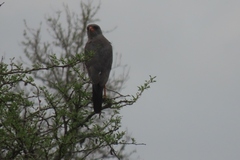
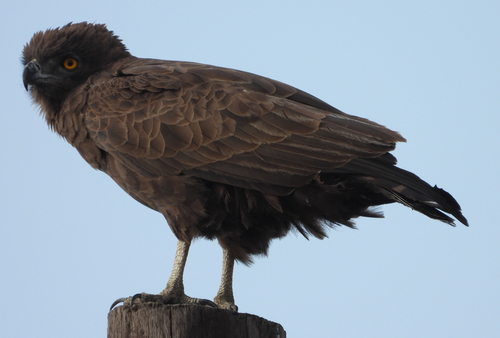
The dark chanting goshawk is a medium-sized, bulky hawk with an upright stance. The head, breast and upperparts are essentially dark grey, while the underparts, other than the breast, are white, finely barred with black. The wing primaries are black, and the tail has broad black and white bars. The cere and the long legs are orange-red. The female is, on average, larger than the male, weighing up to 840g to the male's maximum weight of 700g. Juveniles tend to have browner plumage reminiscent in colour and pattern to a buzzard Buteo spp but with the broad winged, long tailed silhouette of an accipiter.

As its common name suggests, the dark chanting goshawk is a vocal bird, although less so than its two congeners. It often calls from a perch or in flight, making an accelerating series of piping notes and fluty whistles, which has been described as a song or chant and there are up to a dozen notes in a series peeu-peeu-pu-pu-pu. It also... Wikipedia →

Sounds

Call0:09

Saudi Arabia · 2022

© Oscar Campbell · XC715253 · CC BY-NC-ND 4.0

Recording1:15

Nigeria · 2020

© Sun Madakan · XC589156 · CC BY-NC-SA 4.0

Call1:30

South Africa · 2013

© Peter Boesman · XC280442 · CC BY-NC-ND 4.0

Global Distribution

Parks Where Found

# Park Country Daily sighting probability
1 Awash National Park 🇪🇹 Ethiopia
~60%
2 Serengeti National Park 🇹🇿 Tanzania
~30%
3 Murchison Falls National Park 🇺🇬 Uganda
~30%
4 Kidepo Valley National Park 🇺🇬 Uganda
~30%
5 uMkhuze Game Reserve 🇿🇦 South Africa
~10%
6 Masai Mara National Reserve 🇰🇪 Kenya
~10%
7 Ngorongoro Conservation Area 🇹🇿 Tanzania
~10%
8 Hwange National Park 🇿🇼 Zimbabwe
~10%
9 Mikumi National Park 🇹🇿 Tanzania
~10%
10 Niokolo-Koba National Park 🇸🇳 Senegal
~10%
11 Kruger National Park 🇿🇦 South Africa
<5%
12 Chobe National Park 🇧🇼 Botswana
<5%
13 Lower Zambezi National Park 🇿🇲 Zambia
<5%
14 Kafue National Park 🇿🇲 Zambia
<5%
15 Mana Pools National Park 🇿🇼 Zimbabwe
<5%
16 Tarangire National Park 🇹🇿 Tanzania
<5%
17 South Luangwa National Park 🇿🇲 Zambia
<5%
18 Moremi Game Reserve 🇧🇼 Botswana
<5%
19 Samburu National Reserve 🇰🇪 Kenya
<5%

Cities Where Found

# City Country Daily sighting probability
1 Maiduguri 🇳🇬 Nigeria
~10%
2 Serrekunda 🇬🇲 Gambia
<5%

Before you go

What are the chances of seeing a Dark Chanting-Goshawk in Kidepo Valley National Park?

Possible

About 30% of wildlife watchers report a Dark Chanting-Goshawk sighting in Kidepo Valley National Park on a given day, based on 97 verified sightings from GBIF citizen-science data from 2019 to 2026. It is the 60th most-seen of the 332 birds we can rate there. Over three days the chance rises to about 60%, and over a week to about 90%, if each day is a fresh chance.

When is the best time to see a Dark Chanting-Goshawk in Kidepo Valley National Park?

September

In that month about 50% of wildlife watchers report a Dark Chanting-Goshawk in Kidepo Valley National Park on a given day, against about 10% in August and December, the lowest months. April and May have too few records to rate.

What time of day is best to see a Dark Chanting-Goshawk?

Between 7 and 10 am

Across all the parks we cover, that three-hour window holds the most Dark Chanting-Goshawk sightings with a recorded time, and about 9 in 10 of them come between 6 am and 6 pm: it is a daytime animal.

Where does the Dark Chanting-Goshawk sighting chance come from?

GBIF citizen-science records

It is estimated from how often the Dark Chanting-Goshawk is recorded against all the birds logged in Kidepo Valley National Park (97 verified sightings from 2019 to 2026), calibrated against known sighting rates. Figures are rounded to the nearest 10% because citizen-science data supports honest approximations, not decimals, and months with records from fewer than five people show "—". How it works.

← Back to Kidepo Valley National Park