


Completed



Hooded Vulture
Necrosyrtes monachus
Silhouette: Sheatherius · PhyloPic
- KingdomAnimalia (Animals)
- PhylumChordata (Chordates)
- ClassAves (Birds)
- OrderAccipitriformes (Hawks, Eagles, Kites, and Allies)
- FamilyAccipitridae (Hawks, Eagles, and Kites)
- GenusNecrosyrtes
- SpeciesNecrosyrtes monachus (Hooded Vulture)
In 3 days ~50% in a week ~80%
82 Verified sightings at Kidepo Valley National Park From 2019 to 2026
6,074 In all 30 parks
July Best month
☀️ Diurnal When it's spotted
About the Hooded Vulture
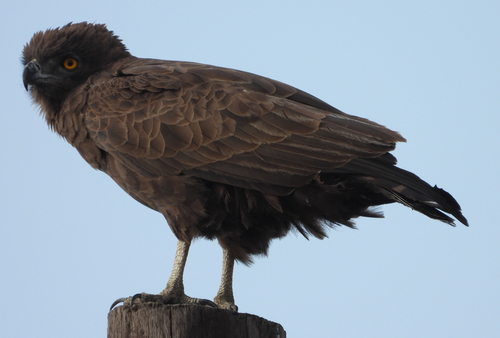
The hooded vulture (Necrosyrtes monachus) is an Old World vulture in the order Accipitriformes, which also includes eagles, kites, buzzards and hawks. It is the only member of the genus Necrosyrtes, which is sister to the larger Gyps genus, both of which are a part of the Aegypiinae subfamily of Old World vultures. It is native to sub-Saharan Africa, where it has a widespread distribution with populations in southern, East and West Africa. It is a scruffy-looking, small vulture with dark brown plumage, a long thin bill, bare crown, face and fore-neck, and a downy nape and hind-neck. Its face is usually a light red colour. It typically scavenges on carcasses of wildlife and domestic animals. Although it remains a common species with a stable population in the lower region of Casamance, some areas of The Gambia, and Guinea-Bissau, other regions such as Dakar, Senegal, show more than 85% losses in population over the last 50 years. Threats include poisoning, hunting, loss of habitat and collisions with electricity infrastructure, and the International Union for Conservation of Nature has rated its conservation status as "critically endangered" in their latest assessment (2022). The highest current regional density of hooded vultures is in the western region of The Gambia. Wikipedia →
Sounds
Call0:11
Ethiopia · 2014
© Andrew Spencer · XC277866 · CC BY-NC-ND 4.0
Recent sightings of Hooded Vulture in Kidepo Valley National Park
LIVEiNaturalistGlobal Distribution
Parks Where Found
Cities Where Found
| # | City | Country | Daily sighting probability |
|---|---|---|---|
| 1 | Serrekunda | 🇬🇲 Gambia | |
| 2 | Addis Ababa | 🇪🇹 Ethiopia | |
| 3 | Ouagadougou | 🇧🇫 Burkina Faso | |
| 4 | Freetown | 🇸🇱 Sierra Leone | |
| 5 | Kampala | 🇺🇬 Uganda | |
| 6 | Dakar | 🇸🇳 Senegal | |
| 7 | Accra | 🇬🇭 Ghana | |
| 8 | Kumasi | 🇬🇭 Ghana | |
| 9 | Kigali | 🇷🇼 Rwanda |
Zoos & Centres Where Found
Closest Relatives at Kidepo Valley National Park




Before you go
What are the chances of seeing a Hooded Vulture in Kidepo Valley National Park?
Possible
About 20% of wildlife watchers report a Hooded Vulture sighting in Kidepo Valley National Park on a given day, based on 82 verified sightings from GBIF citizen-science data from 2019 to 2026. It is the 85th most-seen of the 332 birds we can rate there. Over three days the chance rises to about 50%, and over a week to about 80%, if each day is a fresh chance.
When is the best time to see a Hooded Vulture in Kidepo Valley National Park?
July
In that month about 50% of wildlife watchers report a Hooded Vulture in Kidepo Valley National Park on a given day, against about 10% in January–February and August, the lowest months. That is one of Kidepo Valley National Park's wettest months, with about 130 mm of rain against 10 mm in February. April and May have too few records to rate.
What time of day is best to see a Hooded Vulture?
Between 8 and 11 am
Across all the parks we cover, that three-hour window holds the most Hooded Vulture sightings with a recorded time, and about 9 in 10 of them come between 6 am and 6 pm: it is a daytime animal.
Is Kidepo Valley National Park the best place to see a Hooded Vulture?
8th of 30
Of the 30 parks where we can rate Hooded Vulture sightings, Kidepo Valley National Park ranks 8th at about 20%. The best odds are in Hwange National Park (Zimbabwe, about 40%), Lower Zambezi National Park (Zambia, about 30%) and Mana Pools National Park (Zimbabwe, about 30%).
Which relatives of the Hooded Vulture live in Kidepo Valley National Park?
Same family: Accipitridae
The closest relatives of the Hooded Vulture that you can see in Kidepo Valley National Park (family Accipitridae, Hawks, Eagles, and Kites) are White-backed Vulture (about 60%), Lappet-faced Vulture (about 60%) and Bateleur (about 40%), with each one's daily chance of a sighting.
Where does the Hooded Vulture sighting chance come from?
GBIF citizen-science records
It is estimated from how often the Hooded Vulture is recorded against all the birds logged in Kidepo Valley National Park (82 verified sightings from 2019 to 2026), calibrated against known sighting rates. Figures are rounded to the nearest 10% because citizen-science data supports honest approximations, not decimals, and months with records from fewer than five people show "—". How it works.
