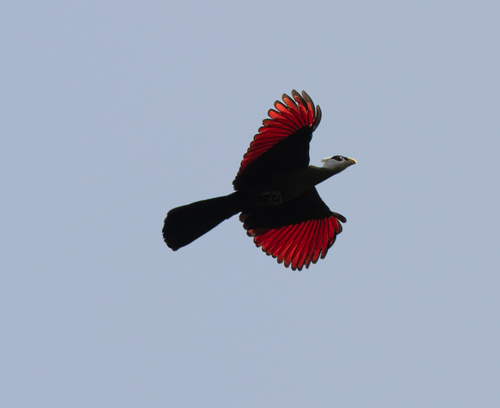
White-Bellied Go-Away-Bird

White-Bellied Go-Away-Bird

Corythaixoides leucogaster

Silhouette: Lisa M. "Pixxl" (photo), John E. McCormack, Michael G. Harvey, Brant C. Faircloth, Nicholas G. Crawford, Travis C. Glenn, Robb T. Brumfield & T. Michael Keesey · PhyloPic

Daily sighting probability ~50% · Likely
at Kidepo Valley National Park

In 3 days ~90% in a week >90%

188 Verified sightings at Kidepo Valley National Park From 2019 to 2026
3,990 In all 15 parks
February Best month
☀️ Diurnal When it's spotted

About the White-Bellied Go-Away-Bird

The white-bellied go-away-bird (Crinifer leucogaster) is a bird of eastern Africa in the family Musophagidae, commonly known as turacos. German naturalist Eduard Rüppell described this species in 1842. The white-bellied go-away-bird is placed in the bird family Musophagidae ("banana-eaters"), which includes plantain-eaters and other go-away-birds. Although traditionally, this group was placed within cuckoos in the order Cuculiformes, recent genetic analysis have strongly supported separate placement in the full order of Musophagiformes.

They are semi-zygodactylous meaning the fourth (outer) toe can be switched back and forth. Musophagidae often have prominent crests and long tails. Some species are renowned for their bright pigments. There is an ongoing discussion over generic-level classification: C. leucogaster is often referred to as being in the genus Corythaixoides or Criniferoides. Most earlier taxonomic treatments place it within Corythaixoide, however many concluded that it required the genus, Crinifer.

This species averages 51 cm (20") in length. Its long, pointed grey and black tail with a white median band is characteristic of the species... Wikipedia →

Sounds

Recording0:20

Kenya · 2017

© Ryan Donnelly · iNaturalist · CC BY 4.0

Recording0:06

Kenya · 2025

© dicksonmunka · iNaturalist · CC BY-NC 4.0

Recording0:28

Kenya · 2026

© Wasini Tour Guide · iNaturalist · CC BY-NC 4.0

Global Distribution

Parks Where Found

# Park Country Daily sighting probability
1 Meru National Park 🇰🇪 Kenya
~70%
2 Tsavo West National Park 🇰🇪 Kenya
~70%
3 Tarangire National Park 🇹🇿 Tanzania
~60%
4 Samburu National Reserve 🇰🇪 Kenya
~60%
5 Mkomazi National Park 🇹🇿 Tanzania
~60%
6 Kidepo Valley National Park 🇺🇬 Uganda
~50%
7 Awash National Park 🇪🇹 Ethiopia
~40%
8 Nairobi National Park 🇰🇪 Kenya
~30%
9 Tsavo East National Park 🇰🇪 Kenya
~30%
10 Amboseli National Park 🇰🇪 Kenya
~20%
11 Ruaha National Park 🇹🇿 Tanzania
~10%
12 Lake Manyara National Park 🇹🇿 Tanzania
<5%
13 Lake Nakuru National Park 🇰🇪 Kenya
<5%
14 Serengeti National Park 🇹🇿 Tanzania
<5%
15 Ngorongoro Conservation Area 🇹🇿 Tanzania
<5%

Cities Where Found

# City Country Daily sighting probability
1 Nairobi 🇰🇪 Kenya
<5%

Zoos & Centres Where Found

# Zoo / Centre Country
1 San Diego Zoo 🇺🇸 United States In captivity
2 Zlín-Lešná Zoo 🇨🇿 Czechia In captivity
3 Houston Zoo 🇺🇸 United States In captivity
4 Ueno Zoo 🇯🇵 Japan In captivity
5 Ueno Zoological Gardens (West Garden) 🇯🇵 Japan In captivity
6 World of Birds Wildlife Sanctuary and Monkey Park 🇿🇦 South Africa In captivity

Before you go

What are the chances of seeing a White-Bellied Go-Away-Bird in Kidepo Valley National Park?

Likely

About 50% of wildlife watchers report a White-Bellied Go-Away-Bird sighting in Kidepo Valley National Park on a given day, based on 188 verified sightings from GBIF citizen-science data from 2019 to 2026. It is the 24th most-seen of the 332 birds we can rate there. Over three days the chance rises to about 90%, and over a week to over 90%, if each day is a fresh chance.

When is the best time to see a White-Bellied Go-Away-Bird in Kidepo Valley National Park?

February, September and November

In those months about 60% of wildlife watchers report a White-Bellied Go-Away-Bird in Kidepo Valley National Park on a given day, against about 30% in March and August, the lowest months. Those are among Kidepo Valley National Park's driest months, with about 40 mm of rain a month against 130 mm in July. April and May have too few records to rate.

What time of day is best to see a White-Bellied Go-Away-Bird?

Between 8 and 11 am

Across all the parks we cover, that three-hour window holds the most White-Bellied Go-Away-Bird sightings with a recorded time, and about 9 in 10 of them come between 6 am and 6 pm: it is a daytime animal.

Which relatives of the White-Bellied Go-Away-Bird live in Kidepo Valley National Park?

Same family: Musophagidae

The closest relatives of the White-Bellied Go-Away-Bird that you can see in Kidepo Valley National Park (family Musophagidae, Turacos) are Eastern Grey Plantain-eater (about 50%) and White-crested Turaco (about 50%), with each one's daily chance of a sighting.

Where does the White-Bellied Go-Away-Bird sighting chance come from?

GBIF citizen-science records

It is estimated from how often the White-Bellied Go-Away-Bird is recorded against all the birds logged in Kidepo Valley National Park (188 verified sightings from 2019 to 2026), calibrated against known sighting rates. Figures are rounded to the nearest 10% because citizen-science data supports honest approximations, not decimals, and months with records from fewer than five people show "—". How it works.

← Back to Kidepo Valley National Park