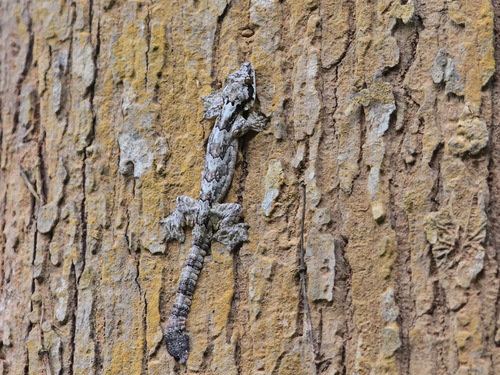
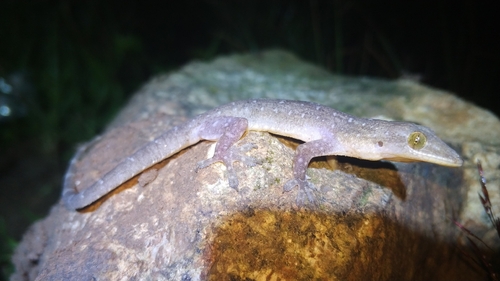
Garnot's House Gecko

Garnot's House Gecko

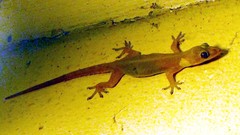
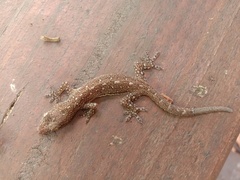
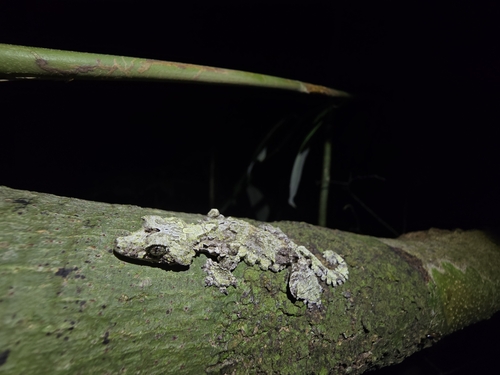
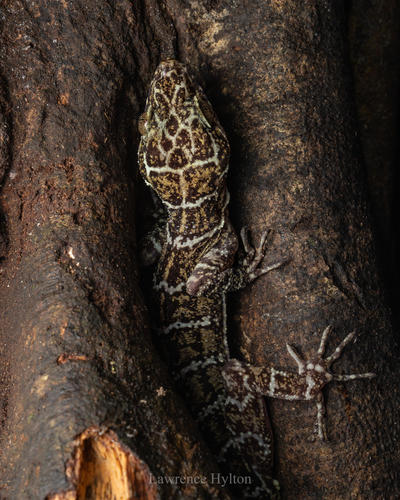
Hemidactylus garnotii

Silhouette: Alex Slavenko · PhyloPic

LCLeast ConcernNTVUENCR
Daily sighting probability ~10% · With luck
at Kinabalu Park

In 3 days ~30% in a week ~50%

10 Verified sightings at Kinabalu Park From 2019 to 2026
45 In all 5 parks
October Best month
☀️🌙 Day & Night When it's spotted

About the Garnot's House Gecko

The Indo-Pacific gecko (Hemidactylus garnotii), also known as Garnot's house gecko, fox gecko, or the Assam greyish-brown gecko, is a species of gecko native to South and Southeast Asia, Polynesia, and the east coast of Australia.

Adults grow to about 10–13 cm (4–5 in) in length. Similar to H. frenatus, they exhibit the ability to change the colour of their skin, from dark gray or brown with light markings in daylight, to a pale, translucent colour at night. Often mistaken for a common house gecko, the species can be distinguished by its rows of large, spiny scales on the lateral edges of the tail.

The species epithet, garnotii, is named in honor of the French naturalist Prosper Garnot. The name gecko is onomatopoeic, in reference to the chirp of H. frenatus, one of three extant relatives of H. garnotii, which has historically been interpreted as a "gecko, gecko" sound. The common name fox gecko relates to the species' long, narrow snout, similar to that of a fox.

The Indo-Pacific gecko bears a striking resemblance to its extant cousin H. frenatus, its closest relative. However, individuals of H. garnotii tend to be much larger than H. frenatus, with... Wikipedia →
Global Distribution

Parks Where Found

# Park Country Daily sighting probability
1 Kinabatangan Wildlife Sanctuary 🇲🇾 Malaysia
~10%
2 Kinabalu Park 🇲🇾 Malaysia
~10%
3 Khao Yai National Park 🇹🇭 Thailand
~10%
4 Kaeng Krachan National Park 🇹🇭 Thailand
~10%
5 Everglades National Park 🇺🇸 United States
~10%

Cities Where Found

# City Country Daily sighting probability
1 Hong Kong 🇨🇳 China
~20%
2 Guatemala City 🇬🇹 Guatemala
~10%
3 Sydney 🇦🇺 Australia
~10%
4 Tuen Mun 🇨🇳 China
~10%
5 Medellín 🇨🇴 Colombia
~10%
6 Guangzhou 🇨🇳 China
~10%
7 Orlando 🇺🇸 United States
<5%
8 San Diego 🇺🇸 United States
<5%
9 Los Angeles 🇺🇸 United States
<5%
10 Miami 🇺🇸 United States
<5%

Before you go

What are the chances of seeing a Garnot's House Gecko in Kinabalu Park?

With luck

About 10% of wildlife watchers report a Garnot's House Gecko sighting in Kinabalu Park on a given day, based on 10 verified sightings from GBIF citizen-science data from 2019 to 2026. It is the 63rd most-seen of the 69 reptiles we can rate there. Over three days the chance rises to about 30%, and over a week to about 50%, if each day is a fresh chance.

When is the best time to see a Garnot's House Gecko in Kinabalu Park?

October

In that month about 30% of wildlife watchers report a Garnot's House Gecko in Kinabalu Park on a given day, against under 5% in February–June, September and November–December, the lowest months.

What time of day is best to see a Garnot's House Gecko?

Between 8 and 11 pm

Across all the parks we cover, that three-hour window holds the most Garnot's House Gecko sightings with a recorded time, and about 6 in 10 of them come between 6 pm and 6 am: it is seen both by day and at night.

Is Kinabalu Park the best place to see a Garnot's House Gecko?

Among the best

Of the 5 parks where we can rate Garnot's House Gecko sightings, Kinabalu Park ranks 2nd at about 10%, level with the leaders once rounded. The best odds are in Kinabatangan Wildlife Sanctuary (Malaysia, about 10%).

Which relatives of the Garnot's House Gecko live in Kinabalu Park?

Same genus: Hemidactylus

The closest relatives of the Garnot's House Gecko that you can see in Kinabalu Park (genus Hemidactylus, House Geckos) are Flat-tailed House Gecko (about 40%) and Common House Gecko (about 30%), with each one's daily chance of a sighting.

Where does the Garnot's House Gecko sighting chance come from?

GBIF citizen-science records

It is estimated from how often the Garnot's House Gecko is recorded against all the reptiles logged in Kinabalu Park (10 verified sightings from 2019 to 2026), calibrated against known sighting rates. Figures are rounded to the nearest 10% because citizen-science data supports honest approximations, not decimals, and months with records from fewer than five people show "—". How it works.

← Back to Kinabalu Park