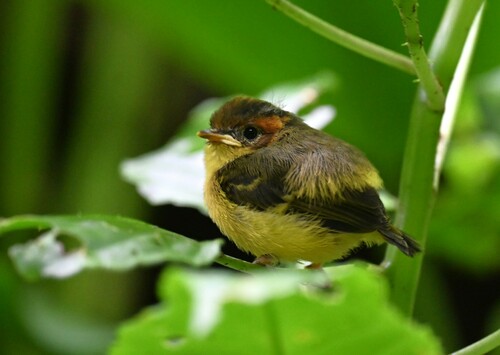
Little Cuckoo-Dove

Little Cuckoo-Dove

Macropygia ruficeps

Silhouette: Sheatherius · PhyloPic

LCLeast ConcernNTVUENCR
Daily sighting probability ~50% · Likely
at Kinabalu Park

In 3 days ~90% in a week >90%

1,523 Verified sightings at Kinabalu Park From 2019 to 2026
2,071 In all 6 parks
August Best month
🌅 Crepuscular When it's spotted

About the Little Cuckoo-Dove

The little cuckoo-dove (Macropygia ruficeps) is a species of bird in the family Columbidae. It is a reddish brown pigeon, and is found in Brunei, China, Indonesia, Laos, Malaysia, Myanmar, Thailand, and Vietnam. It is listed as a species of least concern on the International Union for Conservation of Nature Red List of Endangered Species.

The little cuckoo-dove is a reddish brown pigeon, measuring 27 to 30 cm (11 to 12 in) in length, and weighing 74 to 88 g (2.6 to 3.1 oz). It has cinnamon buff plumage. It has greyish white irides. The beak is brown, and has a black tip. The feet are coral red in colour. The tail is long, and it differentiates the little cuckoo-dove from other sympatric (species existing in the same geographic area and thus frequently encountering one another) pigeons. Little cuckoo-doves travel in loose flocks.

The little cuckoo-dove is found in evergreen hill forests and forest peripheries, in the north of its range. Southwards, it is found in drier forests and in adjacent areas of second-growth forests. It is also found in cultivated areas. It is commonly found in submontane habitats at elevations of 300 to 2,000 m... Wikipedia →

Sounds

Song0:21

Malaysia · 2022

© GABRIEL LEITE · XC731410 · CC BY-NC-SA 4.0

Call0:10

Malaysia · 2012

© Marc Anderson · XC146216 · CC BY-NC-ND 3.0

Song0:12

Indonesia · 2017

© Ross Gallardy · XC410184 · CC BY-NC-SA 4.0

Global Distribution

Parks Where Found

# Park Country Daily sighting probability
1 Kinabalu Park 🇲🇾 Malaysia
~50%
2 Kerinci Seblat National Park 🇮🇩 Indonesia
~50%
3 Gunung Leuser National Park 🇮🇩 Indonesia
~10%
4 Kaeng Krachan National Park 🇹🇭 Thailand
<5%
5 Taman Negara National Park 🇲🇾 Malaysia
<5%
6 Bali Barat National Park 🇮🇩 Indonesia
<5%

Before you go

What are the chances of seeing a Little Cuckoo-Dove in Kinabalu Park?

Likely

About 50% of wildlife watchers report a Little Cuckoo-Dove sighting in Kinabalu Park on a given day, based on 1,523 verified sightings from GBIF citizen-science data from 2019 to 2026. It is the 15th most-seen of the 247 birds we can rate there. Over three days the chance rises to about 90%, and over a week to over 90%, if each day is a fresh chance.

When is the best time to see a Little Cuckoo-Dove in Kinabalu Park?

May, July–August and October

In those months about 60% of wildlife watchers report a Little Cuckoo-Dove in Kinabalu Park on a given day, against about 20% in January, the lowest month.

What time of day is best to see a Little Cuckoo-Dove?

Between 2 and 5 am

Across all the parks we cover, that three-hour window holds the most Little Cuckoo-Dove sightings with a recorded time, and about 6 in 10 of them come between 6 pm and 6 am: it is most active around dawn and dusk.

Is Kinabalu Park the best place to see a Little Cuckoo-Dove?

Yes

Of the 6 parks where we can rate Little Cuckoo-Dove sightings, Kinabalu Park has the highest daily chance: about 50%. Next come Kerinci Seblat National Park (Indonesia, about 50%) and Gunung Leuser National Park (Indonesia, about 10%).

Where does the Little Cuckoo-Dove sighting chance come from?

GBIF citizen-science records

It is estimated from how often the Little Cuckoo-Dove is recorded against all the birds logged in Kinabalu Park (1,523 verified sightings from 2019 to 2026), calibrated against known sighting rates. Figures are rounded to the nearest 10% because citizen-science data supports honest approximations, not decimals, and months with records from fewer than five people show "—". How it works.

← Back to Kinabalu Park