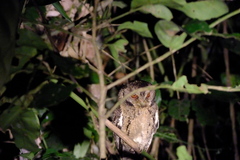
Sunda Scops-Owl

Sunda Scops-Owl

Otus lempiji

Silhouette: Armelle Ansart (photograph), Maxime Dahirel (digitisation) · PhyloPic

LCLeast ConcernNTVUENCR
Daily sighting probability <5% · Rare
at Kinabatangan Wildlife Sanctuary

In 3 days ~10% in a week ~20%

55 Verified sightings at Kinabatangan Wildlife Sanctuary From 2019 to 2026
167 In all 6 parks
June Best month
☀️ Diurnal When it's spotted

About the Sunda Scops-Owl

The Sunda scops owl (Otus lempiji) is a small brown owl native to the Sunda Islands. The taxon is considered a subspecies of O. bakkamoena by some authors. It grows from 20 to 25 cm (7.9 to 9.8 in) and can weigh 100 to 170 g (3.5 to 6.0 oz). It is speckled with black on the upper parts and streaked with black on the lower parts. It has a light collar and dark eyes, which differentiate it from the reddish scops, mountain scops, Oriental scops and Rajah scops owls.

It lives on the Malay Peninsula, Singapore, Borneo, Sumatra and Java. It can be found primarily in forests and gardens but is occasionally attracted to buildings. The diet of the Sunda scops owl mainly consists of insects, as well as small animals. Some examples of the prey they hunt are rats, small fish, lizards, crickets, and beetles’ larvae. However, their most preferred prey are rats.

It has been included in the IUCN Red List of threatened species as a least concern species. It is common throughout its range where there is suitable habitat. The Sunda scops owl lines its nest with plant fibre. It... Wikipedia →

Sounds

Call0:10

China · 2026

© Albert Lastukhin &amp; Anton Lastukhin · XC1107751 · CC BY-NC-ND 4.0

Song1:03

Malaysia · 2023

© Ding Li Yong · XC826662 · CC BY-NC-ND 4.0

Call1:11

Malaysia · 2024

© Lim Ying Hien · XC949405 · CC BY-NC-ND 4.0

Global Distribution

Parks Where Found

# Park Country Daily sighting probability
1 Way Kambas National Park 🇮🇩 Indonesia
~40%
2 Bali Barat National Park 🇮🇩 Indonesia
~30%
3 Gunung Leuser National Park 🇮🇩 Indonesia
~10%
4 Kinabatangan Wildlife Sanctuary 🇲🇾 Malaysia
<5%
5 Sepilok 🇲🇾 Malaysia
<5%
6 Kinabalu Park 🇲🇾 Malaysia
<5%

Zoos & Centres Where Found

# Zoo / Centre Country
1 Gembira Loka Zoo 🇮🇩 Indonesia In captivity
2 Amaru 🇪🇨 Ecuador In captivity
3 Jakarta Aquarium 🇮🇩 Indonesia In captivity
4 Vogelpark Bali 🇮🇩 Indonesia In captivity

Before you go

What are the chances of seeing a Sunda Scops-Owl in Kinabatangan Wildlife Sanctuary?

Rare

Under 5% of wildlife watchers report a Sunda Scops-Owl sighting in Kinabatangan Wildlife Sanctuary on a given day, based on 55 verified sightings from GBIF citizen-science data from 2019 to 2026. It is the 129th most-seen of the 231 birds we can rate there. Over three days the chance rises to about 10%, and over a week to about 20%, if each day is a fresh chance.

When is the best time to see a Sunda Scops-Owl in Kinabatangan Wildlife Sanctuary?

June

In that month about 10% of wildlife watchers report a Sunda Scops-Owl in Kinabatangan Wildlife Sanctuary on a given day, against under 5% in July to May, the lowest months.

What time of day is best to see a Sunda Scops-Owl?

Between 2 and 5 pm

Across all the parks we cover, that three-hour window holds the most Sunda Scops-Owl sightings with a recorded time, and about 7 in 10 of them come between 6 am and 6 pm: it is a daytime animal.

Where does the Sunda Scops-Owl sighting chance come from?

GBIF citizen-science records

It is estimated from how often the Sunda Scops-Owl is recorded against all the birds logged in Kinabatangan Wildlife Sanctuary (55 verified sightings from 2019 to 2026), calibrated against known sighting rates. Figures are rounded to the nearest 10% because citizen-science data supports honest approximations, not decimals, and months with records from fewer than five people show "—". How it works.

← Back to Kinabatangan Wildlife Sanctuary