Wrinkled Hornbill

Wrinkled Hornbill

Rhabdotorrhinus corrugatus

Silhouette: Charles J. Sharp and T. Michael Keesey · PhyloPic

LCNTVUENEndangeredCR
Daily sighting probability ~50% · Likely
at Kinabatangan Wildlife Sanctuary

In 3 days ~90% in a week >90%

1,370 Verified sightings at Kinabatangan Wildlife Sanctuary From 2019 to 2026
1,638 In all 6 parks
July Best month
🌅 Crepuscular When it's spotted

About the Wrinkled Hornbill

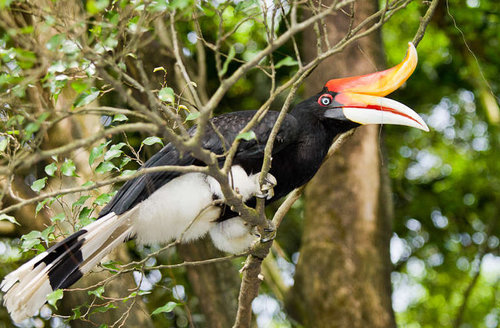
The wrinkled hornbill or Sunda wrinkled hornbill (Rhabdotorrhinus corrugatus) is a medium-large hornbill which is found in forest in the Thai-Malay Peninsula, Sumatra and Borneo. The wrinkled hornbill is around 70 cm long, and has a very large bill that is fused to the skull. It has mainly black plumage, a blue eye-ring, and a broadly white or rufous-tipped tail. The male and female have different head and bill patterns. Males have bright yellow feathers on the auriculars, cheeks, throat, neck-sides and chest, but these areas are black in the female, except for the blue throat. The bill of the male is yellow with a red base and casque, and a brownish basal half of the lower mandible. The bill and casque of the female is almost entirely yellow.

This is a forest species and eats mainly fruit, such as figs, although it will also eat small animals such as frogs and insects. Wrinkled hornbills do not drink, but get the water they need from their food. Their call is a harsh "Kak-kak", or a deep "Row-wow" which can be heard for miles.

These birds are monogamous and remain in a pair for life. They use holes found in trees for nests, and the female will plaster over the entrance with mud and droppings, leaving a nesting mother and her chicks only a small hole, too small for them to exit. They are fed exclusively by the male, who regurgitates food for them. After several months, when the chicks are ready, the female will break out of her nest.

Wrinkled hornbills were first bred in captivity in 1988. Heavy deforestation in their forest habitat has led them to be uplisted from near threatened to endangered on the IUCN Red List in 2018. Wikipedia →

Sounds

Call1:22

Malaysia · 2026

© Ding Li Yong · XC1077279 · CC BY-NC-ND 4.0

Song0:14

Malaysia · 2020

© Romuald Mikusek · XC613311 · CC BY-NC-SA 4.0

Flight call0:09

Brunei · 2021

© Okamoto Keita Sin · XC665735 · CC BY-NC-SA 4.0

Global Distribution

Parks Where Found

# Park Country Daily sighting probability
1 Kinabatangan Wildlife Sanctuary 🇲🇾 Malaysia
~50%
2 Danum Valley Conservation Area 🇲🇾 Malaysia
~10%
3 Gunung Leuser National Park 🇮🇩 Indonesia
~10%
4 Taman Negara National Park 🇲🇾 Malaysia
<5%
5 Sepilok 🇲🇾 Malaysia
<5%
6 Kinabalu Park 🇲🇾 Malaysia
<5%

Zoos & Centres Where Found

# Zoo / Centre Country
1 San Diego Zoo 🇺🇸 United States In captivity
2 Tulsa Zoo 🇺🇸 United States In captivity
3 Bioparque Estrella 🇲🇽 Mexico In captivity
4 Toronto Zoo 🇨🇦 Canada In captivity
5 Badoca Safari Park 🇵🇹 Portugal In captivity
6 Sedgwick County Zoo 🇺🇸 United States In captivity
7 Chester Zoo 🇬🇧 United Kingdom In captivity
8 Moody Gardens 🇺🇸 United States In captivity
9 National Zoo of Malaysia 🇲🇾 Malaysia In captivity
10 Fort Worth Zoo 🇺🇸 United States In captivity
11 Honolulu Zoo 🇺🇸 United States In captivity
12 Zoo Atlanta 🇺🇸 United States In captivity
13 Point Defiance Zoo & Aquarium 🇺🇸 United States In captivity
14 Turtle Back Zoo 🇺🇸 United States In captivity
15 Vogelpark Avifauna 🇳🇱 Netherlands In captivity
16 Georgia Aquarium 🇺🇸 United States In captivity
17 Tracy Aviary 🇺🇸 United States In captivity
18 Zoo El Pantanal 🇪🇨 Ecuador In captivity
19 Zoo Lagos 🇵🇹 Portugal In captivity
20 Johor Zoo 🇲🇾 Malaysia In captivity
21 Zoo de Lourosa 🇵🇹 Portugal In captivity
22 OdySea Aquarium 🇺🇸 United States In captivity
23 Blue Planet Aquarium 🇬🇧 United Kingdom In captivity
24 Bangkok Aquarium 🇹🇭 Thailand In captivity
25 Hidden Acres Rescue for Thoroughbreds 🇺🇸 United States In captivity
26 Schildpaddencentrum 🇳🇱 Netherlands In captivity

Before you go

What are the chances of seeing a Wrinkled Hornbill in Kinabatangan Wildlife Sanctuary?

Likely

About 50% of wildlife watchers report a Wrinkled Hornbill sighting in Kinabatangan Wildlife Sanctuary on a given day, based on 1,370 verified sightings from GBIF citizen-science data from 2019 to 2026. It is the 18th most-seen of the 231 birds we can rate there. Over three days the chance rises to about 90%, and over a week to over 90%, if each day is a fresh chance.

When is the best time to see a Wrinkled Hornbill in Kinabatangan Wildlife Sanctuary?

January and June–July

In those months about 60% of wildlife watchers report a Wrinkled Hornbill in Kinabatangan Wildlife Sanctuary on a given day, against about 40% in May and September–October, the lowest months.

What time of day is best to see a Wrinkled Hornbill?

Between midnight and 3 am

Across all the parks we cover, that three-hour window holds the most Wrinkled Hornbill sightings with a recorded time, and about 7 in 10 of them come between 6 pm and 6 am: it is most active around dawn and dusk.

Is Kinabatangan Wildlife Sanctuary the best place to see a Wrinkled Hornbill?

Yes

Of the 6 parks where we can rate Wrinkled Hornbill sightings, Kinabatangan Wildlife Sanctuary has the highest daily chance: about 50%. Next come Danum Valley Conservation Area (Malaysia, about 10%) and Gunung Leuser National Park (Indonesia, about 10%).

Which relatives of the Wrinkled Hornbill live in Kinabatangan Wildlife Sanctuary?

Same family: Bucerotidae

The closest relatives of the Wrinkled Hornbill that you can see in Kinabatangan Wildlife Sanctuary (family Bucerotidae, Hornbills) are Oriental Pied Hornbill (about 90%), Black Hornbill (about 60%) and Rhinoceros Hornbill (about 50%), with each one's daily chance of a sighting.

Where does the Wrinkled Hornbill sighting chance come from?

GBIF citizen-science records

It is estimated from how often the Wrinkled Hornbill is recorded against all the birds logged in Kinabatangan Wildlife Sanctuary (1,370 verified sightings from 2019 to 2026), calibrated against known sighting rates. Figures are rounded to the nearest 10% because citizen-science data supports honest approximations, not decimals, and months with records from fewer than five people show "—". How it works.

← Back to Kinabatangan Wildlife Sanctuary