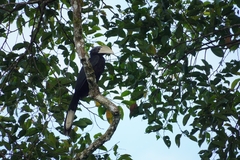

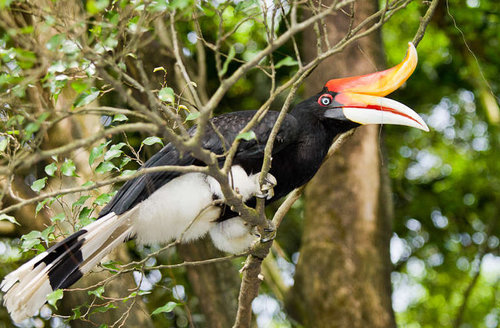
Black Hornbill

Black Hornbill

Anthracoceros malayanus

Silhouette: Rohit N · PhyloPic

LCNTVUVulnerableENCR
Daily sighting probability ~60% · Likely
at Kinabatangan Wildlife Sanctuary

In 3 days ~90% in a week >90%

1,665 Verified sightings at Kinabatangan Wildlife Sanctuary From 2019 to 2026
4,186 In all 9 parks
June Best month
☀️ Diurnal When it's spotted

About the Black Hornbill

The black hornbill (Anthracoceros malayanus) is a species of bird of the hornbill family Bucerotidae. It lives in Asia in Brunei Darussalam, Indonesia, Malaysia, Singapore, Thailand. The species has a selectiveness towards the environment and resources when it comes to reproduction. It is a lowland specialist. This organism will only start breeding and nesting when there is a large supply of fruits available, and in trees of larger size. When there are limited resources available, and may curtail nesting for years when there is a low availability of fruits(4).

It is the major seed disperser for Durio graveolens, a species of durian. The connection is strong enough to reflect in some of the common names for the fruit: The Kenyah and Dayak peoples call it durian anggang (lit. 'hornbill durian'), and in Malay it is called durian burong/durian burung (lit. 'durian bird'). It also has a role in seed disbursement for Vitex pinnata.

It is known to fly for hours at a time. It is threatened by hunting and habitat loss. It is a frugivore, eating a wide range of fruits—over 50 species. It most commonly feeds on figs and Vitex pinnata; its diet includes Sterculia cordata and Durio... Wikipedia →

Sounds

Call0:42

Malaysia · 2026

© Kim Chuah Lim · XC1075509 · CC BY-NC-SA 4.0

Song0:33

Malaysia · 2025

© Ding Li Yong · XC973423 · CC BY-NC-ND 4.0

Call0:28

Malaysia · 2022

© GABRIEL LEITE · XC730652 · CC BY-NC-SA 4.0

Global Distribution

Parks Where Found

# Park Country Daily sighting probability
1 Kinabatangan Wildlife Sanctuary 🇲🇾 Malaysia
~60%
2 Sepilok 🇲🇾 Malaysia
~60%
3 Tanjung Puting National Park 🇮🇩 Indonesia
~20%
4 Way Kambas National Park 🇮🇩 Indonesia
~20%
5 Danum Valley Conservation Area 🇲🇾 Malaysia
~20%
6 Taman Negara National Park 🇲🇾 Malaysia
~20%
7 Gunung Leuser National Park 🇮🇩 Indonesia
~10%
8 Khao Luang National Park 🇹🇭 Thailand
<5%
9 Kerinci Seblat National Park 🇮🇩 Indonesia
<5%

Zoos & Centres Where Found

# Zoo / Centre Country
1 Parc des oiseaux 🇫🇷 France In captivity
2 Zoo Opole 🇵🇱 Poland In captivity
3 Gembira Loka Zoo 🇮🇩 Indonesia In captivity
4 Birdworld 🇬🇧 United Kingdom In captivity
5 Kuala Lumpur Bird Park 🇲🇾 Malaysia In captivity
6 Parque del pueblo 🇲🇽 Mexico In captivity
7 Johor Zoo 🇲🇾 Malaysia In captivity
8 Aquaria KLCC 🇲🇾 Malaysia In captivity
9 Bangkok Aquarium 🇹🇭 Thailand In captivity

Before you go

What are the chances of seeing a Black Hornbill in Kinabatangan Wildlife Sanctuary?

Likely

About 60% of wildlife watchers report a Black Hornbill sighting in Kinabatangan Wildlife Sanctuary on a given day, based on 1,665 verified sightings from GBIF citizen-science data from 2019 to 2026. It is the 12th most-seen of the 231 birds we can rate there. Over three days the chance rises to about 90%, and over a week to over 90%, if each day is a fresh chance.

When is the best time to see a Black Hornbill in Kinabatangan Wildlife Sanctuary?

March and June–July

In those months about 70% of wildlife watchers report a Black Hornbill in Kinabatangan Wildlife Sanctuary on a given day, against about 50% in February and November, the lowest months.

What time of day is best to see a Black Hornbill?

Between 7 and 10 am

Across all the parks we cover, that three-hour window holds the most Black Hornbill sightings with a recorded time, and about 9 in 10 of them come between 6 am and 6 pm: it is a daytime animal.

Is Kinabatangan Wildlife Sanctuary the best place to see a Black Hornbill?

Yes

Of the 9 parks where we can rate Black Hornbill sightings, Kinabatangan Wildlife Sanctuary has the highest daily chance: about 60%. Next come Sepilok (Malaysia, about 60%) and Tanjung Puting National Park (Indonesia, about 20%). All parks ranked.

Where does the Black Hornbill sighting chance come from?

GBIF citizen-science records

It is estimated from how often the Black Hornbill is recorded against all the birds logged in Kinabatangan Wildlife Sanctuary (1,665 verified sightings from 2019 to 2026), calibrated against known sighting rates. Figures are rounded to the nearest 10% because citizen-science data supports honest approximations, not decimals, and months with records from fewer than five people show "—". How it works.

← Back to Kinabatangan Wildlife Sanctuary