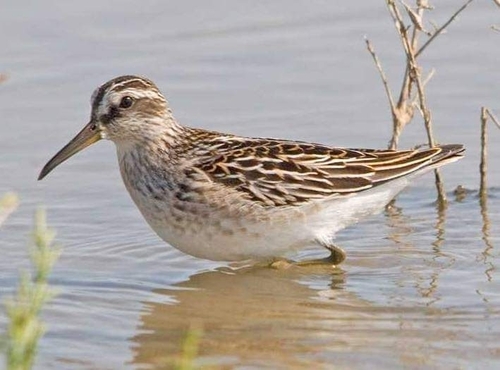
Broad-billed Sandpiper

Broad-billed Sandpiper

Calidris falcinellus

Silhouette: Edwin Price · PhyloPic

LCNTVUVulnerableENCR
Daily sighting probability <5% · Rare
at Kiskunság National Park

In 3 days <5% in a week ~10%

14 Verified sightings at Kiskunság National Park From 2019 to 2026
52 In all 2 parks
September Best month
☀️ Diurnal When it's spotted

About the Broad-billed Sandpiper

The broad-billed sandpiper (Calidris falcinellus) is a small wader. The scientific specific name falcinellus is the diminutive from Latin falx, falcis, "a small sickle". It was formerly treated in its own monospecific genus Limicola, but this was found to be embedded within the wider genus Calidris, into which it was transferred in 2004.

Within the genus Calidris, the broad-billed sandpiper is most closely related to the sharp-tailed sandpiper (C. acuminata). The two subspecies are: C. f. falcinellus – breeds northern Scandinavia, northwest Russia; winters east Africa, Middle East, India

C. f. sibirica – breeds central and eastern Siberia; winters southeast Asia Broad-billed sandpipers are small waders, 16–18 cm long, slightly smaller than the dunlin, but larger than the little stint; it has a longer, straighter bill with the tip distinctly kinked down, and shorter legs than dunlin. The breeding adult has dark brown upperparts patterned with narrow, pale feather fringes, and white underparts with blackish markings on the breast. It has a pale crown stripe, and a distinctive double (split) supercilium. As its English name suggests, the bill is slightly broader than... Wikipedia →
Sounds

Song0:16

Sweden · 2025

© Lars Edenius · XC1005270 · CC BY-NC-SA 4.0

Call1:04

Russian Federation · 2017

© Sunny · XC396657 · CC BY-NC-SA 4.0

Song0:05

Norway · 2021

© Stein Ø. Nilsen · XC663126 · CC BY-NC-SA 4.0

Global Distribution

Parks Where Found

# Park Country Daily sighting probability
1 Kiskunság National Park 🇭🇺 Hungary
<5%
2 Wadden Sea National Park 🇩🇪 Germany
<5%

Cities Where Found

# City Country Daily sighting probability
1 Kuwait City 🇰🇼 Kuwait
~10%
2 Karachi 🇵🇰 Pakistan
~10%
3 Helsinki 🇫🇮 Finland
<5%
4 Manila 🇵🇭 Philippines
<5%
5 Kollam 🇮🇳 India
<5%
6 Kozhikode 🇮🇳 India
<5%
7 Auckland 🇳🇿 New Zealand
<5%
8 Dubai 🇦🇪 United Arab Emirates
<5%
9 Istanbul 🇹🇷 Turkey
<5%
10 Mumbai 🇮🇳 India
<5%

Before you go

What are the chances of seeing a Broad-billed Sandpiper in Kiskunság National Park?

Rare

Under 5% of wildlife watchers report a Broad-billed Sandpiper sighting in Kiskunság National Park on a given day, based on 14 verified sightings from GBIF citizen-science data from 2019 to 2026. It is the 199th most-seen of the 222 birds we can rate there. Over three days the chance rises to under 5%, and over a week to about 10%, if each day is a fresh chance.

When is the best time to see a Broad-billed Sandpiper in Kiskunság National Park?

August and September

In those months about 10% of wildlife watchers report a Broad-billed Sandpiper in Kiskunság National Park on a given day, against under 5% in October to July, the lowest months.

What time of day is best to see a Broad-billed Sandpiper?

Between 9 am and noon

Across all the parks we cover, that three-hour window holds the most Broad-billed Sandpiper sightings with a recorded time, and about 9 in 10 of them come between 6 am and 6 pm: it is a daytime animal.

Is Kiskunság National Park the best place to see a Broad-billed Sandpiper?

Yes

Of the 2 parks where we can rate Broad-billed Sandpiper sightings, Kiskunság National Park has the highest daily chance: under 5%. Next come Wadden Sea National Park (Germany, under 5%).

Which relatives of the Broad-billed Sandpiper live in Kiskunság National Park?

Same genus: Calidris

The closest relatives of the Broad-billed Sandpiper that you can see in Kiskunság National Park (genus Calidris, Calidris Sandpipers) are Ruff (about 40%), Dunlin (about 20%) and Little Stint (about 10%), with each one's daily chance of a sighting.

Where does the Broad-billed Sandpiper sighting chance come from?

GBIF citizen-science records

It is estimated from how often the Broad-billed Sandpiper is recorded against all the birds logged in Kiskunság National Park (14 verified sightings from 2019 to 2026), calibrated against known sighting rates. Figures are rounded to the nearest 10% because citizen-science data supports honest approximations, not decimals, and months with records from fewer than five people show "—". How it works.

← Back to Kiskunság National Park