Rufous-chested Swallow

Rufous-chested Swallow

Cecropis semirufa

Silhouette: Andy Wilson · PhyloPic

LCLeast ConcernNTVUENCR
Daily sighting probability ~10% · With luck
at Kruger National Park

In 3 days ~40% in a week ~70%

1,284 Verified sightings at Kruger National Park From 2019 to 2026
3,184 In all 18 parks
November Best month
☀️ Diurnal When it's spotted

About the Rufous-chested Swallow

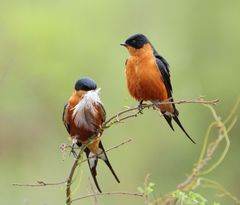
The red-breasted swallow (Cecropis semirufa), also known as the rufous-chested swallow, is a member of the family Hirundinidae, found in Sub-Saharan Africa. It is confined to the tropical rainforest during the wet season.

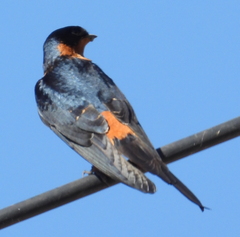
The red-breasted swallow is similar to the mosque swallow but is slightly smaller and has longer tail streamers, both species having a blue crown and mantle contrasting with a rufous rump and underparts, In the red-breasted swallow the dark crown extends below the eye and there is no white on the underwing. The juvenile is similar to the red-rumped swallow but has blue on the side of the head rather than dull red.

The red-breasted swallow is found over most of Africa south of the Sahara from the Eastern Cape north to northern Namibia and southern Angola in the west and Mozambique in the east, with a disjunct range from Senegal south to northern Angola east to Uganda, southwestern Kenya and northwestern Tanzania.

The red-breasted swallow is migratory in most of its range. In southern Africa it is a summer visitor, nesting between July and March with most of the population migrating to equatorial Africa, although a... Wikipedia →

Sounds

Song0:44

Zambia · 2025

© Dries Van de Loock · XC978977 · CC BY-NC-ND 4.0

Call1:06

South Africa · 2023

© Marc Anderson · XC880505 · CC BY-NC-ND 4.0

Flight call0:04

Gabon · 2019

© Étienne Leroy · XC497370 · CC BY-NC-SA 4.0

Global Distribution

Parks Where Found

# Park Country Daily sighting probability
1 Etosha National Park 🇳🇦 Namibia
~20%
2 iSimangaliso Wetland Park 🇿🇦 South Africa
~20%
3 uMkhuze Game Reserve 🇿🇦 South Africa
~20%
4 Hluhluwe-Imfolozi Park 🇿🇦 South Africa
~20%
5 Hwange National Park 🇿🇼 Zimbabwe
~10%
6 Kruger National Park 🇿🇦 South Africa
~10%
7 Lake Mburo National Park 🇺🇬 Uganda
~10%
8 Pilanesberg National Park 🇿🇦 South Africa
~10%
9 Masai Mara National Reserve 🇰🇪 Kenya
~10%
10 Kafue National Park 🇿🇲 Zambia
~10%
11 Kidepo Valley National Park 🇺🇬 Uganda
~10%
12 Queen Elizabeth National Park 🇺🇬 Uganda
<5%
13 Moremi Game Reserve 🇧🇼 Botswana
<5%
14 Chobe National Park 🇧🇼 Botswana
<5%
15 Serengeti National Park 🇹🇿 Tanzania
<5%
16 Kibale National Park 🇺🇬 Uganda
<5%
17 Virunga National Park 🇨🇩 Democratic Republic of the Congo
<5%
18 Bwindi Impenetrable National Park 🇺🇬 Uganda
<5%

Cities Where Found

# City Country Daily sighting probability
1 Freetown 🇸🇱 Sierra Leone
~10%

Before you go

What are the chances of seeing a Rufous-chested Swallow in Kruger National Park?

With luck

About 10% of wildlife watchers report a Rufous-chested Swallow sighting in Kruger National Park on a given day, based on 1,284 verified sightings from GBIF citizen-science data from 2019 to 2026. It is the 138th most-seen of the 464 birds we can rate there. Over three days the chance rises to about 40%, and over a week to about 70%, if each day is a fresh chance.

When is the best time to see a Rufous-chested Swallow in Kruger National Park?

November and December

In those months about 30% of wildlife watchers report a Rufous-chested Swallow in Kruger National Park on a given day, against under 5% in March to July, the lowest months. Those are among Kruger National Park's wettest months, with about 75 mm of rain a month against almost none in August.

What time of day is best to see a Rufous-chested Swallow?

Between 7 and 10 am

Across all the parks we cover, that three-hour window holds the most Rufous-chested Swallow sightings with a recorded time, and about 9 in 10 of them come between 6 am and 6 pm: it is a daytime animal.

Is Kruger National Park the best place to see a Rufous-chested Swallow?

6th of 18

Of the 18 parks where we can rate Rufous-chested Swallow sightings, Kruger National Park ranks 6th at about 10%. The best odds are in Etosha National Park (Namibia, about 20%), iSimangaliso Wetland Park (South Africa, about 20%) and uMkhuze Game Reserve (South Africa, about 20%).

Which relatives of the Rufous-chested Swallow live in Kruger National Park?

Same genus: Cecropis

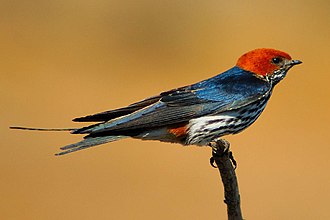
The closest relatives of the Rufous-chested Swallow that you can see in Kruger National Park (genus Cecropis, Red-rumped Swallows, Striped Swallows, and Allies) are Lesser Striped-Swallow (about 30%) and Mosque Swallow (about 10%), with each one's daily chance of a sighting.

Where does the Rufous-chested Swallow sighting chance come from?

GBIF citizen-science records

It is estimated from how often the Rufous-chested Swallow is recorded against all the birds logged in Kruger National Park (1,284 verified sightings from 2019 to 2026), calibrated against known sighting rates. Figures are rounded to the nearest 10% because citizen-science data supports honest approximations, not decimals, and months with records from fewer than five people show "—". How it works.

← Back to Kruger National Park