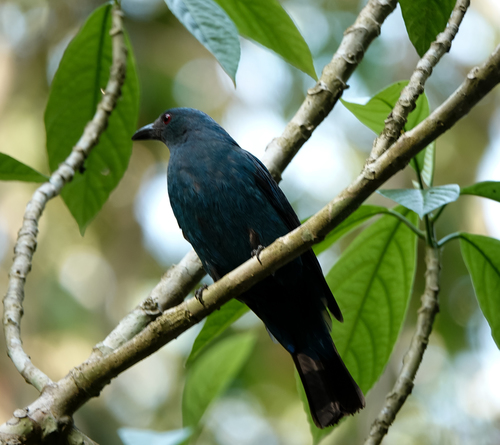
Black-and-yellow Broadbill

Black-and-yellow Broadbill

Eurylaimus ochromalus

Silhouette: Sheatherius · PhyloPic

LCNTNear ThreatenedVUENCR
Daily sighting probability ~60% · Likely
at Kubah National Park

In 3 days ~90% in a week >90%

42 Verified sightings at Kubah National Park From 2019 to 2026
5,219 In all 13 parks
May Best month
☀️ Diurnal When it's spotted

About the Black-and-yellow Broadbill

The black-and-yellow broadbill (Eurylaimus ochromalus) is a species of bird in the typical broadbill family Eurylaimidae. A small, distinctive species, it has a black head, breastband, and upperparts, a white neckband, yellow streaking on the back and wings, and vinous-pink underparts that turn yellow towards the belly. The beak is bright blue, with a green tip to the upper mandible and black edges. It shows some sexual dimorphism, with the black breastband being incomplete in females.

Native to Brunei, Indonesia, Malaysia, Myanmar, Singapore, and Thailand, it inhabits evergreen forest, dipterocarp forest, swamp forest, heath forest, and forest edge, along with secondary forest and plantations that contain large trees. Mainly inhabiting lowlands, the species is found up to elevations of 1,220 m (4,000 ft). The black-and-yellow broadbill is mainly insectivorous, but also feeds on molluscs and incidentally takes fruit.

The black-and-yellow broadbill breeds during the dry season throughout its range, with both sexes helping build a large, untidy, pear-shaped nest out of moss, fungal mycelia, and leaves. Eggs are laid in clutches of two or three, sometimes containing a fourth runt egg, and are incubated by both sexes. The species is listed as near-threatened by the IUCN because of a decline in its population caused by habitat loss.

Wikipedia →

Sounds

Song0:23

Malaysia · 2026

© Ding Li Yong · XC1166896 · CC BY-NC-ND 4.0

Call0:28

Malaysia · 2025

© Étienne Leroy · XC1076695 · CC BY-NC-SA 4.0

Duet0:23

Malaysia · 2024

© Greg Irving · XC919663 · CC BY-NC-SA 4.0

Global Distribution

Parks Where Found

# Park Country Daily sighting probability
1 Khao Luang National Park 🇹🇭 Thailand
~60%
2 Kubah National Park 🇲🇾 Malaysia
~60%
3 Danum Valley Conservation Area 🇲🇾 Malaysia
~50%
4 Sepilok 🇲🇾 Malaysia
~50%
5 Taman Negara National Park 🇲🇾 Malaysia
~40%
6 Kinabatangan Wildlife Sanctuary 🇲🇾 Malaysia
~30%
7 Way Kambas National Park 🇮🇩 Indonesia
~30%
8 Khao Sok National Park 🇹🇭 Thailand
~20%
9 Kaeng Krachan National Park 🇹🇭 Thailand
~10%
10 Tanjung Puting National Park 🇮🇩 Indonesia
~10%
11 Kinabalu Park 🇲🇾 Malaysia
~10%
12 Gunung Leuser National Park 🇮🇩 Indonesia
~10%
13 Kerinci Seblat National Park 🇮🇩 Indonesia
<5%

Cities Where Found

# City Country Daily sighting probability
1 Kuala Lumpur 🇲🇾 Malaysia
~10%

Before you go

What are the chances of seeing a Black-and-yellow Broadbill in Kubah National Park?

Likely

About 60% of wildlife watchers report a Black-and-yellow Broadbill sighting in Kubah National Park on a given day, based on 42 verified sightings from GBIF citizen-science data from 2019 to 2026. It is the 2nd most-seen of the 92 birds we can rate there. Over three days the chance rises to about 90%, and over a week to over 90%, if each day is a fresh chance.

When is the best time to see a Black-and-yellow Broadbill in Kubah National Park?

May

In that month about 70% of wildlife watchers report a Black-and-yellow Broadbill in Kubah National Park on a given day, against about 40% in July and December, the lowest months. January–February, September and November have too few records to rate.

What time of day is best to see a Black-and-yellow Broadbill?

Between 9 am and noon

Across all the parks we cover, that three-hour window holds the most Black-and-yellow Broadbill sightings with a recorded time, and about 9 in 10 of them come between 6 am and 6 pm: it is a daytime animal.

Is Kubah National Park the best place to see a Black-and-yellow Broadbill?

Among the best

Of the 13 parks where we can rate Black-and-yellow Broadbill sightings, Kubah National Park ranks 2nd at about 60%, level with the leaders once rounded. The best odds are in Khao Luang National Park (Thailand, about 60%). All parks ranked.

Where does the Black-and-yellow Broadbill sighting chance come from?

GBIF citizen-science records

It is estimated from how often the Black-and-yellow Broadbill is recorded against all the birds logged in Kubah National Park (42 verified sightings from 2019 to 2026), calibrated against known sighting rates. Figures are rounded to the nearest 10% because citizen-science data supports honest approximations, not decimals, and months with records from fewer than five people show "—". How it works.

← Back to Kubah National Park