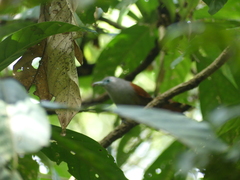

Raffles's Malkoha

Raffles's Malkoha

Rhinortha chlorophaea

Silhouette: Nicolas Huet le Jeune and Jean-Gabriel Prêtre (vectorized by T. Michael Keesey) · PhyloPic

LCLeast ConcernNTVUENCR
Daily sighting probability ~40% · Likely
at Kubah National Park

In 3 days ~80% in a week >90%

33 Verified sightings at Kubah National Park From 2019 to 2026
3,394 In all 11 parks
March Best month
☀️ Diurnal When it's spotted

About the Raffles's Malkoha

Raffles's malkoha (Rhinortha chlorophaea) is a species of cuckoo (family Cuculidae). It was formerly often placed in Phaenicophaeus with the other malkohas, but it appears to not be very closely related to the true malkohas. It exhibits several autapomorphies and sexual dimorphism (which its presumed relatives all lack).

It is found in Brunei, Indonesia, Malaysia, Myanmar, and Thailand. It was once found in Singapore but is now considered extirpated. Its natural habitat is subtropical or tropical moist lowland forests. Its diet consists of insects, including caterpillars, cicadas, crickets, beetles, and locusts.

During courtship, the male Raffles's malkoha has been observed to stand on the base of the female's outstretched wings and hold a frog in its bill. It is unclear whether the frog is a gift to the female or whether the male keeps it afterward.

Wikipedia →

Sounds

Song0:14

Malaysia · 2026

© Ding Li Yong · XC1145576 · CC BY-NC-ND 4.0

Call0:16

Malaysia · 2024

© Lim Ying Hien · XC918882 · CC BY-NC-ND 4.0

Song0:04

Thailand · 2018

© Somkiat Pakapinyo (Chai) · XC415822 · CC BY-NC-SA 4.0

Global Distribution

Parks Where Found

# Park Country Daily sighting probability
1 Khao Luang National Park 🇹🇭 Thailand
~50%
2 Way Kambas National Park 🇮🇩 Indonesia
~50%
3 Taman Negara National Park 🇲🇾 Malaysia
~50%
4 Sepilok 🇲🇾 Malaysia
~40%
5 Kubah National Park 🇲🇾 Malaysia
~40%
6 Danum Valley Conservation Area 🇲🇾 Malaysia
~30%
7 Gunung Leuser National Park 🇮🇩 Indonesia
~20%
8 Khao Sok National Park 🇹🇭 Thailand
~10%
9 Kaeng Krachan National Park 🇹🇭 Thailand
~10%
10 Kinabatangan Wildlife Sanctuary 🇲🇾 Malaysia
<5%
11 Kinabalu Park 🇲🇾 Malaysia
<5%

Cities Where Found

# City Country Daily sighting probability
1 Kuala Lumpur 🇲🇾 Malaysia
~10%

Before you go

What are the chances of seeing a Raffles's Malkoha in Kubah National Park?

Likely

About 40% of wildlife watchers report a Raffles's Malkoha sighting in Kubah National Park on a given day, based on 33 verified sightings from GBIF citizen-science data from 2019 to 2026. It is the 6th most-seen of the 92 birds we can rate there. Over three days the chance rises to about 80%, and over a week to over 90%, if each day is a fresh chance.

When is the best time to see a Raffles's Malkoha in Kubah National Park?

March, May–June and December

In those months about 50% of wildlife watchers report a Raffles's Malkoha in Kubah National Park on a given day, against about 30% in April, the lowest month. January–February, September and November have too few records to rate.

What time of day is best to see a Raffles's Malkoha?

Between 9 am and noon

Across all the parks we cover, that three-hour window holds the most Raffles's Malkoha sightings with a recorded time, and nearly all of them come between 6 am and 6 pm: it is a daytime animal.

Which relatives of the Raffles's Malkoha live in Kubah National Park?

Same family: Cuculidae

The closest relatives of the Raffles's Malkoha that you can see in Kubah National Park (family Cuculidae, Cuckoos) are Indian Cuckoo (about 30%), Plaintive Cuckoo (about 20%) and Chestnut-breasted Malkoha (about 20%), with each one's daily chance of a sighting.

Where does the Raffles's Malkoha sighting chance come from?

GBIF citizen-science records

It is estimated from how often the Raffles's Malkoha is recorded against all the birds logged in Kubah National Park (33 verified sightings from 2019 to 2026), calibrated against known sighting rates. Figures are rounded to the nearest 10% because citizen-science data supports honest approximations, not decimals, and months with records from fewer than five people show "—". How it works.

← Back to Kubah National Park