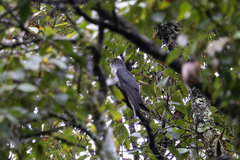
Indian Cuckoo

Indian Cuckoo

Cuculus micropterus

Silhouette: Nicolas Huet le Jeune and Jean-Gabriel Prêtre (vectorized by T. Michael Keesey) · PhyloPic

LCLeast ConcernNTVUENCR
Daily sighting probability ~30% · Possible
at Kubah National Park

In 3 days ~60% in a week ~90%

24 Verified sightings at Kubah National Park From 2019 to 2026
6,796 In all 33 parks
March Best month
☀️ Diurnal When it's spotted

About the Indian Cuckoo

The Indian cuckoo or short-winged cuckoo (Cuculus micropterus) is a member of the cuckoo order of birds, the Cuculiformes, that is found in the Indian subcontinent and Southeast Asia. It ranges from India, Bangladesh, Bhutan, Nepal and Sri Lanka east to Indonesia and north to China and Russia. It is a solitary and shy bird, found in forests and open woodland at up to 3,600 m (11,800 ft).

This is a medium-sized cuckoo with both sexes alike. It has grey upperparts while the underside has broad black barring. The tail is barred with a broad subterminal dark band and a white tip. Young birds have white markings on the crown and white chin and throat contrasting with a dark face. Juveniles are browner and have broad white tips to the head and wing feathers. The eye-ring is gray to yellow (a feature shared with the common hawk-cuckoo). The iris is light brown to reddish. The female differs from the male in being slightly paler grey on the throat and in having more brown on the breast and tail. The barring on the belly is narrower than in the male. Nestlings have an orange-red mouth and yellow flanges to the gape.

The call is loud with four notes. They have been transcribed...

Wikipedia →

Sounds

Call0:05

China · 2026

© Wang zikun · XC1138853 · CC BY-NC-SA 4.0

Flight call0:22

China · 2026

© Bo Shunqi 薄顺奇 · XC1136972 · CC BY-NC-SA 4.0

Song0:17

Malaysia · 2014

© Marc Anderson · XC1061156 · CC BY-NC-ND 4.0

Global Distribution

Parks Where Found

# Park Country Daily sighting probability
1 Kubah National Park 🇲🇾 Malaysia
~30%
2 Kanha National Park 🇮🇳 India
~30%
3 Bandhavgarh National Park 🇮🇳 India
~20%
4 Taman Negara National Park 🇲🇾 Malaysia
~20%
5 Royal Manas National Park 🇧🇹 Bhutan
~20%
6 Sepilok 🇲🇾 Malaysia
~20%
7 Wilpattu National Park 🇱🇰 Sri Lanka
~10%
8 Minneriya National Park 🇱🇰 Sri Lanka
~10%
9 Royal Bardia National Park 🇳🇵 Nepal
~10%
10 Danum Valley Conservation Area 🇲🇾 Malaysia
~10%
11 Manas National Park 🇮🇳 India
~10%
12 Kaziranga National Park 🇮🇳 India
~10%
13 Chitwan National Park 🇳🇵 Nepal
~10%
14 Jim Corbett National Park 🇮🇳 India
~10%
15 Way Kambas National Park 🇮🇩 Indonesia
~10%
16 Nagarhole National Park 🇮🇳 India
~10%
17 Cuc Phuong National Park 🇻🇳 Vietnam
<5%
18 Bandipur National Park 🇮🇳 India
<5%
19 Satpura National Park 🇮🇳 India
<5%
20 Kinabatangan Wildlife Sanctuary 🇲🇾 Malaysia
<5%
21 Cat Tien National Park 🇻🇳 Vietnam
<5%
22 Namdapha National Park 🇮🇳 India
<5%
23 Mudumalai National Park 🇮🇳 India
<5%
24 Yala National Park 🇱🇰 Sri Lanka
<5%
25 Khao Luang National Park 🇹🇭 Thailand
<5%
26 Doi Inthanon National Park 🇹🇭 Thailand
<5%
27 Kinabalu Park 🇲🇾 Malaysia
<5%
28 Sinharaja Forest Reserve 🇱🇰 Sri Lanka
<5%
29 Kaeng Krachan National Park 🇹🇭 Thailand
<5%
30 Khao Sok National Park 🇹🇭 Thailand
<5%
31 Periyar National Park 🇮🇳 India
<5%
32 Sundarbans National Park 🇮🇳 India
<5%
33 Khao Yai National Park 🇹🇭 Thailand
<5%

Cities Where Found

# City Country Daily sighting probability
1 Hefei 🇨🇳 China
~20%
2 Beijing 🇨🇳 China
~10%
3 Dhaka 🇧🇩 Bangladesh
~10%
4 Savar 🇧🇩 Bangladesh
~10%
5 Guwahati 🇮🇳 India
~10%
6 Jinan 🇨🇳 China
~10%
7 Qingdao 🇨🇳 China
~10%
8 Tuen Mun 🇨🇳 China
~10%
9 Kuala Lumpur 🇲🇾 Malaysia
~10%
10 Nanjing 🇨🇳 China
<5%

Before you go

What are the chances of seeing an Indian Cuckoo in Kubah National Park?

Possible

About 30% of wildlife watchers report an Indian Cuckoo sighting in Kubah National Park on a given day, based on 24 verified sightings from GBIF citizen-science data from 2019 to 2026. It is the 20th most-seen of the 92 birds we can rate there. Over three days the chance rises to about 60%, and over a week to about 90%, if each day is a fresh chance.

When is the best time to see an Indian Cuckoo in Kubah National Park?

March

In that month about 60% of wildlife watchers report an Indian Cuckoo in Kubah National Park on a given day, against about 10% in July and August, the lowest months. January–February, September and November have too few records to rate.

What time of day is best to see an Indian Cuckoo?

Between 7 and 10 am

Across all the parks we cover, that three-hour window holds the most Indian Cuckoo sightings with a recorded time, and about 7 in 10 of them come between 6 am and 6 pm: it is a daytime animal.

Is Kubah National Park the best place to see an Indian Cuckoo?

Yes

Of the 33 parks where we can rate Indian Cuckoo sightings, Kubah National Park has the highest daily chance: about 30%. Next come Kanha National Park (India, about 30%) and Bandhavgarh National Park (India, about 20%).

Which relatives of the Indian Cuckoo live in Kubah National Park?

Same family: Cuculidae

The closest relatives of the Indian Cuckoo that you can see in Kubah National Park (family Cuculidae, Cuckoos) are Raffles's Malkoha (about 40%), Plaintive Cuckoo (about 20%) and Chestnut-breasted Malkoha (about 20%), with each one's daily chance of a sighting.

Where does the Indian Cuckoo sighting chance come from?

GBIF citizen-science records

It is estimated from how often the Indian Cuckoo is recorded against all the birds logged in Kubah National Park (24 verified sightings from 2019 to 2026), calibrated against known sighting rates. Figures are rounded to the nearest 10% because citizen-science data supports honest approximations, not decimals, and months with records from fewer than five people show "—". How it works.

← Back to Kubah National Park