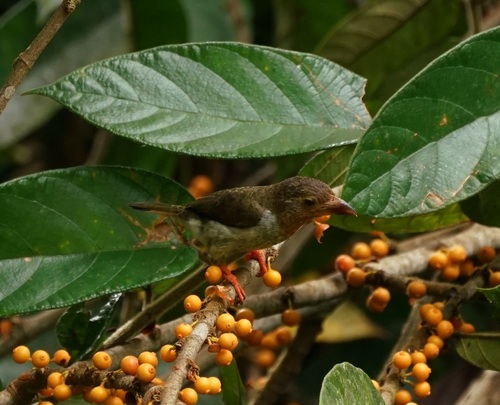

Red-throated Barbet

Red-throated Barbet

Psilopogon mystacophanos

Silhouette: Vijay Cavale (photo), John E. McCormack, Michael G. Harvey, Brant C. Faircloth, Nicholas G. Crawford, Travis C. Glenn, Robb T. Brumfield & T. Michael Keesey · PhyloPic

LCNTNear ThreatenedVUENCR
Daily sighting probability ~30% · Possible
at Kubah National Park

In 3 days ~70% in a week ~90%

27 Verified sightings at Kubah National Park From 2019 to 2026
2,465 In all 12 parks
July Best month
☀️ Diurnal When it's spotted

About the Red-throated Barbet

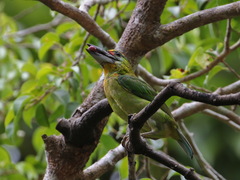
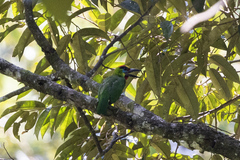
The red-throated barbet (Psilopogon mystacophanos) is a species of bird in the family Megalaimidae. It is found in Brunei, Indonesia, Malaysia, Myanmar, and Thailand. Its natural habitats are subtropical or tropical moist lowland forest and subtropical or tropical swamps.

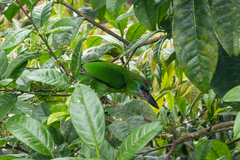
It is threatened by habitat loss. The red-throated barbet male is mainly green with a red crown, throat, and spot below the throat, as well as a black spot above each eye and a yellow crown patch. Males also have some blue near the eyes and on the lower part of the throat. The female lacks most of the male's facial coloration, but is otherwise similar. Juveniles resemble females. Adults measure 23 cm (9.1 in) in length and weigh 60–95 g (2.1–3.4 oz).

Wikipedia →

Sounds

Call0:21

Malaysia · 2015

© Marc Anderson · XC1065107 · CC BY-NC-ND 4.0

Song0:50

Malaysia · 2024

© Joost van Bruggen · XC955773 · CC BY-NC-ND 4.0

Song0:55

Malaysia · 2022

© GABRIEL LEITE · XC731243 · CC BY-NC-SA 4.0

Global Distribution

Parks Where Found

# Park Country Daily sighting probability
1 Khao Luang National Park 🇹🇭 Thailand
~70%
2 Khao Sok National Park 🇹🇭 Thailand
~30%
3 Danum Valley Conservation Area 🇲🇾 Malaysia
~30%
4 Kubah National Park 🇲🇾 Malaysia
~30%
5 Taman Negara National Park 🇲🇾 Malaysia
~30%
6 Gunung Leuser National Park 🇮🇩 Indonesia
~20%
7 Kinabatangan Wildlife Sanctuary 🇲🇾 Malaysia
~10%
8 Bako National Park 🇲🇾 Malaysia
~10%
9 Kaeng Krachan National Park 🇹🇭 Thailand
~10%
10 Kinabalu Park 🇲🇾 Malaysia
<5%
11 Kerinci Seblat National Park 🇮🇩 Indonesia
<5%
12 Sepilok 🇲🇾 Malaysia
<5%

Cities Where Found

# City Country Daily sighting probability
1 Kuching 🇲🇾 Malaysia
~10%

Before you go

What are the chances of seeing a Red-throated Barbet in Kubah National Park?

Possible

About 30% of wildlife watchers report a Red-throated Barbet sighting in Kubah National Park on a given day, based on 27 verified sightings from GBIF citizen-science data from 2019 to 2026. It is the 17th most-seen of the 92 birds we can rate there. Over three days the chance rises to about 70%, and over a week to about 90%, if each day is a fresh chance.

When is the best time to see a Red-throated Barbet in Kubah National Park?

July and December

In those months about 50% of wildlife watchers report a Red-throated Barbet in Kubah National Park on a given day, against about 20% in March, August and October, the lowest months. January–February, September and November have too few records to rate.

What time of day is best to see a Red-throated Barbet?

Between 7 and 10 am

Across all the parks we cover, that three-hour window holds the most Red-throated Barbet sightings with a recorded time, and about 9 in 10 of them come between 6 am and 6 pm: it is a daytime animal.

Which relatives of the Red-throated Barbet live in Kubah National Park?

Same genus: Psilopogon

The closest relatives of the Red-throated Barbet that you can see in Kubah National Park (genus Psilopogon, Typical Asian Barbets) are Red-crowned Barbet (about 60%), Black-eared Barbet (about 50%) and Gold-whiskered Barbet (about 30%), with each one's daily chance of a sighting.

Where does the Red-throated Barbet sighting chance come from?

GBIF citizen-science records

It is estimated from how often the Red-throated Barbet is recorded against all the birds logged in Kubah National Park (27 verified sightings from 2019 to 2026), calibrated against known sighting rates. Figures are rounded to the nearest 10% because citizen-science data supports honest approximations, not decimals, and months with records from fewer than five people show "—". How it works.

← Back to Kubah National Park