
Volcano Junco

Volcano Junco

Junco vulcani

Silhouette: L. Shyamal · PhyloPic

LCLeast ConcernNTVUENCR
Daily sighting probability <5% · Rare
at La Amistad International Park (Panama)

In 3 days <5%

78 Verified sightings at La Amistad International Park (Panama) From 2019 to 2026
2,691 In all 6 parks
September Best month
☀️ Diurnal When it's spotted

About the Volcano Junco

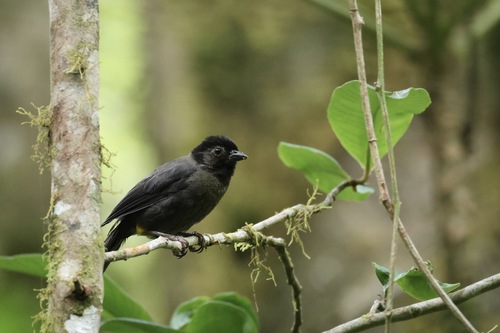
The volcano junco (Junco vulcani) is a species of bird in the family Passerellidae, the New World sparrows. It is found in Costa Rica and Panama. The volcano junco was formally described in 1878 with the binomial Zonotrichia vulcani. It was eventually reassigned to its present genus Junco that had been erected in 1831.

The volcano junco is monotypic. Though a 1970 publication considered it, the dark-eyed junco (J. hyemalis), and the yellow-eyed junco (J. phaenotus) to be sister species, evaluations in the early 2000s showed that it is basal to the genus and not closely related to the other Junco species.

The volcano junco is about 16 cm (6.3 in) long and weighs about 28 g (0.99 oz). The sexes have the same plumage. Adults have a grayish olive crown and nape, sometimes with dusky streaks. They have black lores and a black or slate black "mask" around the eye. The rest of their head and neck are pale gray with an olive tinge on the ear coverts. Their upperparts are buffy brown with black streaks. Their wings are dusky with thin to somewhat wider buffy brown feather edges. Their tail is dusky with thin gray feather edges and pale gray tips... Wikipedia →

Sounds

Call0:56

Costa Rica · 2019

© Hans Matheve · XC518721 · CC BY-NC-ND 4.0

Song0:38

Costa Rica · 2011

© Andrew Spencer · XC71680 · CC BY-NC-ND 2.5

Call0:17

Costa Rica · 2010

© Scott Olmstead · XC45142 · CC BY-NC-ND 2.5

Global Distribution

Parks Where Found

# Park Country Daily sighting probability
1 Irazú Volcano National Park 🇨🇷 Costa Rica
~50%
2 Tapantí-Macizo de la Muerte National Park 🇨🇷 Costa Rica
~10%
3 Chirripó National Park 🇨🇷 Costa Rica
<5%
4 Volcán Barú National Park 🇵🇦 Panama
<5%
5 Los Quetzales National Park 🇨🇷 Costa Rica
<5%
6 La Amistad International Park (Panama) 🇵🇦 Panama
<5%

Before you go

What are the chances of seeing a Volcano Junco in La Amistad International Park (Panama)?

Rare

Under 5% of wildlife watchers report a Volcano Junco sighting in La Amistad International Park (Panama) on a given day, based on 78 verified sightings from GBIF citizen-science data from 2019 to 2026. It is the 522nd most-seen of the 657 birds we can rate there. Over three days the chance rises to under 5%, if each day is a fresh chance.

When is the best time to see a Volcano Junco in La Amistad International Park (Panama)?

Any time of year

In every month with enough records, under 5% of wildlife watchers report a Volcano Junco in La Amistad International Park (Panama) on a given day, so our monthly data shows no clear season.

What time of day is best to see a Volcano Junco?

Between 9 am and noon

Across all the parks we cover, that three-hour window holds the most Volcano Junco sightings with a recorded time, and about 9 in 10 of them come between 6 am and 6 pm: it is a daytime animal.

Which relatives of the Volcano Junco live in La Amistad International Park (Panama)?

Same family: Passerellidae

The closest relatives of the Volcano Junco that you can see in La Amistad International Park (Panama) (family Passerellidae, New World Sparrows) are Rufous-collared Sparrow (about 30%), Common Chlorospingus (about 20%) and Black-striped Sparrow (about 20%), with each one's daily chance of a sighting.

Where does the Volcano Junco sighting chance come from?

GBIF citizen-science records

It is estimated from how often the Volcano Junco is recorded against all the birds logged in La Amistad International Park (Panama) (78 verified sightings from 2019 to 2026), calibrated against known sighting rates. Figures are rounded to the nearest 10% because citizen-science data supports honest approximations, not decimals, and months with records from fewer than five people show "—". How it works.

← Back to La Amistad International Park (Panama)