
Fischer's Lovebird

Fischer's Lovebird

Agapornis fischeri

Silhouette: Hugo Gruson · PhyloPic

LCNTNear ThreatenedVUENCR
Daily sighting probability ~10% · With luck
at Lake Manyara National Park

In 3 days ~30% in a week ~50%

47 Verified sightings at Lake Manyara National Park From 2019 to 2026
2,511 In all 6 parks
December Best month
☀️ Diurnal When it's spotted

About the Fischer's Lovebird

Fischer's lovebird (Agapornis fischeri) is a small parrot species of the genus Agapornis. They were originally discovered in the late 19th century. They are named after the 19th century German explorer of East Africa Gustav Fischer.

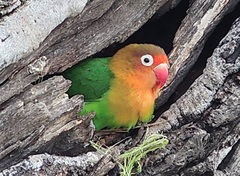
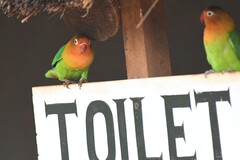
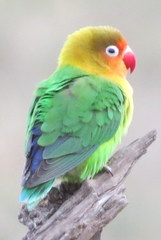
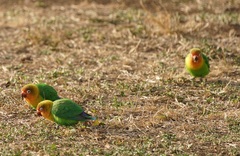
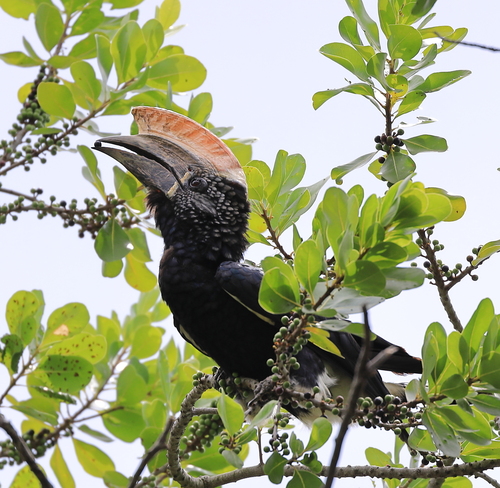
The Fischer's lovebird has a green back, chest, and wings. Their necks are a golden yellow and as it progresses upward it becomes darker orange. The top of the head is olive green, and the beak is bright red. The upper surface of the tail has some purple or blue feathers. It has a white circle of bare skin (eye-ring) around its eyes. Young birds are very similar to the adults, except for the fact that they are duller and the base of their mandible has brown markings. They are one of the smaller lovebirds, about 14 cm (5.5 in) in length and 43-58g weight.

While most Fischer's lovebirds are green, several color variations have been bred. The blue variation is predominant; lacking yellow, it has a bright blue back, tail, and chest, a white neck, a pale grey head and a pale pink beak. This mutation was first bred by R. Horsham in South Africa in 1957. There is a yellow lutino mutation, which first appeared in France. These birds are typically... Wikipedia →

Sounds

Call0:33

Kenya · 2024

© Peter Boesman · XC947900 · CC BY-NC-ND 4.0

Flight call0:14

Portugal · 2023

© Nelson Conceição · XC798772 · CC BY-NC-SA 4.0

Alarm call0:08

Kenya · 2020

© isaac kilusu · XC593238 · CC BY-NC-SA 4.0

Global Distribution

Parks Where Found

# Park Country Daily sighting probability
1 Serengeti National Park 🇹🇿 Tanzania
~40%
2 Ngorongoro Conservation Area 🇹🇿 Tanzania
~20%
3 Amboseli National Park 🇰🇪 Kenya
~10%
4 Lake Manyara National Park 🇹🇿 Tanzania
~10%
5 Tarangire National Park 🇹🇿 Tanzania
~10%
6 Arusha National Park 🇹🇿 Tanzania
<5%

Cities Where Found

# City Country Daily sighting probability
1 Los Angeles 🇺🇸 United States
<5%

Zoos & Centres Where Found

# Zoo / Centre Country
1 Ragunan Zoo 🇮🇩 Indonesia In captivity
2 San Diego Zoo 🇺🇸 United States In captivity
3 Taman Safari Bali (Bali Safari) 🇮🇩 Indonesia In captivity
4 Parc des oiseaux 🇫🇷 France In captivity
5 Zoo Miami 🇺🇸 United States In captivity
6 Kragga Kamma Game Park 🇿🇦 South Africa In captivity
7 Assam State Zoo cum Botanical Garden 🇮🇳 India In captivity
8 Taipei Zoo 🇹🇼 Taiwan In captivity
9 Safari West 🇺🇸 United States In captivity
10 Jallo Park 🇵🇰 Pakistan In captivity
11 Bronx Zoo 🇺🇸 United States In captivity
12 Parc du Belvédère 🇹🇳 Tunisia In captivity
13 Kadoorie Farm and Botanic Garden 🇭🇰 Hong Kong SAR China In captivity
14 Badoca Safari Park 🇵🇹 Portugal In captivity
15 Nakhon Ratchasima Zoo 🇹🇭 Thailand In captivity
16 Ecological Center of Sonora 🇲🇽 Mexico In captivity
17 Doha Zoo 🇶🇦 Qatar In captivity
18 Shenzhen Safari Park 🇨🇳 China In captivity
19 Parque y Zoológico Nacional Arquitecto Manuel Valverde Podestá 🇩🇴 Dominican Republic In captivity
20 Nanjing Hongshan Forest Zoo 🇨🇳 China In captivity
21 Oakland Zoo 🇺🇸 United States In captivity
22 National Zoological Garden of South Africa 🇿🇦 South Africa In captivity
23 Toledo Zoo 🇺🇸 United States In captivity
24 南昌新动物园 🇨🇳 China In captivity
25 Guadalajara Zoo 🇲🇽 Mexico In captivity
26 Zoológico de San Juan de Aragón 🇲🇽 Mexico In captivity
27 Ukumarí Biopark 🇨🇴 Colombia In captivity
28 Bannerghatta Zoo 🇮🇳 India In captivity
29 Carmel Hai-Bar Nature Reserve 🇮🇱 Israel In captivity
30 Natur- und Tierpark Goldau 🇨🇭 Switzerland In captivity
31 Zoológico la pastroa 🇲🇽 Mexico In captivity
32 Almaty Zoo 🇰🇿 Kazakhstan In captivity
33 Ninoy Aquino Parks & Wildlife Center 🇵🇭 Philippines In captivity
34 Dudley Zoo 🇬🇧 United Kingdom In captivity
35 Gembira Loka Zoo 🇮🇩 Indonesia In captivity
36 Zoo Dortmund 🇩🇪 Germany In captivity
37 Soğanlı Zoo 🇹🇷 Türkiye In captivity
38 Surabaya Zoo 🇮🇩 Indonesia In captivity
39 Bandung Zoo 🇮🇩 Indonesia In captivity
40 El Paso Zoo 🇺🇸 United States In captivity
41 Wildpark Schwentinental 🇩🇪 Germany In captivity
42 Lincoln Park Zoo 🇺🇸 United States In captivity
43 Parc zoologique de Fréjus 🇫🇷 France In captivity
44 Rio de Janeiro Zoological Garden 🇧🇷 Brazil In captivity
45 Giraffe Centre 🇰🇪 Kenya In captivity
46 Seville Zoo 🇪🇸 Spain In captivity
47 Zoológico Los Coyotes 🇲🇽 Mexico In captivity
48 Northumberland Zoo 🇬🇧 United Kingdom In captivity
49 Sayaji Baug Zoo 🇮🇳 India In captivity
50 Skopje Zoo 🇲🇰 North Macedonia In captivity

Before you go

What are the chances of seeing a Fischer's Lovebird in Lake Manyara National Park?

With luck

About 10% of wildlife watchers report a Fischer's Lovebird sighting in Lake Manyara National Park on a given day, based on 47 verified sightings from GBIF citizen-science data from 2019 to 2026. It is the 123rd most-seen of the 307 birds we can rate there. Over three days the chance rises to about 30%, and over a week to about 50%, if each day is a fresh chance.

When is the best time to see a Fischer's Lovebird in Lake Manyara National Park?

April–May and December

In those months about 20% of wildlife watchers report a Fischer's Lovebird in Lake Manyara National Park on a given day, against under 5% in February, June and October, the lowest months. Those are among Lake Manyara National Park's wettest months, with about 160 mm of rain a month against 15 mm in September.

What time of day is best to see a Fischer's Lovebird?

Between 7 and 10 am

Across all the parks we cover, that three-hour window holds the most Fischer's Lovebird sightings with a recorded time, and about 9 in 10 of them come between 6 am and 6 pm: it is a daytime animal.

Where does the Fischer's Lovebird sighting chance come from?

GBIF citizen-science records

It is estimated from how often the Fischer's Lovebird is recorded against all the birds logged in Lake Manyara National Park (47 verified sightings from 2019 to 2026), calibrated against known sighting rates. Figures are rounded to the nearest 10% because citizen-science data supports honest approximations, not decimals, and months with records from fewer than five people show "—". How it works.

← Back to Lake Manyara National Park