Red-and-yellow Barbet

Red-and-yellow Barbet

Trachyphonus erythrocephalus

Silhouette: PhyloPic

LCLeast ConcernNTVUENCR
Daily sighting probability ~30% · Possible
at Lake Manyara National Park

In 3 days ~60% in a week ~90%

141 Verified sightings at Lake Manyara National Park From 2019 to 2026
1,843 In all 13 parks
April Best month
☀️ Diurnal When it's spotted

About the Red-and-yellow Barbet

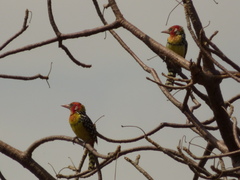
The red-and-yellow barbet (Trachyphonus erythrocephalus) is a species of African barbet found in eastern Africa. Males have distinctive black (spotted white), red, and yellow plumage; females and juveniles are similar, but less brightly colored. The species lives in broken terrain and nests and roosts in burrows. Omnivorous, the species feeds on seeds, fruit, and invertebrates. Where not hunted, they are tame, but their feathers are used by certain tribes, such as the Maasai.

Red-and-yellow barbet adult males have distinctive plumage made up black with spotted white, red and yellow. It has a black forehead and crown with a slight crest. The nape is orange and red with black spots. The side of the neck is red, going into yellow. The back is mostly black with white spots. The tail is a blackish brown with up to eight cream spots forming bars. The under side of the tail is yellow with black bars. The chin and throat are yellow, and there is a black patch at the centre of the throat. The throat is bordered by areas with more orange areas. The breast is orange to red-orange, becoming more yellow at the sides, with a dark band with white spots crossing through the middle... Wikipedia →

Sounds

Song1:21

Kenya · 2024

© Peter Boesman · XC948520 · CC BY-NC-ND 4.0

Duet0:14

Tanzania · 2023

© isaac kilusu · XC774799 · CC BY-NC-SA 4.0

Call0:08

Ethiopia · 2015

© Andrew Spencer · XC244604 · CC BY-NC-SA 4.0

Global Distribution

Parks Where Found

# Park Country Daily sighting probability
1 Tarangire National Park 🇹🇿 Tanzania
~50%
2 Mkomazi National Park 🇹🇿 Tanzania
~50%
3 Samburu National Reserve 🇰🇪 Kenya
~30%
4 Lake Manyara National Park 🇹🇿 Tanzania
~30%
5 Tsavo East National Park 🇰🇪 Kenya
~20%
6 Meru National Park 🇰🇪 Kenya
~20%
7 Tsavo West National Park 🇰🇪 Kenya
~20%
8 Kidepo Valley National Park 🇺🇬 Uganda
~10%
9 Amboseli National Park 🇰🇪 Kenya
<5%
10 Ngorongoro Conservation Area 🇹🇿 Tanzania
<5%
11 Serengeti National Park 🇹🇿 Tanzania
<5%
12 Arusha National Park 🇹🇿 Tanzania
<5%
13 Nairobi National Park 🇰🇪 Kenya
<5%

Zoos & Centres Where Found

# Zoo / Centre Country
1 Disney's Animal Kingdom 🇺🇸 United States In captivity
2 San Diego Zoo 🇺🇸 United States In captivity
3 Pairi Daiza 🇧🇪 Belgium In captivity
4 Basel Zoo 🇨🇭 Switzerland In captivity
5 Barcelona Zoo 🇪🇸 Spain In captivity
6 North Carolina Zoo 🇺🇸 United States In captivity
7 Walsrode World Bird Park 🇩🇪 Germany In captivity
8 Parc des oiseaux 🇫🇷 France In captivity
9 Saint Louis Zoo 🇺🇸 United States In captivity
10 Caldwell Zoo 🇺🇸 United States In captivity
11 Moody Gardens 🇺🇸 United States In captivity
12 Franklin Park Zoo 🇺🇸 United States In captivity
13 Fort Worth Zoo 🇺🇸 United States In captivity
14 Memphis Zoo 🇺🇸 United States In captivity
15 San Antonio Zoo 🇺🇸 United States In captivity
16 Zoo Atlanta 🇺🇸 United States In captivity
17 Attica Zoological Park 🇬🇷 Greece In captivity
18 London Zoo 🇬🇧 United Kingdom In captivity
19 Ueno Zoo 🇯🇵 Japan In captivity
20 Aquarama Barcelona 🇪🇸 Spain In captivity
21 Reserva Zoológica Oasys MiniHollywood 🇪🇸 Spain In captivity
22 Kuala Lumpur Bird Park 🇲🇾 Malaysia In captivity
23 Henry Vilas Zoo 🇺🇸 United States In captivity
24 Reid Park Zoo 🇺🇸 United States In captivity
25 Central Park Zoo 🇺🇸 United States In captivity
26 Ardastra Gardens, Zoo and Conservation Centre 🇧🇸 Bahamas In captivity
27 Vogelpark Heiligenkirchen 🇩🇪 Germany In captivity
28 Zoologischer Garten Hof 🇩🇪 Germany In captivity
29 El Jardí dels Ocells 🇪🇸 Spain In captivity
30 The Green Planet 🇦🇪 United Arab Emirates In captivity

Before you go

What are the chances of seeing a Red-and-yellow Barbet in Lake Manyara National Park?

Possible

About 30% of wildlife watchers report a Red-and-yellow Barbet sighting in Lake Manyara National Park on a given day, based on 141 verified sightings from GBIF citizen-science data from 2019 to 2026. It is the 31st most-seen of the 307 birds we can rate there. Over three days the chance rises to about 60%, and over a week to about 90%, if each day is a fresh chance.

When is the best time to see a Red-and-yellow Barbet in Lake Manyara National Park?

April

In that month about 60% of wildlife watchers report a Red-and-yellow Barbet in Lake Manyara National Park on a given day, against about 20% in February–March and May, the lowest months. That is one of Lake Manyara National Park's wettest months, with about 260 mm of rain against 15 mm in September.

What time of day is best to see a Red-and-yellow Barbet?

Between 9 am and noon

Across all the parks we cover, that three-hour window holds the most Red-and-yellow Barbet sightings with a recorded time, and about 8 in 10 of them come between 6 am and 6 pm: it is a daytime animal.

Where does the Red-and-yellow Barbet sighting chance come from?

GBIF citizen-science records

It is estimated from how often the Red-and-yellow Barbet is recorded against all the birds logged in Lake Manyara National Park (141 verified sightings from 2019 to 2026), calibrated against known sighting rates. Figures are rounded to the nearest 10% because citizen-science data supports honest approximations, not decimals, and months with records from fewer than five people show "—". How it works.

← Back to Lake Manyara National Park