
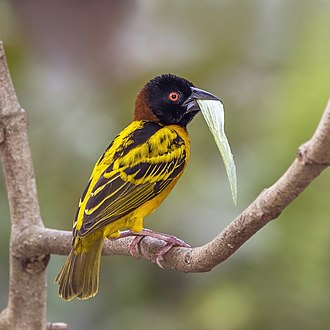
African Thrush

African Thrush

Turdus pelios

Silhouette: Sharon Wegner-Larsen · PhyloPic

LCLeast ConcernNTVUENCR
Daily sighting probability ~20% · Possible
at Lake Mburo National Park

In 3 days ~60% in a week ~90%

283 Verified sightings at Lake Mburo National Park From 2019 to 2026
2,532 In all 14 parks
July Best month
☀️ Diurnal When it's spotted

About the African Thrush

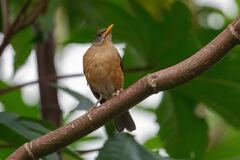
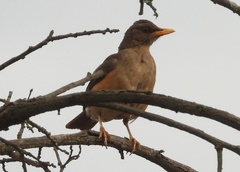
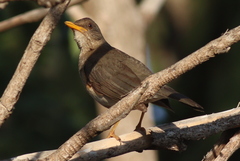
The African thrush or West African thrush (Turdus pelios) is a passerine bird in the thrush family Turdidae. It is common in well-wooded areas over much of the western part of sub-Saharan Africa, it was once considered to be conspecific with the olive thrush but that species has now been split further. Populations are resident (non-migratory).

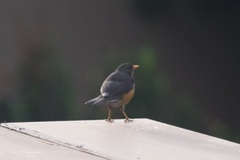
The African Thrush has dark olive-grey upperparts. The underparts show a whitish evenly brown- streaked side throat, the breast is greyish brown and the flanks are pale buff-orange with this colour not extending on to the lower breast, the belly and vent are white. It has a yellow-orange bill. It weighs 46–78 g (1.6–2.8 oz) and measures 21–23 cm (8.3–9.1 in) in length.

The song of the African thrush is a sustained, clear warbling made up of different phrases repeated rather randomly in a sequence. Also a high-pitched squealing flight call. The African thrush is distributed from Senegal and Gambia in the west to South Sudan, Uganda, Ethiopia and Eritrea south to northwestern Zambia and western Angola.

The African thrush can be found in all sorts of wooded habitats including forest... Wikipedia →

Sounds

Song0:27

Ethiopia · 2026

© Kiros Welegrima · XC1105610 · CC BY-NC-SA 4.0

Uncertain0:17

Gabon · 2021

© BurBenj · XC671679 · CC BY-NC-SA 4.0

Call0:25

Zambia · 2019

© Peter Boesman · XC509172 · CC BY-NC-ND 4.0

Global Distribution

Parks Where Found

# Park Country Daily sighting probability
1 Kibale National Park 🇺🇬 Uganda
~40%
2 Akagera National Park 🇷🇼 Rwanda
~30%
3 Semuliki National Park 🇺🇬 Uganda
~30%
4 Lake Mburo National Park 🇺🇬 Uganda
~20%
5 Volcanoes National Park 🇷🇼 Rwanda
~20%
6 Queen Elizabeth National Park 🇺🇬 Uganda
~20%
7 Lake Nakuru National Park 🇰🇪 Kenya
~20%
8 Bwindi Impenetrable National Park 🇺🇬 Uganda
~10%
9 Murchison Falls National Park 🇺🇬 Uganda
~10%
10 Virunga National Park 🇨🇩 Democratic Republic of the Congo
~10%
11 Nyungwe National Park 🇷🇼 Rwanda
~10%
12 Niokolo-Koba National Park 🇸🇳 Senegal
<5%
13 Bale Mountains National Park 🇪🇹 Ethiopia
<5%
14 Kidepo Valley National Park 🇺🇬 Uganda
<5%

Cities Where Found

# City Country Daily sighting probability
1 Abuja 🇳🇬 Nigeria
~90%
2 Ouagadougou 🇧🇫 Burkina Faso
~80%
3 Brazzaville 🇨🇬 Republic of the Congo
~70%
4 Kampala 🇺🇬 Uganda
~70%
5 Accra 🇬🇭 Ghana
~50%
6 Yaoundé 🇨🇲 Cameroon
~50%
7 Bujumbura 🇧🇮 Burundi
~50%
8 Kigali 🇷🇼 Rwanda
~50%
9 Maiduguri 🇳🇬 Nigeria
~50%
10 Lagos 🇳🇬 Nigeria
~40%

Before you go

What are the chances of seeing an African Thrush in Lake Mburo National Park?

Possible

About 20% of wildlife watchers report an African Thrush sighting in Lake Mburo National Park on a given day, based on 283 verified sightings from GBIF citizen-science data from 2019 to 2026. It is the 65th most-seen of the 362 birds we can rate there. Over three days the chance rises to about 60%, and over a week to about 90%, if each day is a fresh chance.

When is the best time to see an African Thrush in Lake Mburo National Park?

March–April and July–September

In those months about 30% of wildlife watchers report an African Thrush in Lake Mburo National Park on a given day, against about 10% in June and November, the lowest months.

What time of day is best to see an African Thrush?

Between 7 and 10 am

Across all the parks we cover, that three-hour window holds the most African Thrush sightings with a recorded time, and about 9 in 10 of them come between 6 am and 6 pm: it is a daytime animal.

Is Lake Mburo National Park the best place to see an African Thrush?

4th of 14

Of the 14 parks where we can rate African Thrush sightings, Lake Mburo National Park ranks 4th at about 20%. The best odds are in Kibale National Park (Uganda, about 40%), Akagera National Park (Rwanda, about 30%) and Semuliki National Park (Uganda, about 30%).

Which relatives of the African Thrush live in Lake Mburo National Park?

Same order: Passeriformes

The closest relatives of the African Thrush that you can see in Lake Mburo National Park (order Passeriformes, Perching Birds) are Rüppell's Glossy-starling (about 80%), Trilling Cisticola (about 60%) and Common Bulbul (about 60%), with each one's daily chance of a sighting.

Where does the African Thrush sighting chance come from?

GBIF citizen-science records

It is estimated from how often the African Thrush is recorded against all the birds logged in Lake Mburo National Park (283 verified sightings from 2019 to 2026), calibrated against known sighting rates. Figures are rounded to the nearest 10% because citizen-science data supports honest approximations, not decimals, and months with records from fewer than five people show "—". How it works.

← Back to Lake Mburo National Park