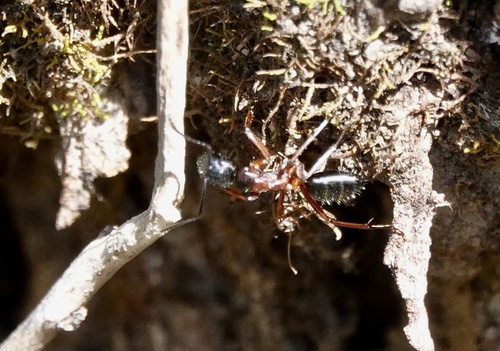
Daily sighting probability ~10% · With luck
at Lamington National Park

In 3 days ~20% in a week ~40%

6 Verified sightings at Lamington National Park From 2019 to 2026
29 In all 3 parks
March Best month
☀️ Diurnal When it's spotted

About the Amegilla cingulata

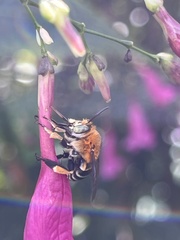
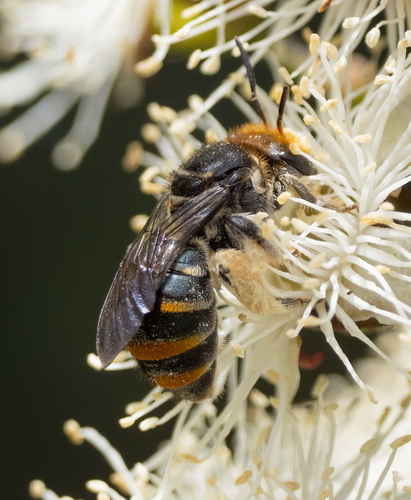
Amegilla cingulata is a species of blue-banded bee native to Australia. Currently, several scientific organizations are conducting research on how A. cingulata benefits agriculture through its distinctive "buzz pollination".

A. cingulata was first described by Danish entomologist Johan Christian Fabricius in 1775. Its specific epithet cingulata is from the Latin word cingulum ("belt") referring to the bee's bands. The genus Amegilla contains over 250 additional species, but several are virtually indistinguishable from A. cingulata, so they are commonly confused with it.

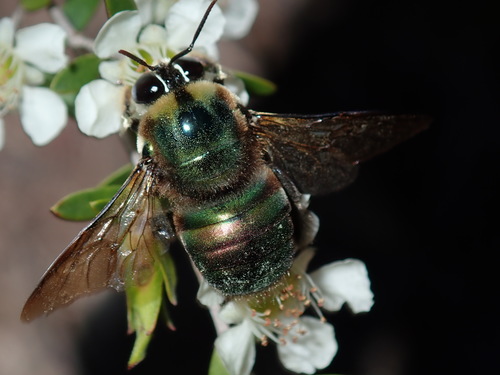
A. cingulata has a very striking appearance similar to several other species of Amegilla. Unlike honey bees, it has pale opalescent blue stripes on its abdomen. The male can be distinguished by the number of complete bands, having five as opposed to the females' four. In size, A. cingulata can grow to 10–12 mm (0.39–0.47 in).

A. cingulata is found along the coast and inland in New South Wales, Queensland, Victoria and the Australian Capital Territory, as well as South Australia and Western Australia; reports of this species from places such as Papua New... Wikipedia →

Global Distribution

Parks Where Found

# Park Country Daily sighting probability
1 Springbrook National Park 🇦🇺 Australia
~10%
2 Daintree National Park 🇦🇺 Australia
~10%
3 Lamington National Park 🇦🇺 Australia
~10%

Cities Where Found

# City Country Daily sighting probability
1 Brisbane 🇦🇺 Australia
~10%

Before you go

What are the chances of seeing an Amegilla cingulata in Lamington National Park?

With luck

About 10% of wildlife watchers report an Amegilla cingulata sighting in Lamington National Park on a given day, based on 6 verified sightings from GBIF citizen-science data from 2019 to 2026. It is the 308th most-seen of the 430 insects we can rate there. Over three days the chance rises to about 20%, and over a week to about 40%, if each day is a fresh chance.

When is the best time to see an Amegilla cingulata in Lamington National Park?

March

In that month about 20% of wildlife watchers report an Amegilla cingulata in Lamington National Park on a given day, against under 5% in January and June–November, the lowest months. That is one of Lamington National Park's wettest months, with about 150 mm of rain against 40 mm in August.

What time of day is best to see an Amegilla cingulata?

Between 9 am and noon

Across all the parks we cover, that three-hour window holds the most Amegilla cingulata sightings with a recorded time, and about 8 in 10 of them come between 6 am and 6 pm: it is a daytime animal.

Is Lamington National Park the best place to see an Amegilla cingulata?

Among the best

Of the 3 parks where we can rate Amegilla cingulata sightings, Lamington National Park ranks 3rd at about 10%, level with the leaders once rounded. The best odds are in Springbrook National Park (Australia, about 10%) and Daintree National Park (Australia, about 10%).

Where does the Amegilla cingulata sighting chance come from?

GBIF citizen-science records

It is estimated from how often the Amegilla cingulata is recorded against all the insects logged in Lamington National Park (6 verified sightings from 2019 to 2026), calibrated against known sighting rates. Figures are rounded to the nearest 10% because citizen-science data supports honest approximations, not decimals, and months with records from fewer than five people show "—". How it works.

← Back to Lamington National Park