Peacock Carpenter Bee

Peacock Carpenter Bee

Xylocopa bombylans

Daily sighting probability ~10% · With luck
at Lamington National Park

In 3 days ~20% in a week ~40%

7 Verified sightings at Lamington National Park From 2019 to 2026
17 In all 3 parks
October Best month
☀️ Diurnal When it's spotted

About the Peacock Carpenter Bee

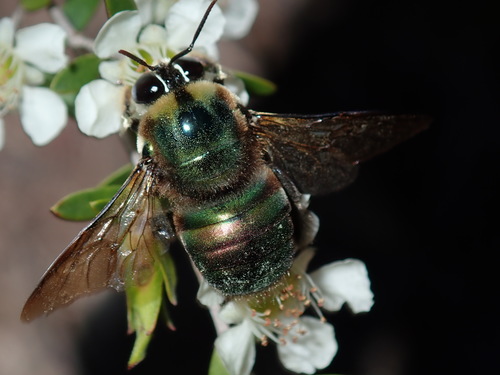
Xylocopa bombylans, the peacock carpenter bee, is a species of carpenter bee found in Australia. It gets its common name by its habit of burrowing into wood. It was originally described by Danish naturalist Johan Christian Fabricius in 1775. Its specific epithet is the Latin bombylans "like a bumblebee". The generic name is derived from the Ancient Greek (Ancient Greek: ξυλοκόπος, romanized: ksulokópos) "wood-cutter".

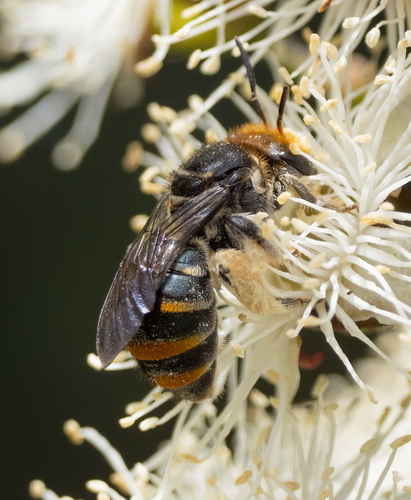
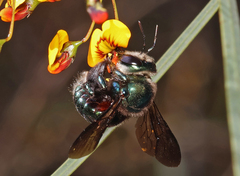
As its name implies, the peacock carpenter bee is a metallic blue-green or green in colour, although it may even appear purplish from some angles. A large stocky bee, it is often heard by its loud low-pitched buzzing while flying between flowers. The male has white face markings. The bee does have a sting which is potentially painful, although no stings have been recorded.

The natural distribution is from the Cape York Peninsula in north Queensland south along the eastern seaboard to the Sydney region (where it overlaps with X. aerata). They can be seen from spring to autumn, commonly feeding at pea flowers of the family Fabaceae, such as Gompholobium species, including Gompholobium latifolium in spring, and Pultenaea elliptica in autumn. It is a pollinator of Melastoma affine. Other flowers visited include those of Banksia, Xanthorrhoea, Hardenbergia violacea, Tristania, Leptospermum, Aotus, Cassia and Leucopogon.

The Peacock carpenter bee nests by hollowing out stalks of grasstrees (Xanthorrhoea), or soft wood such as Banksia, Casuarina, Melaleuca and Leptospermum. The female excavates a tunnel with her jaws and picks up and dumps the wood shavings outside. The hollow can reach 30 centimetres (12 in) long by 11–14 millimetres (0.43–0.55 in) in diameter. Larger pieces of wood may allow for multiple tunnels. Several female bees may use a nest, one breeding and the others guarding. A bee defends the 7–10-millimetre (0.3–0.4 in) wide entrance by blocking it with its abdomen (compare Allodapula). Both male and female bees may overwinter within the tunnels. The tunnels are partitioned into several cells, where the mother bee lays an egg in each accompanied by provisions of nectar and pollen. Wikipedia →
Global Distribution

Parks Where Found

# Park Country Daily sighting probability
1 Lamington National Park 🇦🇺 Australia
~10%
2 Daintree National Park 🇦🇺 Australia
~10%
3 Blue Mountains National Park 🇦🇺 Australia
<5%

Cities Where Found

# City Country Daily sighting probability
1 Sydney 🇦🇺 Australia
<5%
2 Brisbane 🇦🇺 Australia
<5%

Before you go

What are the chances of seeing a Peacock Carpenter Bee in Lamington National Park?

With luck

About 10% of wildlife watchers report a Peacock Carpenter Bee sighting in Lamington National Park on a given day, based on 7 verified sightings from GBIF citizen-science data from 2019 to 2026. It is the 308th most-seen of the 430 insects we can rate there. Over three days the chance rises to about 20%, and over a week to about 40%, if each day is a fresh chance.

When is the best time to see a Peacock Carpenter Bee in Lamington National Park?

October

In that month about 20% of wildlife watchers report a Peacock Carpenter Bee in Lamington National Park on a given day, against under 5% in November to July, the lowest months.

What time of day is best to see a Peacock Carpenter Bee?

Between 9 am and noon

Across all the parks we cover, that three-hour window holds the most Peacock Carpenter Bee sightings with a recorded time, and nearly all of them come between 6 am and 6 pm: it is a daytime animal.

Is Lamington National Park the best place to see a Peacock Carpenter Bee?

Yes

Of the 3 parks where we can rate Peacock Carpenter Bee sightings, Lamington National Park has the highest daily chance: about 10%. Next come Daintree National Park (Australia, about 10%) and Blue Mountains National Park (Australia, under 5%).

Where does the Peacock Carpenter Bee sighting chance come from?

GBIF citizen-science records

It is estimated from how often the Peacock Carpenter Bee is recorded against all the insects logged in Lamington National Park (7 verified sightings from 2019 to 2026), calibrated against known sighting rates. Figures are rounded to the nearest 10% because citizen-science data supports honest approximations, not decimals, and months with records from fewer than five people show "—". How it works.

← Back to Lamington National Park