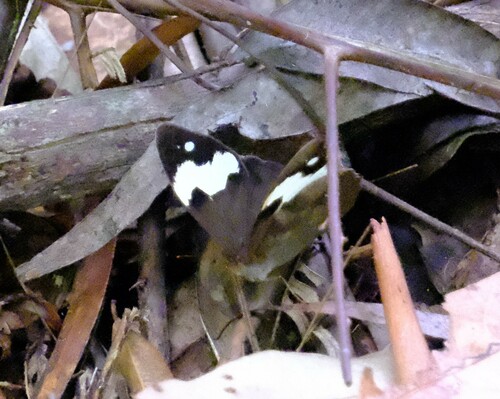
Pale Brown Hawkmoth

Pale Brown Hawkmoth

Theretra latreillii

Daily sighting probability ~10% · With luck
at Lamington National Park

In 3 days ~30% in a week ~50%

10 Verified sightings at Lamington National Park From 2019 to 2026
68 In all 5 parks
March Best month
☀️🌙 Day & Night When it's spotted

About the Pale Brown Hawkmoth

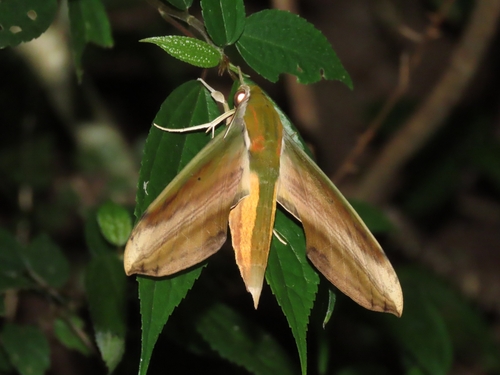
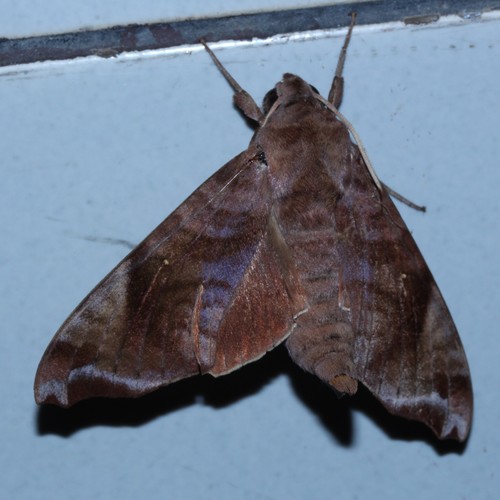
Theretra latreillii, the pale brown hawk moth, is a moth of the family Sphingidae described by William Sharp Macleay in 1826. It is found in most of Asia, including Borneo, China, Hong Kong, the Philippines, Taiwan and also throughout the tropical and temperate regions of Australia.

The adult grows to a length of about 70 millimetres (2.8 in). The body is ochreous brown. Antennae, head front and sides of thorax are paler. Forewing with a black speck at end of cell. There are two oblique indistinct lines from near the apex to near base of inner margin. Three similar lines running from the apex nearly parallel to outer margin. Hindwing is smoky black with paler towards anal angle. Ventral side is with a slight rosy tinge.

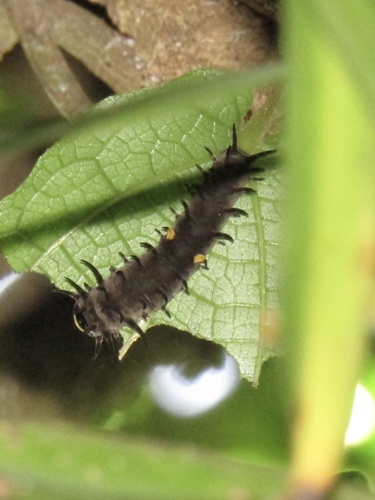
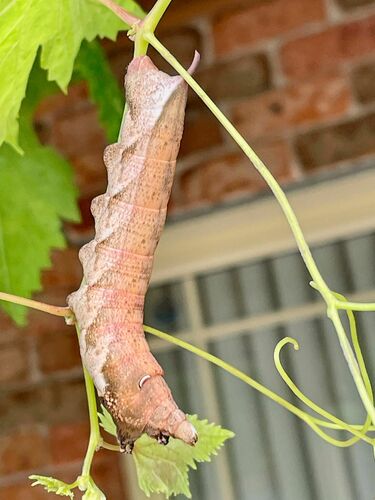
Larva is brown with darker specks. A pale lateral line runs on thoracic somites. Ocellus on 4th somite is whitish, centered with a black ring on an ochreous ground. Larvae have been recorded on Parthenocissus quinquefolia, Cayratia clematidea, Cayratia corniculata, Impatiens walleriana, Leea indica, Lagerstroemia indica... Wikipedia →
Global Distribution

Parks Where Found

# Park Country Daily sighting probability
1 Daintree National Park 🇦🇺 Australia
~20%
2 Lamington National Park 🇦🇺 Australia
~10%
3 Springbrook National Park 🇦🇺 Australia
~10%
4 Royal National Park 🇦🇺 Australia
~10%
5 Blue Mountains National Park 🇦🇺 Australia
~10%

Cities Where Found

# City Country Daily sighting probability
1 Brisbane 🇦🇺 Australia
~10%
2 Sydney 🇦🇺 Australia
~10%

Before you go

What are the chances of seeing a Pale Brown Hawkmoth in Lamington National Park?

With luck

About 10% of wildlife watchers report a Pale Brown Hawkmoth sighting in Lamington National Park on a given day, based on 10 verified sightings from GBIF citizen-science data from 2019 to 2026. It is the 179th most-seen of the 430 insects we can rate there. Over three days the chance rises to about 30%, and over a week to about 50%, if each day is a fresh chance.

When is the best time to see a Pale Brown Hawkmoth in Lamington National Park?

February and March

In those months about 20% of wildlife watchers report a Pale Brown Hawkmoth in Lamington National Park on a given day, against under 5% in May–September and December, the lowest months. Those are among Lamington National Park's wettest months, with about 160 mm of rain a month against 40 mm in August.

What time of day is best to see a Pale Brown Hawkmoth?

Between 7 and 10 pm

Across all the parks we cover, that three-hour window holds the most Pale Brown Hawkmoth sightings with a recorded time, and about 7 in 10 of them come between 6 pm and 6 am: it is seen both by day and at night.

Is Lamington National Park the best place to see a Pale Brown Hawkmoth?

2nd of 5

Of the 5 parks where we can rate Pale Brown Hawkmoth sightings, Lamington National Park ranks 2nd at about 10%. The best odds are in Daintree National Park (Australia, about 20%).

Where does the Pale Brown Hawkmoth sighting chance come from?

GBIF citizen-science records

It is estimated from how often the Pale Brown Hawkmoth is recorded against all the insects logged in Lamington National Park (10 verified sightings from 2019 to 2026), calibrated against known sighting rates. Figures are rounded to the nearest 10% because citizen-science data supports honest approximations, not decimals, and months with records from fewer than five people show "—". How it works.

← Back to Lamington National Park