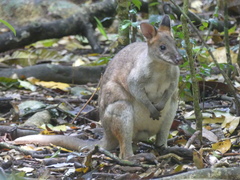
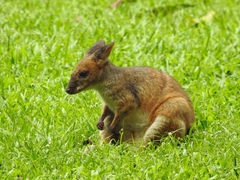
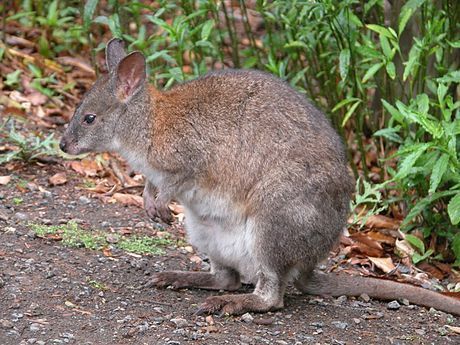
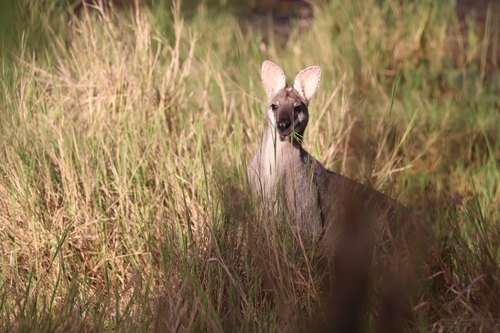
Red-legged Pademelon

Red-legged Pademelon

Thylogale stigmatica

Silhouette: Kawinwit Kittipalawattanapol · PhyloPic

LCLeast ConcernNTVUENCR
Daily sighting probability ~40% · Likely
at Lamington National Park

In 3 days ~80% in a week >90%

116 Verified sightings at Lamington National Park From 2019 to 2026
658 In all 3 parks
February Best month
☀️ Diurnal When it's spotted

About the Red-legged Pademelon

The red-legged pademelon (Thylogale stigmatica) is a species of small macropod found on the northeastern coast of Australia and in New Guinea. In Australia it has a scattered distribution from the tip of Cape York Peninsula in Queensland to around Tamworth in New South Wales. In New Guinea it is found in south central lowlands.

The red-legged pademelon is usually solitary but may group together when feeding. It is found mostly in rainforests, where it is rarely seen, but it is not considered threatened. In New South Wales, however, it is considered to be vulnerable. It feeds on fallen fruit, leaves and grasses. It weighs 2.5 to 7 kg and is 38–58 cm long with a 30–47 cm tail.

There are four subspecies of the red-legged pademelon: T. s. wilcoxi, found in southern Queensland and New South Wales. The red-legged pademelon, a member of the family Macropodidae (which includes wallabies, kangaroos, etc.), is a kangaroo species that inhabits the rainforests. Like many marsupials, the newborn pademelon is underdeveloped and is carried and... Wikipedia →

Sounds

Mechanical sound0:21

Australia · 2020

© Marc Anderson · XC979551 · CC BY-NC-ND 4.0

Global Distribution

Parks Where Found

# Park Country Daily sighting probability
1 Springbrook National Park 🇦🇺 Australia
~70%
2 Lamington National Park 🇦🇺 Australia
~40%
3 Daintree National Park 🇦🇺 Australia
~20%

Zoos & Centres Where Found

# Zoo / Centre Country
1 National Zoo of Malaysia 🇲🇾 Malaysia In captivity
2 Currumbin Wildlife Sanctuary 🇦🇺 Australia In captivity
3 Hartley’s Crocodile Adventures 🇦🇺 Australia In captivity
4 Billabong Sanctuary 🇦🇺 Australia In captivity
5 Ipswich Nature Centre 🇦🇺 Australia In captivity
6 Sea Life Sydney Aquarium 🇦🇺 Australia In captivity
7 Wild Life Sydney 🇦🇺 Australia In captivity
8 Birdworld Kuranda 🇦🇺 Australia In captivity
9 Kuranda Koala Gardens 🇦🇺 Australia In captivity
10 Cairns Tropical Zoo 🇦🇺 Australia In captivity
11 Cairns Zoom and Wildlife Dome 🇦🇺 Australia In captivity
12 Reef HQ 🇦🇺 Australia In captivity
13 Wildlife Habitat Port Douglas 🇦🇺 Australia In captivity

Before you go

What are the chances of seeing a Red-legged Pademelon in Lamington National Park?

Likely

About 40% of wildlife watchers report a Red-legged Pademelon sighting in Lamington National Park on a given day, based on 116 verified sightings from GBIF citizen-science data from 2019 to 2026. It is the 5th most-seen of the 26 mammals we can rate there. Over three days the chance rises to about 80%, and over a week to over 90%, if each day is a fresh chance.

When is the best time to see a Red-legged Pademelon in Lamington National Park?

February, May and November–December

In those months about 50% of wildlife watchers report a Red-legged Pademelon in Lamington National Park on a given day, against about 30% in July and September, the lowest months.

What time of day is best to see a Red-legged Pademelon?

Between noon and 3 pm

Across all the parks we cover, that three-hour window holds the most Red-legged Pademelon sightings with a recorded time, and about 9 in 10 of them come between 6 am and 6 pm: it is a daytime animal.

Is Lamington National Park the best place to see a Red-legged Pademelon?

2nd of 3

Of the 3 parks where we can rate Red-legged Pademelon sightings, Lamington National Park ranks 2nd at about 40%. The best odds are in Springbrook National Park (Australia, about 70%).

Where does the Red-legged Pademelon sighting chance come from?

GBIF citizen-science records

It is estimated from how often the Red-legged Pademelon is recorded against all the mammals logged in Lamington National Park (116 verified sightings from 2019 to 2026), calibrated against known sighting rates. Figures are rounded to the nearest 10% because citizen-science data supports honest approximations, not decimals, and months with records from fewer than five people show "—". How it works.

← Back to Lamington National Park