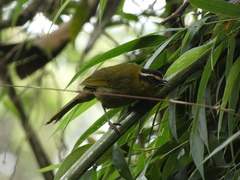
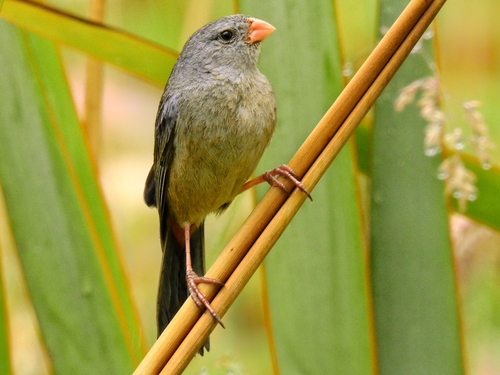
Black-capped Hemispingus

Black-capped Hemispingus

Kleinothraupis atropileus

Silhouette: Sheatherius · PhyloPic

LCLeast ConcernNTVUENCR
Daily sighting probability ~10% · With luck
at Los Nevados National Natural Park

In 3 days ~20% in a week ~30%

304 Verified sightings at Los Nevados National Natural Park From 2019 to 2026
518 In all 4 parks
April Best month
☀️ Diurnal When it's spotted

About the Black-capped Hemispingus

The black-capped hemispingus (Kleinothraupis atropileus) is a species of bird in the family Thraupidae. It is found in the Andes mountains of Colombia, Ecuador, Venezuela and Peru. Its natural habitat is subtropical or tropical moist montane forests.

The black-capped hemispingus was formally described as Arremon atro-pileus by the French ornithologist Frédéric de Lafresnaye in 1842. Lafresnaye erroneously gave the type locality of the species as Bolivia, but it was later corrected to Bogotá, Colombia. The specific epithet is derived from the Latin words meaning "black skullcap". The black-capped hemispingus has two recognised subspecies. These subspecies are sometimes considered separate species.

Kleinothraupis atropileus atropileus (Lafresnaye, 1842): The nominate subspecies, it is found from Venezuela south through Colombia and Ecuador to far northwest Peru. Kleinothraupis atropileus auricularis (Cabanis, 1873): It is only found in Peru south of the Marañón River.

The black-capped hemispingus is, on average, 15–16 cm (5.9–6.3 in) long and weighs 18–26 g (0.6–0.9 oz). It has olive-brown upperparts, and largely olive to olive-yellow underparts. The... Wikipedia →

Sounds

Song1:04

Colombia · 2020

© Jerome Fischer · XC583133 · CC BY-NC-SA 4.0

Call0:30

Ecuador · 2019

© Bram Vogels · XC511687 · CC BY-NC-SA 4.0

Alarm call0:32

Ecuador · 2006

© Olaf Jahn · XC262667 · CC BY-NC-SA 4.0

Global Distribution

Parks Where Found

# Park Country Daily sighting probability
1 Podocarpus National Park 🇪🇨 Ecuador
~10%
2 Los Nevados National Natural Park 🇨🇴 Colombia
~10%
3 Chingaza National Natural Park 🇨🇴 Colombia
<5%
4 Farallones de Cali National Natural Park 🇨🇴 Colombia
<5%

Before you go

What are the chances of seeing a Black-capped Hemispingus in Los Nevados National Natural Park?

With luck

About 10% of wildlife watchers report a Black-capped Hemispingus sighting in Los Nevados National Natural Park on a given day, based on 304 verified sightings from GBIF citizen-science data from 2019 to 2026. It is the 140th most-seen of the 424 birds we can rate there. Over three days the chance rises to about 20%, and over a week to about 30%, if each day is a fresh chance.

When is the best time to see a Black-capped Hemispingus in Los Nevados National Natural Park?

April–June, August–October and December–January

In those months about 10% of wildlife watchers report a Black-capped Hemispingus in Los Nevados National Natural Park on a given day, against under 5% in February–March, July and November, the lowest months.

What time of day is best to see a Black-capped Hemispingus?

Between 8 and 11 am

Across all the parks we cover, that three-hour window holds the most Black-capped Hemispingus sightings with a recorded time, and about 8 in 10 of them come between 6 am and 6 pm: it is a daytime animal.

Is Los Nevados National Natural Park the best place to see a Black-capped Hemispingus?

Among the best

Of the 4 parks where we can rate Black-capped Hemispingus sightings, Los Nevados National Natural Park ranks 2nd at about 10%, level with the leaders once rounded. The best odds are in Podocarpus National Park (Ecuador, about 10%).

Where does the Black-capped Hemispingus sighting chance come from?

GBIF citizen-science records

It is estimated from how often the Black-capped Hemispingus is recorded against all the birds logged in Los Nevados National Natural Park (304 verified sightings from 2019 to 2026), calibrated against known sighting rates. Figures are rounded to the nearest 10% because citizen-science data supports honest approximations, not decimals, and months with records from fewer than five people show "—". How it works.

← Back to Los Nevados National Natural Park