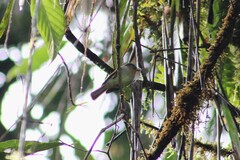
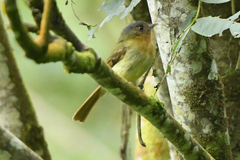
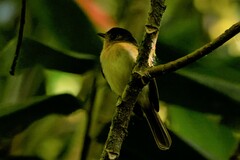
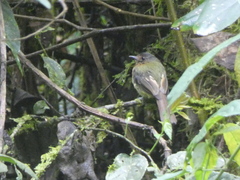

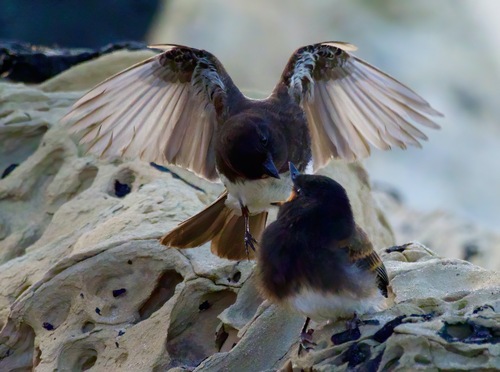
Rufous-breasted Flycatcher

Rufous-breasted Flycatcher

Leptopogon rufipectus

Silhouette: Emily Willoughby · PhyloPic

LCLeast ConcernNTVUENCR
Daily sighting probability ~10% · With luck
at Los Nevados National Natural Park

In 3 days ~30% in a week ~60%

741 Verified sightings at Los Nevados National Natural Park From 2019 to 2026
812 In all 4 parks
October Best month
☀️ Diurnal When it's spotted

About the Rufous-breasted Flycatcher

The rufous-breasted flycatcher (Leptopogon rufipectus) is a species of bird in the family Tyrannidae, the tyrant flycatchers. It is found in Colombia, Ecuador, Peru and Venezuela. The rufous-breasted flycatcher was originally described in 1846 as Tyrannula rufipectus. It was later transferred to genus Leptopogon but for a time in the early twentieth century was treated by some authors as Leptopogon erythrops.

The rufous-breasted flycatcher is monotypic. It and the Inca flycatcher (L. taczanowskii) are sister species and may form a superspecies. The rufous-breasted flycatcher is 13 to 13.5 cm (5.1 to 5.3 in) long; six individuals weighed 10 to 18 g (0.35 to 0.63 oz). The sexes have the same plumage. Adults have a gray crown. Their face is mostly rufous with some gray in the lores and ear coverts and a dusky crescent around the back of the coverts. Their back and rump are olive green. Their wings are dusky with ochraceous or olive yellow edges on the flight feathers. Their wing coverts are dusky with ochraceous tips that show as two indistinct wing bars. Their tail is reddish brown to brownish olive. Their throat and breast are rufous... Wikipedia →

Sounds

Call0:12

Ecuador · 2026

© Daan van der Hoeven · XC1155234 · CC BY-NC-SA 4.0

Begging call0:30

Ecuador · 2008

© Mitch Lysinger · XC260875 · CC BY-NC-SA 4.0

Song0:16

Colombia · 2004

© Diego Calderón (Colección de Sonidos Ambientales - Instituto Humboldt) · XC148031 · CC BY-NC-SA 3.0

Global Distribution

Parks Where Found

# Park Country Daily sighting probability
1 Los Nevados National Natural Park 🇨🇴 Colombia
~10%
2 Farallones de Cali National Natural Park 🇨🇴 Colombia
<5%
3 Podocarpus National Park 🇪🇨 Ecuador
<5%
4 Chingaza National Natural Park 🇨🇴 Colombia
<5%

Before you go

What are the chances of seeing a Rufous-breasted Flycatcher in Los Nevados National Natural Park?

With luck

About 10% of wildlife watchers report a Rufous-breasted Flycatcher sighting in Los Nevados National Natural Park on a given day, based on 741 verified sightings from GBIF citizen-science data from 2019 to 2026. It is the 68th most-seen of the 424 birds we can rate there. Over three days the chance rises to about 30%, and over a week to about 60%, if each day is a fresh chance.

When is the best time to see a Rufous-breasted Flycatcher in Los Nevados National Natural Park?

February–March, August and October

In those months about 20% of wildlife watchers report a Rufous-breasted Flycatcher in Los Nevados National Natural Park on a given day, against about 10% in April–July, September and November–January, the lowest months.

What time of day is best to see a Rufous-breasted Flycatcher?

Between 9 am and noon

Across all the parks we cover, that three-hour window holds the most Rufous-breasted Flycatcher sightings with a recorded time, and about 8 in 10 of them come between 6 am and 6 pm: it is a daytime animal.

Is Los Nevados National Natural Park the best place to see a Rufous-breasted Flycatcher?

Yes

Of the 4 parks where we can rate Rufous-breasted Flycatcher sightings, Los Nevados National Natural Park has the highest daily chance: about 10%. Next come Farallones de Cali National Natural Park (Colombia, under 5%) and Podocarpus National Park (Ecuador, under 5%).

Where does the Rufous-breasted Flycatcher sighting chance come from?

GBIF citizen-science records

It is estimated from how often the Rufous-breasted Flycatcher is recorded against all the birds logged in Los Nevados National Natural Park (741 verified sightings from 2019 to 2026), calibrated against known sighting rates. Figures are rounded to the nearest 10% because citizen-science data supports honest approximations, not decimals, and months with records from fewer than five people show "—". How it works.

← Back to Los Nevados National Natural Park