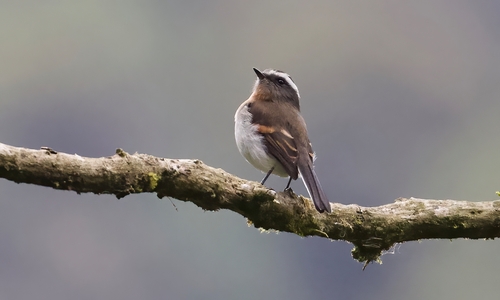
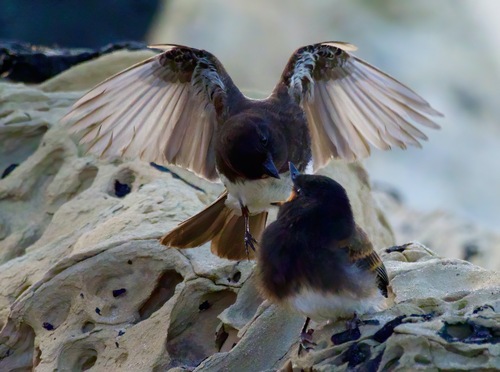
Slaty-backed Chat-Tyrant

Slaty-backed Chat-Tyrant

Ochthoeca cinnamomeiventris

Silhouette: Emily Willoughby · PhyloPic

LCLeast ConcernNTVUENCR
Daily sighting probability ~10% · With luck
at Los Nevados National Natural Park

In 3 days ~30% in a week ~50%

555 Verified sightings at Los Nevados National Natural Park From 2019 to 2026
711 In all 4 parks
September Best month
☀️ Diurnal When it's spotted

About the Slaty-backed Chat-Tyrant

The slaty-backed chat-tyrant or chestnut-bellied chat-tyrant (Ochthoeca cinnamomeiventris) is a species of bird in the family Tyrannidae, the tyrant flycatchers. It is found in Bolivia, Colombia, Ecuador, Peru, and Venezuela.

The slaty-backed chat-tyrant was formally described in 1843 as Muscicapa cinnamomeiventris, erroneously placing it in the Old World flycatcher family. It was eventually moved to genus Ochthoeca and for a time it, the maroon-belted chat-tyrant (O. thoracica) and the blackish chat-tyrant (O. nigrita) were considered conspecific. A study published in 1998 suggested that each of them should be raised to full species level. By 2006 the IOC had recognized the slaty-backed chat-tyrant as a species. BirdLife International's Handbook of the Birds of the World (HBW) recognized it in 2016 and the Clements taxonomy in 2022. However, the South American Classification Committee of the American Ornithological Society retains the blackish chat-tyrant as a subspecies of the slaty-backed.

The slaty-backed chat-tyrant is monotypic. The slaty-backed chat-tyrant is 12 to 13 cm (4.7 to 5.1 in) long and weighs 11 to 13 g (0.39 to 0.46... Wikipedia →

Sounds

Song0:35

Colombia · 2025

© Fabrice Schmitt · XC1007492 · CC BY-NC-SA 4.0

Call0:08

Colombia · 2020

© Andres Angulo Rubiano · XC558166 · CC BY-NC-SA 4.0

Begging call0:37

Ecuador · 2008

© Mitch Lysinger · XC260943 · CC BY-NC-SA 4.0

Global Distribution

Parks Where Found

# Park Country Daily sighting probability
1 Los Nevados National Natural Park 🇨🇴 Colombia
~10%
2 Podocarpus National Park 🇪🇨 Ecuador
~10%
3 Chingaza National Natural Park 🇨🇴 Colombia
~10%
4 Farallones de Cali National Natural Park 🇨🇴 Colombia
<5%

Before you go

What are the chances of seeing a Slaty-backed Chat-Tyrant in Los Nevados National Natural Park?

With luck

About 10% of wildlife watchers report a Slaty-backed Chat-Tyrant sighting in Los Nevados National Natural Park on a given day, based on 555 verified sightings from GBIF citizen-science data from 2019 to 2026. It is the 94th most-seen of the 424 birds we can rate there. Over three days the chance rises to about 30%, and over a week to about 50%, if each day is a fresh chance.

When is the best time to see a Slaty-backed Chat-Tyrant in Los Nevados National Natural Park?

Any time of year

In every month with enough records, about 10% of wildlife watchers report a Slaty-backed Chat-Tyrant in Los Nevados National Natural Park on a given day, so our monthly data shows no clear season.

What time of day is best to see a Slaty-backed Chat-Tyrant?

Between 7 and 10 am

Across all the parks we cover, that three-hour window holds the most Slaty-backed Chat-Tyrant sightings with a recorded time, and about 9 in 10 of them come between 6 am and 6 pm: it is a daytime animal.

Is Los Nevados National Natural Park the best place to see a Slaty-backed Chat-Tyrant?

Yes

Of the 4 parks where we can rate Slaty-backed Chat-Tyrant sightings, Los Nevados National Natural Park has the highest daily chance: about 10%. Next come Podocarpus National Park (Ecuador, about 10%) and Chingaza National Natural Park (Colombia, about 10%).

Where does the Slaty-backed Chat-Tyrant sighting chance come from?

GBIF citizen-science records

It is estimated from how often the Slaty-backed Chat-Tyrant is recorded against all the birds logged in Los Nevados National Natural Park (555 verified sightings from 2019 to 2026), calibrated against known sighting rates. Figures are rounded to the nearest 10% because citizen-science data supports honest approximations, not decimals, and months with records from fewer than five people show "—". How it works.

← Back to Los Nevados National Natural Park