
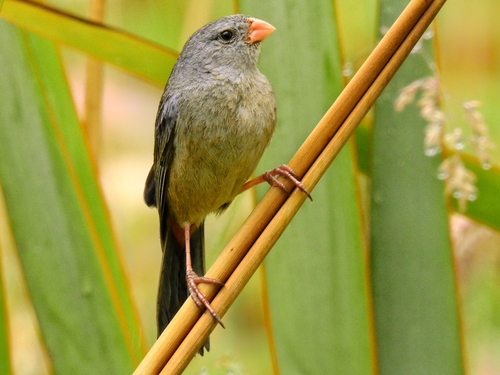
White-capped Tanager

White-capped Tanager

Sericossypha albocristata

Silhouette: Sheatherius · PhyloPic

LCNTVUVulnerableENCR
Daily sighting probability ~10% · With luck
at Los Nevados National Natural Park

In 3 days ~20% in a week ~30%

320 Verified sightings at Los Nevados National Natural Park From 2019 to 2026
438 In all 3 parks
January Best month
☀️ Diurnal When it's spotted

About the White-capped Tanager

The white-capped tanager (Sericossypha albocristata) is a Vulnerable species of bird in the family Thraupidae, the tanagers and allies. It is found from Venezuela to Peru. The white-capped tanager was formally described in 1843 by the French ornithologist Frédéric de Lafresnaye under the Latin name Tangara (Lamprotes) albo-cristatus. The species is now the only species in the genus Sericossypha that was introduced in 1844 by René Lesson. The genus name combines the Ancient Greek sērikos meaning "silken" with kossuphos meaning "blackbird". The specific epithet albocristata is formed from the Latin albus meaning "white" with cristatus meaning "crested" or "plumed". The species is monotypic: No subspecies are recognized.

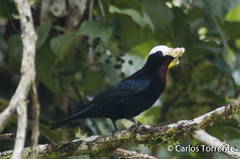
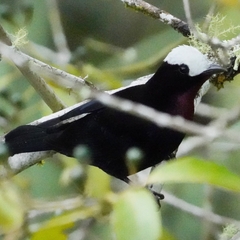
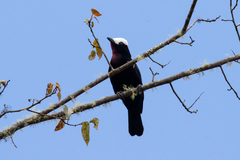
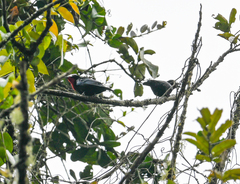
The white-capped tanager is the heaviest member of its family. It averages 24 cm (9.4 in) long and weighs 95 to 125 g (3.4 to 4.4 oz). The species is slightly sexually dimorphic. Adult males have pure white lores, forehead, and crown with a plush texture. Their body is mostly velvety black with a bright crimson throat and breast. Their wings and tail are glossy bluish black. Adult females are less glossy than males and have... Wikipedia →

Sounds

Call0:10

Ecuador · 2026

© Daan van der Hoeven · XC1154815 · CC BY-NC-SA 4.0

Song0:55

Colombia · 2023

© David Monroy Rengifo · XC818064 · CC BY-NC-SA 4.0

Flight call0:13

Ecuador · 1996

© John V. Moore · XC259766 · CC BY-NC-SA 4.0

Global Distribution

Parks Where Found

# Park Country Daily sighting probability
1 Chingaza National Natural Park 🇨🇴 Colombia
~10%
2 Los Nevados National Natural Park 🇨🇴 Colombia
~10%
3 Podocarpus National Park 🇪🇨 Ecuador
<5%

Before you go

What are the chances of seeing a White-capped Tanager in Los Nevados National Natural Park?

With luck

About 10% of wildlife watchers report a White-capped Tanager sighting in Los Nevados National Natural Park on a given day, based on 320 verified sightings from GBIF citizen-science data from 2019 to 2026. It is the 147th most-seen of the 424 birds we can rate there. Over three days the chance rises to about 20%, and over a week to about 30%, if each day is a fresh chance.

When is the best time to see a White-capped Tanager in Los Nevados National Natural Park?

April–June, August–September and December–February

In those months about 10% of wildlife watchers report a White-capped Tanager in Los Nevados National Natural Park on a given day, against under 5% in March, July and October–November, the lowest months.

What time of day is best to see a White-capped Tanager?

Between 9 am and noon

Across all the parks we cover, that three-hour window holds the most White-capped Tanager sightings with a recorded time, and about 8 in 10 of them come between 6 am and 6 pm: it is a daytime animal.

Is Los Nevados National Natural Park the best place to see a White-capped Tanager?

Among the best

Of the 3 parks where we can rate White-capped Tanager sightings, Los Nevados National Natural Park ranks 2nd at about 10%, level with the leaders once rounded. The best odds are in Chingaza National Natural Park (Colombia, about 10%).

Where does the White-capped Tanager sighting chance come from?

GBIF citizen-science records

It is estimated from how often the White-capped Tanager is recorded against all the birds logged in Los Nevados National Natural Park (320 verified sightings from 2019 to 2026), calibrated against known sighting rates. Figures are rounded to the nearest 10% because citizen-science data supports honest approximations, not decimals, and months with records from fewer than five people show "—". How it works.

← Back to Los Nevados National Natural Park