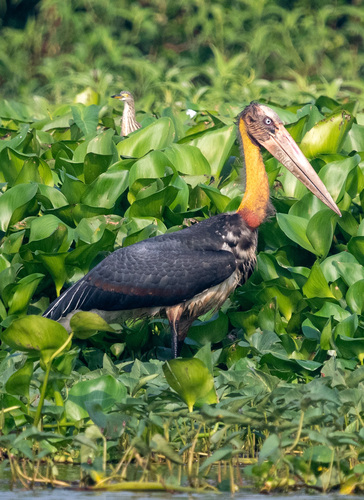

Greater Adjutant

Greater Adjutant

Leptoptilos dubius

Silhouette: L. Shyamal · PhyloPic

LCNTNear ThreatenedVUENCR
Daily sighting probability <5% · Rare
at Manas National Park

In 3 days <5% in a week ~10%

15 Verified sightings at Manas National Park From 2019 to 2026
581 In all 2 parks
March Best month
☀️ Diurnal When it's spotted

About the Greater Adjutant

The greater adjutant (Leptoptilos dubius) is a member of the stork family, Ciconiidae. Its genus includes the lesser adjutant of Asia and the marabou stork of Africa. Once found widely across southern Asia and mainland southeast Asia, the greater adjutant is now restricted to a much smaller range with only three breeding populations; two in India, one in the north-eastern state of Assam and a smaller one around Bhagalpur; and another breeding population in Cambodia. They disperse widely after the breeding season. This large stork has a massive wedge-shaped bill, a bare head and a distinctive neck pouch. During the day, it soars in thermals along with vultures with whom it shares the habit of scavenging. They feed mainly on carrion and offal; however, they are opportunistic and will sometimes prey on vertebrates. The English name is derived from their stiff "military" gait when walking on the ground (see adjutant). Large numbers once lived in Asia, but they have declined (possibly due to improved sanitation) to the point of endangerment. The total population in 2008 was estimated at around a thousand individuals. In the 19th century, they were especially common in the city of Calcutta, where they were referred to as the "Calcutta adjutant" and included in the coat of arms for the city. Known locally as hargila (derived from the Assamese words har, 'bone', and gila, 'swallower', thus 'bone-swallower') and considered to be unclean birds, they were largely left undisturbed but sometimes hunted for the use of their meat in folk medicine. Valued as scavengers, they were once depicted in the logo of the Calcutta Municipal Corporation. Wikipedia →

Global Distribution

Parks Where Found

# Park Country Daily sighting probability
1 Kaziranga National Park 🇮🇳 India
~30%
2 Manas National Park 🇮🇳 India
<5%

Cities Where Found

# City Country Daily sighting probability
1 Guwahati 🇮🇳 India
~10%

Zoos & Centres Where Found

# Zoo / Centre Country
1 Arignar Anna Zoological Park 🇮🇳 India In captivity
2 Assam State Zoo cum Botanical Garden 🇮🇳 India In captivity
3 Sakkarbaug Zoological Garden 🇮🇳 India In captivity
4 Safari World 🇹🇭 Thailand In captivity
5 Mysore Zoo 🇮🇳 India In captivity
6 Chai Nat Bird Park 🇹🇭 Thailand In captivity

Before you go

What are the chances of seeing a Greater Adjutant in Manas National Park?

Rare

Under 5% of wildlife watchers report a Greater Adjutant sighting in Manas National Park on a given day, based on 15 verified sightings from GBIF citizen-science data from 2019 to 2026. It is the 310th most-seen of the 377 birds we can rate there. Over three days the chance rises to under 5%, and over a week to about 10%, if each day is a fresh chance.

When is the best time to see a Greater Adjutant in Manas National Park?

Any time of year

In every month with enough records, under 5% of wildlife watchers report a Greater Adjutant in Manas National Park on a given day, so our monthly data shows no clear season.

What time of day is best to see a Greater Adjutant?

Between 8 and 11 am

Across all the parks we cover, that three-hour window holds the most Greater Adjutant sightings with a recorded time, and about 9 in 10 of them come between 6 am and 6 pm: it is a daytime animal.

Is Manas National Park the best place to see a Greater Adjutant?

2nd of 2

Of the 2 parks where we can rate Greater Adjutant sightings, Manas National Park ranks 2nd at under 5%. The best odds are in Kaziranga National Park (India, about 30%).

Where does the Greater Adjutant sighting chance come from?

GBIF citizen-science records

It is estimated from how often the Greater Adjutant is recorded against all the birds logged in Manas National Park (15 verified sightings from 2019 to 2026), calibrated against known sighting rates. Figures are rounded to the nearest 10% because citizen-science data supports honest approximations, not decimals, and months with records from fewer than five people show "—". How it works.

← Back to Manas National Park