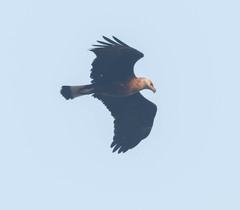
Pallas's Fish Eagle

Pallas's Fish Eagle

Haliaeetus leucoryphus

Silhouette: Ron Holmes/U. S. Fish and Wildlife Service (source photo), T. Michael Keesey (vectorization) · PhyloPic

LCNTVUENEndangeredCR
Daily sighting probability <5% · Rare
at Manas National Park

In 3 days ~10%

31 Verified sightings at Manas National Park From 2019 to 2026
1,878 In all 5 parks
January Best month
☀️ Diurnal When it's spotted

About the Pallas's Fish Eagle

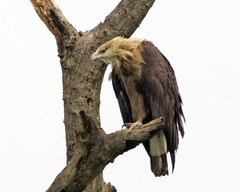
Pallas's fish eagle (Haliaeetus leucoryphus), also known as Pallas's sea eagle or band-tailed fish eagle, is a large, brownish sea eagle. It breeds in the east Palearctic in Kazakhstan, Russia, Tajikistan, Turkmenistan, Uzbekistan, Mongolia, China, India, Nepal, Bangladesh, Myanmar and Bhutan. It is listed as Endangered on the IUCN Red List. It is partially migratory, with Central Asian birds wintering among the southern Asian birds in northern India, and also further west to the Persian Gulf.

The Pallas's fish eagle has a light sandy-brown hood and a whitish face. The wings are darker brown and the back rufous. The long, slender wings (particularly slender for a sea eagle) are rather dark brown underneath. The tail is black with a wide, distinctive white stripe. Juveniles are overall darker, cooler brown with no band on the tail but with several pale areas on the wing, including the underwing coverts and inner primaries. This results in underwings that have a white band in young fish eagles. It takes until the 4th year or so to obtain adult plumage. Among related species, it mainly overlaps in range with the quite dissimilar much shorter winged and slightly smaller... Wikipedia →

Sounds

Call0:19

India · 2024

© Lars Lachmann · XC883587 · CC BY-NC-SA 4.0

Song0:40

India · 1996

© David Farrow · XC37575 · CC BY-NC-SA 3.0

Call0:19

India · 1986

© Jelle Scharringa · XC603104 · CC BY-NC-SA 4.0

Global Distribution

Parks Where Found

# Park Country Daily sighting probability
1 Kaziranga National Park 🇮🇳 India
~60%
2 Jim Corbett National Park 🇮🇳 India
~20%
3 Manas National Park 🇮🇳 India
<5%
4 Royal Manas National Park 🇧🇹 Bhutan
<5%
5 Keoladeo National Park 🇮🇳 India
<5%

Before you go

What are the chances of seeing a Pallas's Fish Eagle in Manas National Park?

Rare

Under 5% of wildlife watchers report a Pallas's Fish Eagle sighting in Manas National Park on a given day, based on 31 verified sightings from GBIF citizen-science data from 2019 to 2026. It is the 284th most-seen of the 377 birds we can rate there. Over three days the chance rises to about 10%, if each day is a fresh chance.

When is the best time to see a Pallas's Fish Eagle in Manas National Park?

January

In that month about 10% of wildlife watchers report a Pallas's Fish Eagle in Manas National Park on a given day, against under 5% in February to December, the lowest months. That is one of Manas National Park's driest months, with about 15 mm of rain against 1070 mm in June.

What time of day is best to see a Pallas's Fish Eagle?

Between 8 and 11 am

Across all the parks we cover, that three-hour window holds the most Pallas's Fish Eagle sightings with a recorded time, and about 9 in 10 of them come between 6 am and 6 pm: it is a daytime animal.

Is Manas National Park the best place to see a Pallas's Fish Eagle?

3rd of 5

Of the 5 parks where we can rate Pallas's Fish Eagle sightings, Manas National Park ranks 3rd at under 5%. The best odds are in Kaziranga National Park (India, about 60%) and Jim Corbett National Park (India, about 20%).

Which relatives of the Pallas's Fish Eagle live in Manas National Park?

Same family: Accipitridae

The closest relatives of the Pallas's Fish Eagle that you can see in Manas National Park (family Accipitridae, Hawks, Eagles, and Kites) are Crested Serpent Eagle (about 50%), Crested Hawk-Eagle (about 30%) and Oriental Honey-buzzard (about 30%), with each one's daily chance of a sighting.

Where does the Pallas's Fish Eagle sighting chance come from?

GBIF citizen-science records

It is estimated from how often the Pallas's Fish Eagle is recorded against all the birds logged in Manas National Park (31 verified sightings from 2019 to 2026), calibrated against known sighting rates. Figures are rounded to the nearest 10% because citizen-science data supports honest approximations, not decimals, and months with records from fewer than five people show "—". How it works.

← Back to Manas National Park