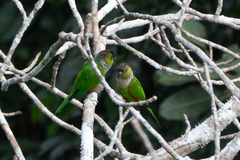
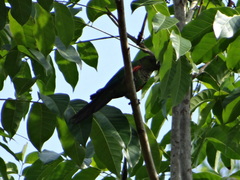
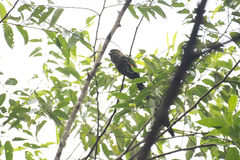
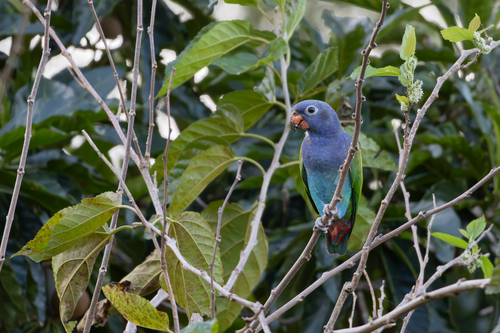
Black-capped Parakeet

Black-capped Parakeet

Pyrrhura rupicola

Silhouette: Sheatherius · PhyloPic

LCLeast ConcernNTVUENCR
Daily sighting probability <5% · Rare
at Manu National Park

In 3 days <5% in a week ~10%

59 Verified sightings at Manu National Park From 2019 to 2026
321 In all 2 parks
December Best month
☀️ Diurnal When it's spotted

About the Black-capped Parakeet

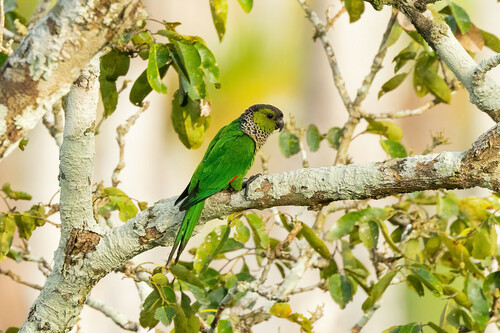
The black-capped parakeet (Pyrrhura rupicola), also known as the black-capped conure or rock conure in aviculture, is a parrot native to the south-western Amazon Basin and adjacent east Andean slopes in Peru, Bolivia and Brazil. It has a total length of approximately 25 cm. It is mostly green with off white scalloping on the hindneck and breast and red primary coverts.

It lives in humid forests, ranging from the Amazonian lowlands up to an altitude of 1000 m on the east Andean slopes. It is designated as Least Concern despite deforestation in the Amazon Basin. Flock size is up to 30 birds with smaller groups forming during breeding season.

In aviculture, these birds are known as black capped conures. They can reproduce in captivity and can also mate with the green cheeked parakeet to produce hybrid offspring. Swiss naturalist Johann Jakob von Tschudi described the species in 1844.

There are two subspecies of Pyrrhura rupicola: P. r. rupicola Commonly called the Sandia conure in aviculture... Wikipedia →
Sounds

Call0:23

Peru · 2012

© Fabrice Schmitt · XC609935 · CC BY-NC-SA 4.0

Flight call0:12

Brazil · 2008

© Dante Buzzetti · XC554960 · CC BY-NC-SA 4.0

Song0:29

Brazil · 2015

© Edson Guilherme · XC265285 · CC BY-NC-SA 4.0

Global Distribution

Parks Where Found

# Park Country Daily sighting probability
1 Tambopata National Reserve 🇵🇪 Peru
~10%
2 Manu National Park 🇵🇪 Peru
<5%

Zoos & Centres Where Found

# Zoo / Centre Country
1 Loro Parque 🇪🇸 Spain In captivity
2 Stone Zoo 🇺🇸 United States In captivity
3 Bangkok Aquarium 🇹🇭 Thailand In captivity

Before you go

What are the chances of seeing a Black-capped Parakeet in Manu National Park?

Rare

Under 5% of wildlife watchers report a Black-capped Parakeet sighting in Manu National Park on a given day, based on 59 verified sightings from GBIF citizen-science data from 2019 to 2026. It is the 436th most-seen of the 641 birds we can rate there. Over three days the chance rises to under 5%, and over a week to about 10%, if each day is a fresh chance.

When is the best time to see a Black-capped Parakeet in Manu National Park?

December

In that month about 10% of wildlife watchers report a Black-capped Parakeet in Manu National Park on a given day, against under 5% in January to November, the lowest months. That is one of Manu National Park's wettest months, with about 250 mm of rain against 60 mm in August.

What time of day is best to see a Black-capped Parakeet?

Between 8 and 11 am

Across all the parks we cover, that three-hour window holds the most Black-capped Parakeet sightings with a recorded time, and about 8 in 10 of them come between 6 am and 6 pm: it is a daytime animal.

Is Manu National Park the best place to see a Black-capped Parakeet?

2nd of 2

Of the 2 parks where we can rate Black-capped Parakeet sightings, Manu National Park ranks 2nd at under 5%. The best odds are in Tambopata National Reserve (Peru, about 10%).

Where does the Black-capped Parakeet sighting chance come from?

GBIF citizen-science records

It is estimated from how often the Black-capped Parakeet is recorded against all the birds logged in Manu National Park (59 verified sightings from 2019 to 2026), calibrated against known sighting rates. Figures are rounded to the nearest 10% because citizen-science data supports honest approximations, not decimals, and months with records from fewer than five people show "—". How it works.

← Back to Manu National Park