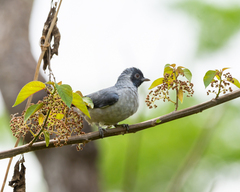
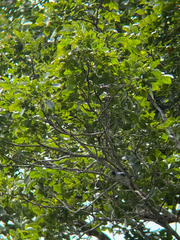
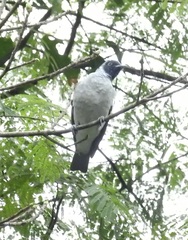
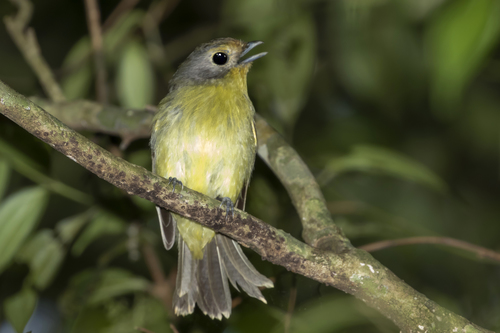
Black-faced Cotinga

Black-faced Cotinga

Conioptilon mcilhennyi

Silhouette: Edwin Price · PhyloPic

LCLeast ConcernNTVUENCR
Daily sighting probability <5% · Rare
at Manu National Park

In 3 days <5% in a week ~10%

61 Verified sightings at Manu National Park From 2019 to 2026
102 In all 2 parks
May Best month
☀️ Diurnal When it's spotted

About the Black-faced Cotinga

The black-faced cotinga (Conioptilon mcilhennyi) is a species of bird in the family Cotingidae. It is found in Bolivia, Brazil, and Peru. The black-faced cotinga was first described by George Lowery and John O'Neill in 1966 and placed in a new genus. They assigned the specific epithet mcilhennyi to recognize John. S. McIlhenny, "who sponsored the Louisiana State University 1964-65 Peruvian Expedition" during which the first specimens were obtained. A large molecular phylogenetic study of the suboscines published in 2020 found that the black-faced cotinga was sister to the bare-necked fruitcrow (Gymnoderus foetidusi).

The black-faced cotinga remains the only member of genus Conioptilon and has no subspecies. The black-faced cotinga is 23 to 25 cm (9.1 to 9.8 in) long; three individuals weighed 81 to 89 g (2.9 to 3.1 oz). Adult males have a mostly black head and throat with a white crescent behind the ear coverts. Their upperparts are dark gray and their wings and tail an even darker gray. Their breast is a lighter gray that becomes white on the lower belly and undertail coverts. Almost unique among passerine birds, their unfeathered parts... Wikipedia →

Sounds

Song0:21

Brazil · 2019

© Felipe Arantes · XC475746 · CC BY-NC-SA 4.0

Call0:45

Brazil · 2013

© GABRIEL LEITE · XC151908 · CC BY-NC-SA 3.0

Chamado0:06

Brazil · 2018

© Caio Brito · XC556228 · CC BY-NC-SA 4.0

Global Distribution

Parks Where Found

# Park Country Daily sighting probability
1 Manu National Park 🇵🇪 Peru
<5%
2 Tambopata National Reserve 🇵🇪 Peru
<5%

Before you go

What are the chances of seeing a Black-faced Cotinga in Manu National Park?

Rare

Under 5% of wildlife watchers report a Black-faced Cotinga sighting in Manu National Park on a given day, based on 61 verified sightings from GBIF citizen-science data from 2019 to 2026. It is the 430th most-seen of the 641 birds we can rate there. Over three days the chance rises to under 5%, and over a week to about 10%, if each day is a fresh chance.

When is the best time to see a Black-faced Cotinga in Manu National Park?

Any time of year

In every month with enough records, under 5% of wildlife watchers report a Black-faced Cotinga in Manu National Park on a given day, so our monthly data shows no clear season.

What time of day is best to see a Black-faced Cotinga?

Between 8 and 11 am

Across all the parks we cover, that three-hour window holds the most Black-faced Cotinga sightings with a recorded time, and about 8 in 10 of them come between 6 am and 6 pm: it is a daytime animal.

Is Manu National Park the best place to see a Black-faced Cotinga?

Yes

Of the 2 parks where we can rate Black-faced Cotinga sightings, Manu National Park has the highest daily chance: under 5%. Next come Tambopata National Reserve (Peru, under 5%).

Which relatives of the Black-faced Cotinga live in Manu National Park?

Same family: Cotingidae

The closest relatives of the Black-faced Cotinga that you can see in Manu National Park (family Cotingidae, Cotingas) are White-winged Becard (about 10%), Screaming Piha (about 10%) and Bare-necked Fruitcrow (about 10%), with each one's daily chance of a sighting.

Where does the Black-faced Cotinga sighting chance come from?

GBIF citizen-science records

It is estimated from how often the Black-faced Cotinga is recorded against all the birds logged in Manu National Park (61 verified sightings from 2019 to 2026), calibrated against known sighting rates. Figures are rounded to the nearest 10% because citizen-science data supports honest approximations, not decimals, and months with records from fewer than five people show "—". How it works.

← Back to Manu National Park