
Screaming Piha

Screaming Piha

Lipaugus vociferans

Silhouette: Edwin Price · PhyloPic

LCLeast ConcernNTVUENCR
Daily sighting probability ~10% · With luck
at Manu National Park

In 3 days ~30% in a week ~60%

519 Verified sightings at Manu National Park From 2019 to 2026
2,035 In all 9 parks
August Best month
☀️ Diurnal When it's spotted

About the Screaming Piha

The screaming piha (Lipaugus vociferans) is a species of passerine bird in the lesser-known family Cotingidae, the cotingas. It is found in every mainland South American country except for these four countries: Argentina, Chile, Paraguay, and Uruguay.

The screaming piha has a complicated taxonomic history. It was originally described as Ampelis cinerea but that binomial was already in use for the pompadour cotinga (now named Xipholena punicea). The oldest available name was Muscicapa vociferans, with which Weid mistakenly placed it in the Old World flycatcher family. It was moved to genus Lipaugus in 1828 by Boie who erected that genus for it (but spelled it Lipangus because of mis-reading the name's Greek origin).

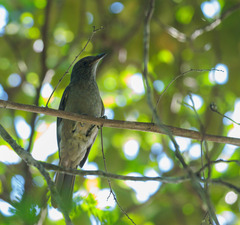
The screaming piha is monotypic. The screaming piha is 24 to 26 cm (9.4 to 10 in) long and weighs 68 to 87 g (2.4 to 3.1 oz). The sexes have the same plumage. Adults have medium gray upperparts. Their tail and their wings' flight feathers and greater coverts are browner or duskier. Their underparts are a paler gray that is palest on the throat. They have a brown, grayish brown, or gray iris, a black maxilla and a dusky mandible... Wikipedia →

Sounds

Call0:12

French Guiana · 2024

© Tristan Guillebot de Nerville · XC1174381 · CC BY-NC-SA 4.0

Song1:27

Ecuador · 2026

© Manuel Sánchez-Nivicela · XC1152128 · CC BY-NC-ND 4.0

Call0:04

Brazil · 2025

© JAYRSON ARAUJO DE OLIVEIRA · XC1035483 · CC BY-NC-SA 4.0

Global Distribution

Parks Where Found

# Park Country Daily sighting probability
1 Brownsberg Nature Park 🇸🇷 Suriname
~50%
2 Tambopata National Reserve 🇵🇪 Peru
~20%
3 Anavilhanas National Park 🇧🇷 Brazil
~20%
4 Manu National Park 🇵🇪 Peru
~10%
5 Amacayacu National Natural Park 🇨🇴 Colombia
~10%
6 Yasuní National Park 🇪🇨 Ecuador
~10%
7 Sierra de la Macarena National Park 🇨🇴 Colombia
~10%
8 Amboró National Park 🇧🇴 Bolivia
<5%
9 Cuyabeno Wildlife Reserve 🇪🇨 Ecuador
<5%

Zoos & Centres Where Found

# Zoo / Centre Country
1 San Diego Zoo 🇺🇸 United States In captivity
2 Burgers' Ocean 🇳🇱 Netherlands In captivity
3 Royal Burgers' Zoo 🇳🇱 Netherlands In captivity
4 Dallas World Aquarium 🇺🇸 United States In captivity
5 National Aquarium 🇺🇸 United States In captivity
6 Pantropica 🇳🇱 Netherlands In captivity

Before you go

What are the chances of seeing a Screaming Piha in Manu National Park?

With luck

About 10% of wildlife watchers report a Screaming Piha sighting in Manu National Park on a given day, based on 519 verified sightings from GBIF citizen-science data from 2019 to 2026. It is the 139th most-seen of the 641 birds we can rate there. Over three days the chance rises to about 30%, and over a week to about 60%, if each day is a fresh chance.

When is the best time to see a Screaming Piha in Manu National Park?

August and September

In those months about 20% of wildlife watchers report a Screaming Piha in Manu National Park on a given day, against under 5% in April, the lowest month. Those are among Manu National Park's driest months, with about 75 mm of rain a month against 290 mm in February.

What time of day is best to see a Screaming Piha?

Between 2 and 5 pm

Across all the parks we cover, that three-hour window holds the most Screaming Piha sightings with a recorded time, and about 9 in 10 of them come between 6 am and 6 pm: it is a daytime animal.

Where does the Screaming Piha sighting chance come from?

GBIF citizen-science records

It is estimated from how often the Screaming Piha is recorded against all the birds logged in Manu National Park (519 verified sightings from 2019 to 2026), calibrated against known sighting rates. Figures are rounded to the nearest 10% because citizen-science data supports honest approximations, not decimals, and months with records from fewer than five people show "—". How it works.

← Back to Manu National Park