
Wing-barred Piprites

Wing-barred Piprites

Piprites chloris

Silhouette: Emily Willoughby · PhyloPic

LCLeast ConcernNTVUENCR
Daily sighting probability <5% · Rare
at Manu National Park

In 3 days ~10% in a week ~20%

122 Verified sightings at Manu National Park From 2019 to 2026
1,052 In all 12 parks
December Best month
☀️ Diurnal When it's spotted

About the Wing-barred Piprites

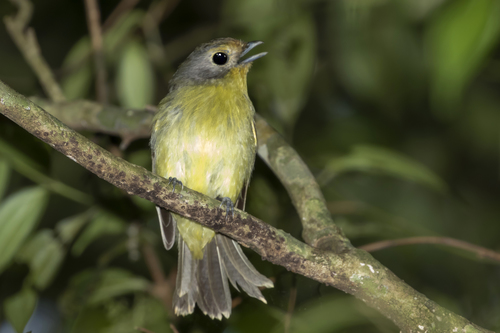
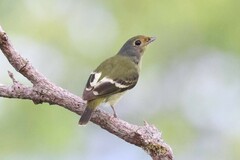
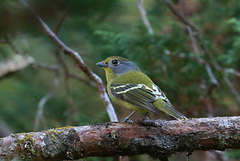
The wing-barred piprites (Piprites chloris) is a species of bird in subfamily Pipritinae of family Tyrannidae, the tyrant flycatchers. It is found in every mainland South American country except Chile and Uruguay. The wing-barred piprites shares genus Piprites with the grey-headed piprites (P. griseiceps) and the black-capped piprites (P. pileata). The grey-headed and wing-barred piprites form a superspecies.

The wing-barred piprites has these seven subspecies: The wing-barred piprites is 12.5 to 14 cm (4.9 to 5.5 in) long and weighs 15 to 21 g (0.53 to 0.74 oz). The sexes have the same plumage. Adults of the nominate subspecies P. c. chloris have a golden forehead, an olive-green crown, and a slightly gray olive-green nape. They have golden lores and a bold yellow eyering. Their upperparts and tail are olive-green with paler green edges on the tail feathers. Their wings are olive-green with paler green edges... Wikipedia →

Sounds

Song0:36

Brazil · 2024

© Augusto Matheus dos Santos · XC950398 · CC BY-NC-SA 4.0

Call0:56

Colombia · 2021

© Mauricio Cuéllar-Ramírez · XC683955 · CC BY-NC-SA 4.0

Song1:10

Ecuador · 2021

© rudy gelis · XC823110 · CC BY-NC-SA 4.0

Global Distribution

Parks Where Found

# Park Country Daily sighting probability
1 Brownsberg Nature Park 🇸🇷 Suriname
~30%
2 Iguazú National Park 🇦🇷 Argentina
~10%
3 Iguaçu National Park 🇧🇷 Brazil
<5%
4 Tambopata National Reserve 🇵🇪 Peru
<5%
5 Yasuní National Park 🇪🇨 Ecuador
<5%
6 Sierra de la Macarena National Park 🇨🇴 Colombia
<5%
7 Amacayacu National Natural Park 🇨🇴 Colombia
<5%
8 Henri Pittier National Park 🇻🇪 Venezuela
<5%
9 Manu National Park 🇵🇪 Peru
<5%
10 Amboró National Park 🇧🇴 Bolivia
<5%
11 Anavilhanas National Park 🇧🇷 Brazil
<5%
12 Podocarpus National Park 🇪🇨 Ecuador
<5%

Before you go

What are the chances of seeing a Wing-barred Piprites in Manu National Park?

Rare

Under 5% of wildlife watchers report a Wing-barred Piprites sighting in Manu National Park on a given day, based on 122 verified sightings from GBIF citizen-science data from 2019 to 2026. It is the 347th most-seen of the 641 birds we can rate there. Over three days the chance rises to about 10%, and over a week to about 20%, if each day is a fresh chance.

When is the best time to see a Wing-barred Piprites in Manu National Park?

July–August and December

In those months about 10% of wildlife watchers report a Wing-barred Piprites in Manu National Park on a given day, against under 5% in January–June and September–November, the lowest months.

What time of day is best to see a Wing-barred Piprites?

Between 9 am and noon

Across all the parks we cover, that three-hour window holds the most Wing-barred Piprites sightings with a recorded time, and about 9 in 10 of them come between 6 am and 6 pm: it is a daytime animal.

Is Manu National Park the best place to see a Wing-barred Piprites?

9th of 12

Of the 12 parks where we can rate Wing-barred Piprites sightings, Manu National Park ranks 9th at under 5%. The best odds are in Brownsberg Nature Park (Suriname, about 30%), Iguazú National Park (Argentina, about 10%) and Iguaçu National Park (Brazil, under 5%).

Which relatives of the Wing-barred Piprites live in Manu National Park?

Same family: Cotingidae

The closest relatives of the Wing-barred Piprites that you can see in Manu National Park (family Cotingidae, Cotingas) are White-winged Becard (about 10%), Screaming Piha (about 10%) and Bare-necked Fruitcrow (about 10%), with each one's daily chance of a sighting.

Where does the Wing-barred Piprites sighting chance come from?

GBIF citizen-science records

It is estimated from how often the Wing-barred Piprites is recorded against all the birds logged in Manu National Park (122 verified sightings from 2019 to 2026), calibrated against known sighting rates. Figures are rounded to the nearest 10% because citizen-science data supports honest approximations, not decimals, and months with records from fewer than five people show "—". How it works.

← Back to Manu National Park