
Bolivian Squirrel

Bolivian Squirrel

Sciurus ignitus

Silhouette: Ferran Sayol · PhyloPic

LCLeast ConcernNTVUENCR
Daily sighting probability ~10% · With luck
at Manu National Park

In 3 days ~30% in a week ~60%

14 Verified sightings at Manu National Park From 2019 to 2026
14 In 1 park
November Best month
☀️ Diurnal When it's spotted

About the Bolivian Squirrel

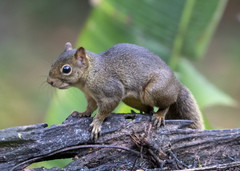
The Bolivian squirrel (Sciurus ignitus) is a tree squirrel that is endemic to South America. Little is known of the species, which may represent a species complex. Bolivian squirrels are moderately sized tree squirrels, with a head-body length of 14 to 22 cm (5.5 to 8.7 in), and a tail of similar length again. Adults weigh from 183 to 242 g (6.5 to 8.5 oz). The fur is mostly dark olive with black and yellow ticking and fading to pale grey or whitish on the chest and underparts. There are faint rings of buff-coloured fur around the eyes and distinct patches of buff fur on the backs of the ears. Females have three pairs of teats.

Bolivian squirrels live along the eastern edge of the Andes from Peru, through Bolivia and Brazil to extreme northern Argentina. Precise details of its habitat are not clear, although it has been found in both lowland and montane tropical forests from 200 to 2,700 m (660 to 8,860 ft) elevation.

Five subspecies are recognised: S. i. ignitus - East of the Andes, in Bolivia and adjacent parts of Peru. Belly fur is ochre. S. i. argentinius - From Bolivia to the extreme northwest of Argentina. Belly fur is yellow,... Wikipedia →

Global Distribution

Parks Where Found

# Park Country Daily sighting probability
1 Manu National Park 🇵🇪 Peru
~10%

More parks will be added in future updates.

Before you go

What are the chances of seeing a Bolivian Squirrel in Manu National Park?

With luck

About 10% of wildlife watchers report a Bolivian Squirrel sighting in Manu National Park on a given day, based on 14 verified sightings from GBIF citizen-science data from 2019 to 2026. It is the 21st most-seen of the 42 mammals we can rate there. Over three days the chance rises to about 30%, and over a week to about 60%, if each day is a fresh chance.

When is the best time to see a Bolivian Squirrel in Manu National Park?

January, June, August–September and November

In those months about 20% of wildlife watchers report a Bolivian Squirrel in Manu National Park on a given day, against under 5% in February–April and December, the lowest months.

What time of day is best to see a Bolivian Squirrel?

Between 9 am and noon

Across all the parks we cover, that three-hour window holds the most Bolivian Squirrel sightings with a recorded time, and about 9 in 10 of them come between 6 am and 6 pm: it is a daytime animal.

Where else can you see a Bolivian Squirrel?

Only Manu National Park, in our data

Manu National Park is the only park on Wallace's Line with enough records to rate Bolivian Squirrel sightings: about 10% of wildlife watchers there report one on a given day.

Where does the Bolivian Squirrel sighting chance come from?

GBIF citizen-science records

It is estimated from how often the Bolivian Squirrel is recorded against all the mammals logged in Manu National Park (14 verified sightings from 2019 to 2026), calibrated against known sighting rates. Figures are rounded to the nearest 10% because citizen-science data supports honest approximations, not decimals, and months with records from fewer than five people show "—". How it works.

← Back to Manu National Park